
-
Écrivez-nous
- Rapports phares
Railway Propulsion Systems Market
Publié le 23 June, 2026
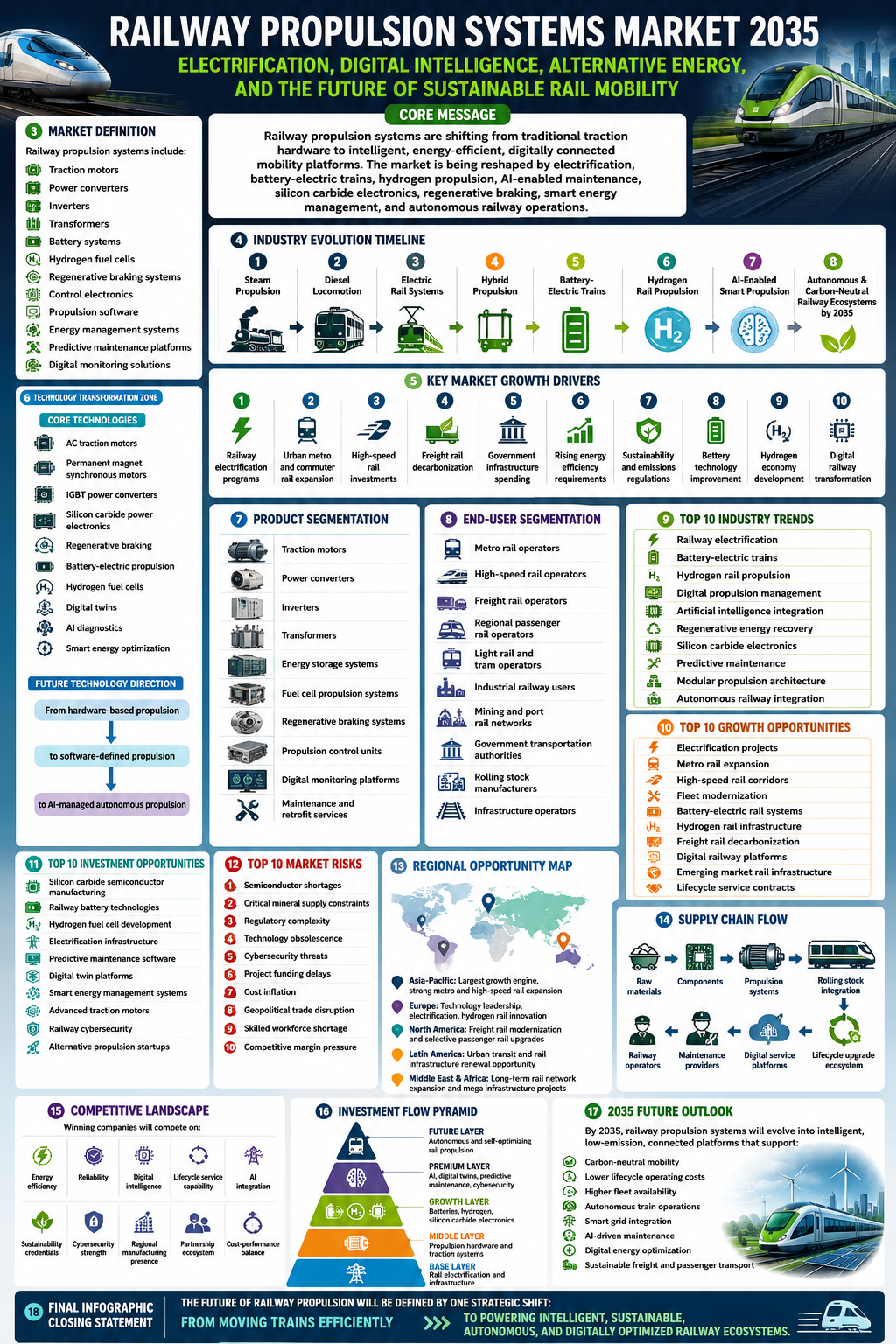
The Railway Propulsion Systems Market represents one of the most strategically important segments within the global rail transportation industry. Railway propulsion systems comprise the complete set of technologies, components, software, and power conversion equipment responsible for generating, controlling, and transmitting power required for train movement. These systems typically include traction motors, power converters, inverters, transformers, control electronics, energy management systems, onboard software platforms, and associated auxiliary equipment. Whether deployed in high-speed passenger trains, metro rail networks, commuter trains, freight locomotives, or light rail transit systems, propulsion technology serves as the operational backbone that determines efficiency, reliability, speed, safety, and lifecycle economics.
Historically, railway propulsion has evolved alongside broader industrial and transportation revolutions. Early railways relied heavily on steam-based propulsion, which dominated global rail transportation for more than a century. The transition toward diesel locomotives accelerated during the twentieth century as rail operators sought greater operational flexibility and reduced infrastructure dependence. However, growing urbanization, environmental concerns, energy efficiency requirements, and technological innovation eventually shifted industry focus toward electric propulsion systems. Electrification transformed rail transport economics by improving energy utilization, reducing operating costs, enhancing acceleration performance, and enabling higher passenger capacities.
The modern railway propulsion systems market is increasingly characterized by digitalization, electrification, automation, and sustainability objectives. Governments worldwide are investing heavily in railway modernization initiatives as transportation networks become central to economic growth, carbon reduction strategies, and urban mobility planning. Rail transport is widely recognized as one of the most energy-efficient modes of mass transportation, creating favorable conditions for propulsion technology investments. Consequently, operators are prioritizing advanced propulsion solutions capable of delivering higher efficiency, lower emissions, predictive maintenance capabilities, and improved passenger experiences.
The strategic significance of propulsion systems extends beyond train movement alone. Propulsion technology directly influences infrastructure utilization, maintenance requirements, operating costs, fleet availability, environmental performance, and long-term asset value. For railway operators managing large fleets, even marginal improvements in propulsion efficiency can generate substantial cost savings over decades of operation. As a result, procurement decisions increasingly focus on total lifecycle value rather than initial acquisition cost.
Now Get Free PDF Report on : Global Railway Propulsion Systems Market Strategic Recommendations 2026-2033 : https://www.statsndata.org/download-sample.php?id=148207
Current industry dynamics indicate a strong shift toward intelligent propulsion architectures. Advanced semiconductor technologies, digital control systems, regenerative braking solutions, energy storage integration, and real-time monitoring capabilities are reshaping industry standards. The emergence of battery-electric trains, hydrogen-powered rail vehicles, hybrid propulsion platforms, and next-generation traction systems is further expanding technological possibilities. Simultaneously, rising demand for urban transit systems, high-speed rail corridors, and sustainable freight transportation is creating new opportunities for propulsion manufacturers and technology suppliers.
Looking toward 2035, railway propulsion systems will become increasingly integrated with broader transportation digitization ecosystems. Artificial intelligence, predictive analytics, autonomous train operations, and smart energy management platforms are expected to redefine propulsion system performance standards. Consequently, the market is transitioning from a component-focused industry toward a software-enabled mobility technology sector where efficiency, connectivity, sustainability, and intelligence become equally important competitive differentiators.
2. Market Ecosystem and Value Chain Analysis
The railway propulsion systems market operates within a highly specialized and interconnected ecosystem involving raw material suppliers, component manufacturers, system integrators, rolling stock producers, infrastructure operators, maintenance providers, and transportation authorities. Each participant contributes value at different stages of the supply chain, collectively determining product performance, reliability, and commercial success.
At the foundation of the ecosystem lies the raw material supply network. Railway propulsion systems require substantial quantities of copper, aluminum, electrical steel, silicon, rare earth materials, advanced polymers, composite materials, and semiconductor-grade silicon. Copper remains particularly important because of its extensive use in traction motors, transformers, power distribution systems, and electrical wiring. Electrical steel plays a critical role in minimizing energy losses within motors and transformers, while rare earth elements support the production of high-performance permanent magnet motors increasingly adopted across modern rail applications.
Component manufacturers occupy the next stage of the value chain. These companies specialize in producing traction motors, insulated-gate bipolar transistor (IGBT) modules, silicon carbide power devices, converters, inverters, transformers, cooling systems, braking systems, sensors, controllers, and software platforms. Increasing technological sophistication has elevated the importance of electronics suppliers as propulsion systems become more digitally controlled and software dependent.
System integration represents one of the most critical value-creation stages. Railway propulsion systems must seamlessly integrate mechanical, electrical, electronic, and software components while meeting stringent safety and reliability standards. System integrators combine diverse technologies into fully functional propulsion architectures optimized for specific train types, operating environments, and customer requirements. Successful integration directly impacts energy efficiency, operational reliability, and maintenance performance.
Rolling stock manufacturers serve as major downstream customers for propulsion providers. These manufacturers incorporate propulsion systems into passenger trains, metro vehicles, freight locomotives, light rail vehicles, and high-speed rail platforms. Collaboration between rolling stock manufacturers and propulsion suppliers often begins during early design phases to ensure compatibility between propulsion technologies and overall vehicle architecture.
Railway operators constitute the ultimate end users within the ecosystem. Their purchasing decisions are increasingly influenced by lifecycle costs, energy efficiency, maintenance requirements, digital capabilities, and sustainability objectives. Operators seek propulsion systems that maximize fleet availability while minimizing operating expenditures and environmental impact.
Aftermarket service providers have become increasingly important contributors to value creation. Modern propulsion systems generate substantial operational data that can be leveraged for predictive maintenance, performance optimization, and asset management. Service providers increasingly offer long-term maintenance contracts, digital monitoring services, remote diagnostics, and performance improvement programs.
Value creation within the railway propulsion ecosystem is shifting from hardware-centric manufacturing toward integrated lifecycle solutions. Revenue streams increasingly extend beyond equipment sales to include software subscriptions, maintenance agreements, analytics services, digital upgrades, and energy optimization solutions. This transition reflects broader industry trends emphasizing long-term customer relationships, recurring revenue generation, and continuous operational improvement.
As railway networks continue expanding globally, ecosystem participants capable of delivering integrated, data-driven, and sustainability-focused solutions are likely to capture greater market share. The value chain is expected to become increasingly collaborative, digitally connected, and innovation driven through 2035.
Technology Landscape and Industry Innovation
Technology development remains the primary force transforming the railway propulsion systems market. Advances in power electronics, semiconductor materials, digital controls, energy storage technologies, and intelligent software systems are fundamentally changing how trains generate, manage, and utilize energy.
At the core of modern propulsion systems are traction motors, which convert electrical energy into mechanical motion. Traditional DC motors have largely been replaced by advanced AC induction motors and permanent magnet synchronous motors. These technologies offer superior efficiency, reduced maintenance requirements, improved reliability, and enhanced power density. Permanent magnet technologies, in particular, are attracting growing attention because of their ability to deliver higher efficiency levels while reducing overall system size and weight.
Power electronics represent another critical area of innovation. Historically, insulated-gate bipolar transistor technologies dominated railway propulsion applications. However, the emergence of silicon carbide semiconductors is creating a major technological shift. Silicon carbide devices enable higher switching frequencies, reduced energy losses, improved thermal performance, smaller cooling requirements, and increased system efficiency. These benefits translate directly into lower operating costs and improved train performance.
Digital control technologies are becoming increasingly sophisticated. Modern propulsion systems incorporate advanced control algorithms capable of continuously optimizing power consumption, traction performance, braking efficiency, and system reliability. Real-time monitoring capabilities allow operators to detect anomalies before failures occur, significantly reducing maintenance costs and service disruptions.
Artificial intelligence and machine learning are emerging as transformative technologies within railway propulsion. AI-powered predictive maintenance systems analyze operational data to identify component degradation patterns, forecast maintenance needs, and optimize maintenance schedules. These capabilities improve fleet availability while reducing unplanned downtime.
Energy recovery technologies are also advancing rapidly. Regenerative braking systems allow trains to recover kinetic energy during deceleration and either return it to the grid or store it for future use. This capability significantly improves overall energy efficiency and supports sustainability objectives. As energy prices rise globally, regenerative technologies are becoming increasingly valuable economic assets.
Battery-electric propulsion systems are gaining momentum, particularly for regional rail routes where full electrification may be economically challenging. Improvements in battery energy density, charging infrastructure, and battery management systems are expanding operational feasibility. Similarly, hydrogen fuel cell propulsion technologies are emerging as viable alternatives for non-electrified rail corridors seeking zero-emission operations.
The technology roadmap toward 2035 suggests increasing convergence between propulsion systems and broader digital transportation ecosystems. Autonomous train operations, intelligent traffic management systems, cloud-based analytics platforms, digital twins, and integrated energy management solutions are expected to become standard features. Future propulsion systems will not simply provide movement but will function as intelligent, interconnected assets capable of optimizing performance across entire rail networks.
This technological evolution is expected to redefine competitive dynamics throughout the industry. Companies investing aggressively in advanced electronics, digital capabilities, energy efficiency technologies, and software integration are likely to establish significant long-term advantages as railway operators prioritize operational intelligence alongside traditional performance metrics.
Major Growth Drivers
The Railway Propulsion Systems Market is benefiting from multiple structural growth drivers that extend well beyond traditional railway expansion. These drivers are rooted in global economic development, urbanization, sustainability objectives, transportation modernization, and technological progress.
One of the strongest growth catalysts is rapid urbanization. Major metropolitan regions worldwide continue experiencing population growth that places increasing pressure on transportation infrastructure. Governments and city planners are responding by expanding metro systems, suburban rail networks, light rail transit systems, and high-capacity passenger transportation corridors. Each new rail project requires advanced propulsion technologies capable of supporting reliable, efficient, and high-frequency operations.
Environmental sustainability objectives represent another major growth driver. Transportation accounts for a significant share of global carbon emissions, prompting governments to prioritize low-emission mobility solutions. Rail transport offers substantial environmental advantages compared with road and air transportation. Consequently, national decarbonization strategies frequently include investments in railway expansion and modernization. These investments directly stimulate demand for advanced electric propulsion systems, regenerative braking technologies, and alternative energy propulsion platforms.
Infrastructure investment programs are also creating substantial market opportunities. Many countries are implementing long-term transportation infrastructure strategies designed to improve economic competitiveness, reduce congestion, and enhance connectivity. High-speed rail projects, cross-border transportation corridors, freight modernization initiatives, and urban transit expansions all contribute to rising propulsion system demand.
Freight transportation requirements are evolving as global supply chains become increasingly complex. Rail freight is gaining importance because of its cost efficiency, energy efficiency, and environmental advantages. Modern freight operators require propulsion systems capable of handling heavier loads, longer distances, and more demanding operating conditions. This trend is encouraging investments in higher-performance traction technologies and advanced locomotive propulsion systems.
Technology advancement itself functions as a growth driver by accelerating replacement cycles. Many existing rail fleets utilize aging propulsion technologies that are less efficient, more expensive to maintain, and incompatible with modern digital infrastructure. Operators are increasingly replacing outdated systems with advanced propulsion platforms that offer lower lifecycle costs and improved operational capabilities.
Government incentives further strengthen market expansion. Public funding programs, transportation grants, railway electrification initiatives, and sustainability-focused investment frameworks are reducing barriers to adoption. These policies are particularly important in emerging economies where transportation infrastructure development remains a national priority.
Digital transformation initiatives are creating additional demand. Railway operators increasingly seek propulsion systems capable of supporting predictive maintenance, real-time monitoring, fleet optimization, and operational analytics. As a result, software-enabled propulsion platforms are becoming essential components of broader railway modernization programs.
Looking ahead to 2035, the combined influence of urban mobility expansion, climate policy implementation, infrastructure investment, freight transportation growth, and technological innovation is expected to sustain robust demand for railway propulsion systems. These drivers are largely structural rather than cyclical, providing a strong foundation for long-term industry growth.
Market Challenges and Risk Factors
Despite strong long-term growth prospects, the Railway Propulsion Systems Market faces several significant challenges and risk factors that could influence investment decisions, technology adoption rates, and overall industry development.
One of the most prominent challenges involves supply chain complexity. Modern propulsion systems depend on highly specialized materials, advanced semiconductors, rare earth elements, and precision-engineered components sourced from global supply networks. Disruptions affecting semiconductor manufacturing, critical mineral availability, geopolitical trade relationships, or logistics infrastructure can create significant production bottlenecks. As propulsion systems become increasingly electronics-intensive, supply chain resilience is emerging as a critical competitive factor.
Cost pressures represent another major challenge. Railway propulsion systems require substantial research and development investments, rigorous testing procedures, certification processes, and long product development cycles. These factors contribute to high capital requirements and elevated production costs. Simultaneously, railway operators face budget constraints and increasing pressure to demonstrate economic value, creating ongoing tension between innovation and affordability.
Regulatory compliance adds additional complexity. Railway propulsion technologies must meet stringent safety, reliability, environmental, electromagnetic compatibility, and operational standards. Regulatory requirements vary across regions, increasing compliance costs for manufacturers seeking global market access. The certification process can be lengthy and resource intensive, potentially delaying commercialization timelines.
Technology adoption barriers also remain significant. Railway operators often manage assets with operational lifespans exceeding thirty years. Consequently, introducing new propulsion technologies requires extensive validation, risk assessment, and compatibility testing. Operators may hesitate to adopt emerging technologies if long-term reliability has not been fully demonstrated under real-world operating conditions.
Cybersecurity risks are becoming increasingly relevant as propulsion systems become more digitally connected. Integration with network management platforms, cloud-based analytics systems, and remote monitoring solutions expands potential vulnerability surfaces. A successful cyberattack affecting propulsion control systems could disrupt operations, compromise safety, and generate substantial financial losses.
Competitive pressures are intensifying as established industry participants compete alongside new technology-focused entrants. Differentiation is becoming more challenging because many core propulsion technologies are approaching maturity. Companies must increasingly compete through software capabilities, service offerings, digital integration, and lifecycle support rather than hardware performance alone.
Macroeconomic uncertainty represents another important risk factor. Railway infrastructure projects often depend on public funding and long-term government commitments. Economic downturns, fiscal constraints, changing political priorities, or budget reallocations can delay or reduce planned railway investments, affecting propulsion system demand.
Finally, technological disruption itself presents a dual challenge. While innovation creates opportunities, it can also render existing products obsolete more rapidly than anticipated. Manufacturers must carefully balance investment in current technologies against emerging solutions such as hydrogen propulsion, battery-electric systems, autonomous operations, and next-generation semiconductor platforms.
Through 2035, organizations capable of managing supply chain resilience, maintaining technological flexibility, ensuring regulatory compliance, and adapting to evolving customer expectations will be best positioned to navigate these risks while capturing long-term market opportunities.
6. Industry Trends Reshaping the Market
The Railway Propulsion Systems Market is undergoing a profound transformation as technological innovation, sustainability imperatives, and evolving transportation requirements reshape industry priorities. The trends emerging today are not merely incremental improvements but represent structural changes that will influence procurement strategies, technology investments, competitive positioning, and operational models through 2035.
One of the most significant trends is the accelerating shift toward complete railway electrification. Governments and railway operators are increasingly prioritizing electric propulsion systems due to their superior energy efficiency, lower operating costs, reduced emissions, and compatibility with long-term decarbonization strategies. Electrification is no longer limited to high-speed rail or metropolitan transit systems. Regional railways, freight corridors, and intercity routes are also becoming targets for electrification initiatives. This transition is driving substantial demand for advanced traction systems, intelligent converters, and energy-efficient propulsion platforms.
Another major trend involves the emergence of alternative propulsion technologies. Battery-electric trains, hydrogen fuel cell-powered trains, and hybrid propulsion systems are gaining momentum, particularly in regions where complete electrification remains economically challenging. These technologies are addressing the operational limitations associated with diesel-powered locomotives while enabling railway operators to meet increasingly stringent environmental regulations. As energy storage technologies mature and hydrogen infrastructure expands, alternative propulsion systems are expected to capture a growing share of future fleet investments.
Digitalization is reshaping propulsion system design and operation. Modern propulsion architectures increasingly incorporate sensors, connectivity platforms, cloud integration, and real-time analytics capabilities. The objective is no longer limited to moving trains efficiently. Operators now seek propulsion systems capable of continuously monitoring performance, predicting maintenance needs, optimizing energy consumption, and improving fleet availability. This trend is transforming propulsion systems from standalone mechanical assets into intelligent digital infrastructure components.
Artificial intelligence and machine learning are becoming central to operational optimization. Advanced algorithms analyze vast amounts of operational data to identify performance anomalies, forecast component failures, optimize maintenance schedules, and improve energy efficiency. The integration of AI into propulsion management systems enables operators to transition from reactive maintenance approaches toward predictive and condition-based maintenance strategies that significantly reduce lifecycle costs.
Energy efficiency has emerged as a major competitive differentiator. Rising electricity costs, sustainability commitments, and operating margin pressures are encouraging railway operators to prioritize propulsion systems capable of minimizing energy consumption. Regenerative braking technologies, lightweight propulsion components, advanced motor designs, and intelligent power management systems are becoming increasingly important investment priorities.
The industry is also witnessing a shift toward modular propulsion architectures. Traditional propulsion systems were often designed for specific train models, limiting flexibility and increasing lifecycle costs. Modern modular platforms allow operators and manufacturers to standardize components across multiple train types, simplifying maintenance, reducing inventory requirements, and improving scalability. This approach enhances operational flexibility while supporting faster deployment of new rolling stock programs.
Cybersecurity is emerging as a critical industry trend. As propulsion systems become more connected and digitally integrated, protecting operational technology networks from cyber threats is becoming a strategic necessity. Future propulsion platforms will increasingly incorporate cybersecurity-by-design principles to safeguard operational continuity and passenger safety.
Looking toward 2035, the convergence of electrification, alternative energy technologies, digital intelligence, energy optimization, and cybersecurity will redefine propulsion system requirements. Companies capable of aligning product development strategies with these long-term trends will be positioned to capture substantial market opportunities as the industry transitions toward more intelligent, sustainable, and connected railway ecosystems.
Product and Service Segment Analysis
The Railway Propulsion Systems Market encompasses a diverse range of products and services that collectively support train movement, power management, energy efficiency, operational reliability, and lifecycle performance. Understanding the relative importance and growth potential of each segment is essential for assessing future market dynamics and investment opportunities.
Traction motors remain the foundational product category within the market. These motors convert electrical energy into mechanical force and directly influence train performance characteristics such as acceleration, speed, efficiency, and reliability. AC induction motors currently dominate many applications because of their proven reliability and operational efficiency. However, permanent magnet synchronous motors are gaining traction due to their higher power density, improved efficiency, and reduced maintenance requirements. As operators seek greater energy savings and lower lifecycle costs, advanced motor technologies are expected to capture increasing market share.
Power converters and inverters represent another major segment. These components regulate electrical power flow between energy sources and traction systems, ensuring efficient operation under varying load conditions. The transition toward silicon carbide semiconductor technologies is creating substantial opportunities within this segment. Silicon carbide-based converters offer superior efficiency, reduced weight, improved thermal performance, and lower energy losses compared with conventional solutions.
Transformers continue to play a critical role in electrified rail networks by adapting power supply characteristics to propulsion system requirements. While transformer technology is relatively mature, innovation continues through lightweight materials, improved cooling systems, and enhanced energy efficiency designs. Future transformer development is expected to focus on reducing weight and improving compatibility with digital monitoring systems.
Energy storage systems are emerging as one of the fastest-growing product segments. Battery technologies are increasingly being integrated into propulsion architectures to support regenerative braking, hybrid operations, and battery-electric train applications. As battery costs decline and performance improves, energy storage systems are expected to become a more significant component of propulsion platforms.
Software and digital services are rapidly increasing their contribution to industry revenue. Historically, propulsion suppliers generated most of their income through hardware sales. Today, operators increasingly demand digital monitoring platforms, predictive maintenance solutions, performance analytics services, and remote diagnostics capabilities. These services create recurring revenue opportunities while improving customer retention and long-term profitability.
Maintenance, repair, and overhaul services constitute another substantial segment. Railway propulsion systems operate under demanding conditions and require regular servicing throughout their lifecycle. Long-term service agreements are becoming increasingly common as operators seek predictable maintenance costs and guaranteed performance levels. Service contracts often extend for decades, providing suppliers with stable revenue streams beyond initial equipment sales.
Retrofit and modernization services are also gaining importance. Many rail operators manage aging fleets that remain structurally sound but utilize outdated propulsion technologies. Modernization programs allow operators to improve efficiency, reliability, and regulatory compliance without replacing entire vehicles. This segment is expected to grow significantly as sustainability objectives encourage asset life extension strategies.
Looking toward 2035, software-enabled services, energy storage solutions, predictive maintenance platforms, and propulsion modernization programs are expected to experience the strongest growth. While traditional hardware segments will remain essential, future market expansion will increasingly be driven by integrated solutions that combine physical equipment with digital intelligence and lifecycle support services.
End-User Industry Analysis
The Railway Propulsion Systems Market serves a diverse range of end users, each with unique operational requirements, investment priorities, regulatory obligations, and performance expectations. Understanding these customer segments is essential because propulsion system specifications increasingly vary according to specific transportation applications.
Urban transit operators represent one of the largest end-user groups. Metro systems, light rail networks, tramways, and suburban commuter rail services require propulsion technologies optimized for frequent acceleration and braking cycles, high passenger volumes, and dense operating schedules. Energy efficiency is particularly important within urban environments because trains often operate continuously throughout the day. Regenerative braking capabilities, compact propulsion architectures, and advanced energy management systems are becoming critical purchasing criteria for transit authorities worldwide.
High-speed rail operators form another strategically important segment. These operators require propulsion systems capable of sustaining high velocities while maintaining reliability, passenger comfort, and operational efficiency. High-speed applications place significant demands on traction motors, power electronics, cooling systems, and control software. As countries expand high-speed rail networks to improve connectivity and reduce aviation-related emissions, demand for advanced high-performance propulsion technologies is expected to increase significantly.
Freight railway operators have distinct requirements that differ substantially from passenger transportation providers. Freight locomotives must deliver high tractive effort, durability, and operational reliability under heavy-load conditions. Energy efficiency remains important, but propulsion systems must also withstand harsh environmental conditions and extended operating cycles. The growth of sustainable logistics strategies is encouraging freight operators to invest in electrified and hybrid propulsion technologies capable of reducing fuel consumption and emissions.
Regional and intercity passenger rail operators represent another important customer segment. These operators often manage routes that combine urban, suburban, and rural environments. Flexibility is therefore a key requirement. Hybrid propulsion systems, battery-electric solutions, and hydrogen-powered trains are increasingly attractive for routes where complete network electrification may not be economically justified.
Industrial railway operators also contribute to market demand. Mining companies, port authorities, manufacturing facilities, and logistics hubs frequently operate dedicated rail systems requiring specialized propulsion solutions. These applications often prioritize durability, low maintenance requirements, and operational reliability over passenger-oriented performance characteristics.
Government agencies and transportation authorities play a significant role as indirect end users because they frequently influence procurement decisions through infrastructure planning, regulatory frameworks, and public funding programs. Their priorities increasingly emphasize sustainability, energy efficiency, safety, and long-term operational value.
Customer expectations are evolving rapidly across all end-user segments. Historically, propulsion procurement focused primarily on performance and reliability. Today, operators increasingly evaluate digital capabilities, predictive maintenance functionality, cybersecurity readiness, environmental performance, and lifecycle economics. This shift is encouraging suppliers to adopt more customer-centric product development strategies.
Looking toward 2035, end-user requirements are expected to become increasingly sophisticated. Autonomous train operations, integrated mobility platforms, advanced analytics, and sustainable energy systems will likely become standard expectations rather than optional features. Suppliers capable of anticipating these evolving customer needs will be best positioned to secure long-term competitive advantages.
Competitive Environment and Strategic Positioning
The Railway Propulsion Systems Market operates within a highly competitive environment characterized by technological specialization, long product lifecycles, significant capital requirements, and complex customer relationships. Competition extends beyond product performance and increasingly encompasses digital capabilities, lifecycle services, sustainability credentials, and ecosystem partnerships.
Industry structure is relatively concentrated because railway propulsion technologies require substantial engineering expertise, extensive certification processes, and long-term reliability validation. These barriers create a competitive landscape dominated by established technology providers with decades of experience in rail transportation systems. However, the industry is also witnessing the emergence of specialized technology firms focusing on software platforms, power electronics, battery technologies, and hydrogen propulsion solutions.
Competitive intensity is increasing as railway modernization programs expand globally. Growing demand attracts new participants while existing players seek to protect market share through innovation, partnerships, and service expansion. As a result, differentiation strategies are becoming increasingly sophisticated and multidimensional.
Technology leadership remains one of the most important sources of competitive advantage. Companies capable of delivering superior energy efficiency, reliability, digital integration, and operational performance can secure premium pricing and stronger customer loyalty. Investments in silicon carbide semiconductors, advanced traction motors, artificial intelligence, and energy management systems are increasingly influencing competitive positioning.
Lifecycle support capabilities represent another critical differentiator. Railway operators prefer suppliers capable of supporting assets throughout decades of operation. Long-term maintenance contracts, predictive analytics services, spare parts management, and modernization programs strengthen customer relationships while generating recurring revenue streams. Consequently, many propulsion providers are evolving from equipment manufacturers into lifecycle service partners.
Strategic partnerships are becoming increasingly important. Collaboration between propulsion suppliers, rolling stock manufacturers, software developers, infrastructure providers, and energy companies enables the development of integrated transportation solutions. These partnerships accelerate innovation, reduce development costs, and improve market access.
Sustainability credentials are also influencing competitive dynamics. Operators and government agencies increasingly prioritize suppliers capable of supporting decarbonization objectives. Companies offering energy-efficient technologies, alternative propulsion solutions, and environmentally responsible manufacturing practices may gain advantages during procurement processes.
Digital transformation is reshaping competitive boundaries. Traditional mechanical engineering expertise remains important, but software capabilities are becoming equally critical. Suppliers that successfully integrate digital monitoring, predictive maintenance, cybersecurity, and data analytics into propulsion platforms are creating new sources of value for customers.
Market positioning strategies vary considerably. Some companies focus on high-performance premium solutions for high-speed rail and advanced transit systems. Others emphasize cost-effective offerings for emerging markets or retrofit opportunities. The most successful organizations often combine technological innovation with strong service capabilities and global support networks.
Through 2035, competitive success will increasingly depend on the ability to deliver integrated solutions that combine hardware excellence, digital intelligence, sustainability performance, and lifecycle value. Organizations that adapt to these evolving competitive requirements are likely to strengthen their market positions as industry transformation accelerates
Regional dynamics play a decisive role in shaping demand patterns, investment priorities, technology adoption rates, and competitive opportunities within the Railway Propulsion Systems Market. While global sustainability and transportation modernization trends influence all regions, each geography exhibits distinct growth drivers and risk factors.
North America remains a strategically important market due to ongoing investments in freight rail modernization, urban transit expansion, and passenger rail development. The region possesses one of the world's largest freight rail networks, creating sustained demand for locomotive propulsion upgrades and energy-efficient technologies. Growing environmental concerns and infrastructure investment initiatives are encouraging increased adoption of electrified and hybrid propulsion solutions. However, extensive reliance on diesel-powered freight operations presents both a challenge and a long-term opportunity for technology providers.
Europe represents one of the most technologically advanced railway markets globally. Strong environmental policies, mature rail infrastructure, and ambitious decarbonization objectives are driving continuous investment in propulsion modernization. High-speed rail expansion, cross-border rail connectivity initiatives, and aggressive railway electrification programs support demand for advanced propulsion systems. Europe is also emerging as a major center for hydrogen-powered train development and next-generation sustainable mobility solutions. Regulatory complexity remains a challenge, but long-term growth prospects remain highly favorable.
Asia-Pacific is expected to remain the largest and fastest-growing regional market through 2035. Rapid urbanization, population growth, infrastructure development, and government investment programs are creating enormous demand for rail transportation systems. Countries across the region continue expanding metro networks, high-speed rail corridors, suburban transit systems, and freight transportation infrastructure. Large-scale railway construction projects generate substantial opportunities for propulsion suppliers. Additionally, domestic manufacturing capabilities and growing technological expertise are strengthening regional competitiveness.
China continues to dominate regional demand because of its extensive high-speed rail network, urban transit expansion, and railway technology investments. India is emerging as another major growth engine due to ambitious railway modernization initiatives, electrification programs, and freight corridor development projects. Southeast Asian nations are also increasing investments in urban transportation systems to address congestion and economic growth requirements.
Latin America presents a mixed opportunity landscape. Urban transit expansion projects and freight transportation modernization initiatives are creating demand for advanced propulsion technologies. However, economic volatility, funding constraints, and political uncertainty can affect project timelines and investment decisions. Countries with strong infrastructure development agendas are likely to generate the most attractive opportunities.
The Middle East and Africa region remains relatively smaller but offers significant long-term potential. Several countries are investing heavily in railway infrastructure to support economic diversification, urban development, and regional connectivity objectives. Large-scale rail projects, particularly within Gulf economies, are creating opportunities for advanced propulsion systems. Africa's long-term growth potential is supported by increasing infrastructure investment and rising demand for efficient freight transportation networks.
Regional opportunities through 2035 will increasingly depend on government transportation strategies, sustainability commitments, economic development priorities, and infrastructure investment capacity. Asia-Pacific is expected to remain the primary growth engine, while Europe will continue leading technological innovation. North America, Latin America, and the Middle East & Africa will offer selective high-value opportunities tied to modernization and expansion initiatives.
Regional Market Analysis
Regional dynamics play a decisive role in shaping demand patterns, investment priorities, technology adoption rates, and competitive opportunities within the Railway Propulsion Systems Market. While global sustainability and transportation modernization trends influence all regions, each geography exhibits distinct growth drivers and risk factors.
North America remains a strategically important market due to ongoing investments in freight rail modernization, urban transit expansion, and passenger rail development. The region possesses one of the world's largest freight rail networks, creating sustained demand for locomotive propulsion upgrades and energy-efficient technologies. Growing environmental concerns and infrastructure investment initiatives are encouraging increased adoption of electrified and hybrid propulsion solutions. However, extensive reliance on diesel-powered freight operations presents both a challenge and a long-term opportunity for technology providers.
Europe represents one of the most technologically advanced railway markets globally. Strong environmental policies, mature rail infrastructure, and ambitious decarbonization objectives are driving continuous investment in propulsion modernization. High-speed rail expansion, cross-border rail connectivity initiatives, and aggressive railway electrification programs support demand for advanced propulsion systems. Europe is also emerging as a major center for hydrogen-powered train development and next-generation sustainable mobility solutions. Regulatory complexity remains a challenge, but long-term growth prospects remain highly favorable.
Asia-Pacific is expected to remain the largest and fastest-growing regional market through 2035. Rapid urbanization, population growth, infrastructure development, and government investment programs are creating enormous demand for rail transportation systems. Countries across the region continue expanding metro networks, high-speed rail corridors, suburban transit systems, and freight transportation infrastructure. Large-scale railway construction projects generate substantial opportunities for propulsion suppliers. Additionally, domestic manufacturing capabilities and growing technological expertise are strengthening regional competitiveness.
China continues to dominate regional demand because of its extensive high-speed rail network, urban transit expansion, and railway technology investments. India is emerging as another major growth engine due to ambitious railway modernization initiatives, electrification programs, and freight corridor development projects. Southeast Asian nations are also increasing investments in urban transportation systems to address congestion and economic growth requirements.
Latin America presents a mixed opportunity landscape. Urban transit expansion projects and freight transportation modernization initiatives are creating demand for advanced propulsion technologies. However, economic volatility, funding constraints, and political uncertainty can affect project timelines and investment decisions. Countries with strong infrastructure development agendas are likely to generate the most attractive opportunities.
The Middle East and Africa region remains relatively smaller but offers significant long-term potential. Several countries are investing heavily in railway infrastructure to support economic diversification, urban development, and regional connectivity objectives. Large-scale rail projects, particularly within Gulf economies, are creating opportunities for advanced propulsion systems. Africa's long-term growth potential is supported by increasing infrastructure investment and rising demand for efficient freight transportation networks.
Regional opportunities through 2035 will increasingly depend on government transportation strategies, sustainability commitments, economic development priorities, and infrastructure investment capacity. Asia-Pacific is expected to remain the primary growth engine, while Europe will continue leading technological innovation. North America, Latin America, and the Middle East & Africa will offer selective high-value opportunities tied to modernization and expansion initiatives.
Supply Chain, Manufacturing, and Trade Analysis
The Railway Propulsion Systems Market relies on one of the most sophisticated industrial supply chains within the transportation sector. The complexity arises from the integration of advanced electrical engineering, precision manufacturing, software development, power electronics, metallurgy, and safety-critical system design. As railway operators increasingly demand higher efficiency, lower emissions, and enhanced digital capabilities, supply chain resilience has become a strategic priority rather than merely an operational consideration.
The production ecosystem begins with the sourcing of critical raw materials such as copper, aluminum, electrical steel, silicon wafers, specialty alloys, rare earth elements, insulation materials, and advanced polymers. Copper remains particularly important because traction motors, transformers, converters, and electrical distribution systems require significant quantities of high-conductivity materials. Any disruption in copper markets can directly affect production costs and project timelines. Similarly, rare earth materials are becoming increasingly important because permanent magnet motors deliver higher efficiency and power density compared to traditional motor technologies.
Component manufacturing forms the second layer of the ecosystem. This stage includes production of traction motors, power converters, inverters, transformers, cooling systems, braking equipment, sensors, control units, and onboard software systems. The increasing adoption of silicon carbide semiconductors has elevated the importance of advanced electronics manufacturing capabilities. Unlike traditional industrial equipment, railway propulsion systems must meet extremely demanding reliability and safety requirements, creating lengthy qualification and testing procedures throughout the supply chain.
System integration represents one of the highest value-added stages. Propulsion systems must function flawlessly within complex railway environments where reliability, safety, and operational continuity are paramount. Integration activities involve combining hardware, electronics, software, communication systems, and safety protocols into a unified platform capable of operating under diverse environmental and operational conditions. This stage increasingly depends on digital engineering tools, simulation technologies, and virtual testing platforms.
Trade patterns within the industry are becoming more regionalized. Geopolitical uncertainty, supply chain disruptions, semiconductor shortages, and transportation bottlenecks have encouraged manufacturers to diversify sourcing strategies and localize production where possible. Governments are also encouraging domestic manufacturing capabilities to reduce dependence on foreign suppliers for critical transportation infrastructure technologies.
International trade remains essential because no single country possesses all the resources, technologies, and manufacturing expertise required for complete propulsion system production. Advanced semiconductors may originate in one region, rare earth materials in another, and final assembly operations in a third. Consequently, global trade relationships continue to influence cost structures, lead times, and competitive positioning.
Supply chain resilience has emerged as a defining strategic objective. Manufacturers increasingly maintain multiple sourcing channels, establish regional manufacturing hubs, invest in inventory management technologies, and develop supplier diversification strategies. Digital supply chain monitoring tools are also becoming more prevalent, enabling real-time visibility into supplier performance, inventory levels, logistics bottlenecks, and potential disruption risks.
Looking toward 2035, supply chains are expected to become more digitally integrated, regionally diversified, and sustainability focused. Companies that successfully combine manufacturing excellence with resilient sourcing strategies and intelligent supply chain management will gain significant competitive advantages in an increasingly complex global market.
Investment and Funding Landscape
Investment activity within the Railway Propulsion Systems Market reflects broader trends in transportation modernization, energy transition, digital transformation, and infrastructure development. Capital flows are increasingly directed toward technologies that improve efficiency, reduce emissions, enhance reliability, and support long-term mobility objectives. As governments and private investors prioritize sustainable transportation, railway propulsion systems are emerging as an attractive investment category with strong long-term growth fundamentals.
Infrastructure spending remains the primary source of market investment. National governments worldwide continue allocating substantial budgets to railway modernization, urban transit expansion, freight corridor development, and high-speed rail projects. These infrastructure initiatives create direct demand for propulsion systems while supporting broader ecosystem growth. Unlike many industrial markets that depend heavily on short-term economic cycles, railway propulsion investments often benefit from multi-decade infrastructure planning horizons.
Capital expenditure trends indicate growing investment in electrification projects. Railway operators increasingly recognize the long-term economic and environmental benefits of electric propulsion technologies. Electrification investments not only improve operational efficiency but also reduce dependence on fossil fuels and support national carbon reduction objectives. Consequently, propulsion suppliers focused on electric traction technologies are attracting significant investment attention.
Digitalization is creating a new wave of funding opportunities. Investors are increasingly interested in companies developing predictive maintenance platforms, fleet optimization software, intelligent energy management systems, cybersecurity solutions, and artificial intelligence applications for rail operations. These technologies generate recurring revenue opportunities while enhancing operational value for customers. As a result, software-oriented railway technology firms are attracting increasing levels of strategic investment.
Alternative propulsion technologies represent another major investment theme. Battery-electric trains, hydrogen-powered locomotives, hybrid propulsion architectures, and advanced energy storage systems are receiving growing attention from both public and private investors. While some of these technologies remain in relatively early stages of commercialization, their potential to support zero-emission transportation objectives is generating substantial funding activity.
Strategic investments from industrial companies are also reshaping the competitive landscape. Large transportation technology providers are expanding their capabilities through acquisitions, joint ventures, and technology partnerships. These investments aim to strengthen positions in emerging areas such as power electronics, battery technologies, software platforms, and digital railway solutions.
Mergers and acquisitions are expected to remain active through 2035. Industry participants increasingly seek access to specialized technologies, intellectual property portfolios, engineering talent, and regional market presence. Consolidation may accelerate as digital capabilities become more important and competitive pressures intensify.
Institutional investors are demonstrating growing interest in railway-related infrastructure assets because of their long-term stability, predictable cash flows, and alignment with sustainability objectives. Pension funds, sovereign wealth funds, infrastructure funds, and long-term capital providers increasingly view rail transportation as a strategic investment category capable of delivering resilient returns.
The future investment outlook remains highly favorable. Continued urbanization, decarbonization efforts, freight transportation growth, and infrastructure modernization are expected to sustain capital inflows into the sector. Companies aligned with electrification, digitalization, alternative energy technologies, and lifecycle service models are likely to attract the greatest investment interest over the next decade.
Regulatory, ESG, and Sustainability Factors
Regulatory frameworks, environmental priorities, and ESG considerations are becoming central forces shaping the Railway Propulsion Systems Market. Increasing pressure to reduce transportation-related emissions, improve energy efficiency, and enhance infrastructure sustainability is influencing procurement decisions, technology development strategies, and long-term investment priorities across the industry.
Government policy remains one of the most influential factors affecting market development. Many countries have established ambitious transportation decarbonization targets that prioritize rail as a lower-emission alternative to road and air transport. These policies encourage railway electrification, investment in sustainable propulsion technologies, and modernization of aging transportation infrastructure. In many cases, regulatory support directly influences technology adoption rates and investment decisions.
Safety regulations remain among the most stringent in the transportation sector. Railway propulsion systems must comply with comprehensive standards governing reliability, operational safety, electromagnetic compatibility, cybersecurity, passenger protection, and environmental performance. Compliance requirements vary across regions, creating complexity for manufacturers operating internationally. However, strict regulatory standards also create barriers to entry that protect established industry participants.
Environmental regulations are becoming increasingly demanding. Governments and transportation authorities are imposing stricter emissions requirements, energy efficiency targets, and sustainability reporting obligations. These measures are accelerating the transition away from diesel-powered systems while encouraging investment in electric, battery-electric, hydrogen, and hybrid propulsion technologies. Environmental compliance is no longer viewed solely as a regulatory obligation. It is increasingly recognized as a competitive advantage.
ESG considerations have moved from peripheral concerns to board-level strategic priorities. Investors, customers, regulators, and communities increasingly evaluate companies based on environmental performance, social responsibility, and governance practices. Railway propulsion manufacturers are responding by improving energy efficiency, reducing manufacturing emissions, enhancing supply chain transparency, and strengthening ethical sourcing practices.
The environmental benefits of rail transportation provide a strong foundation for industry growth. Rail systems generally consume less energy per passenger kilometer or freight ton-kilometer compared with alternative transportation modes. As climate commitments intensify globally, policymakers are expected to allocate greater resources toward rail infrastructure development and modernization. This creates favorable long-term conditions for propulsion technology providers.
Supply chain sustainability is receiving increasing attention. Manufacturers are being asked to demonstrate responsible sourcing of critical materials, particularly rare earth elements, metals, and semiconductor components. Transparency, traceability, and environmental stewardship are becoming important procurement criteria within both public and private sector contracts.
Social considerations also influence market dynamics. Railway investments often support economic development, urban mobility, employment creation, and regional connectivity objectives. Consequently, propulsion technologies that contribute to reliable, accessible, and efficient transportation systems align with broader social development goals.
Looking toward 2035, ESG performance is expected to become deeply integrated into procurement processes, investment decisions, and competitive positioning. Companies capable of combining technological innovation with strong sustainability credentials, transparent governance practices, and responsible supply chain management will be best positioned to capitalize on evolving stakeholder expectations and regulatory requirements.
Future Opportunities and Emerging Business Models
The Railway Propulsion Systems Market is entering a period where future growth opportunities will increasingly be driven by innovation, digital services, alternative energy solutions, and evolving customer expectations. While traditional equipment sales will remain important, new business models are emerging that have the potential to fundamentally reshape revenue generation, customer relationships, and competitive dynamics through 2035.
One of the most significant opportunities lies in the expansion of propulsion-as-a-service models. Historically, railway operators purchased propulsion equipment as capital assets and managed maintenance internally. Increasingly, suppliers are offering long-term service agreements that bundle equipment, maintenance, software updates, predictive analytics, and performance guarantees into integrated lifecycle solutions. This model provides customers with predictable costs while creating recurring revenue streams for suppliers.
Digital services represent another transformative opportunity. Modern propulsion systems generate enormous volumes of operational data that can be analyzed to improve performance, reduce downtime, optimize energy consumption, and extend asset lifecycles. Suppliers capable of monetizing data analytics, predictive maintenance, remote diagnostics, and operational intelligence platforms may unlock entirely new revenue categories that extend far beyond traditional hardware sales.
Alternative propulsion technologies are creating substantial growth potential. Hydrogen-powered trains, battery-electric systems, and hybrid propulsion platforms are expanding addressable market opportunities, particularly in regions where full electrification remains economically challenging. As governments pursue aggressive emissions reduction targets, demand for zero-emission propulsion technologies is expected to accelerate significantly.
Railway modernization programs represent another major opportunity area. Many rail operators continue operating fleets equipped with aging propulsion technologies. Retrofitting these vehicles with modern traction systems, advanced electronics, and intelligent monitoring platforms can deliver substantial efficiency improvements at a fraction of the cost of fleet replacement. This creates a large and relatively stable aftermarket opportunity.
Energy management services may emerge as a major business segment. Railway operators face increasing pressure to manage electricity costs and improve sustainability performance. Propulsion providers that offer integrated energy optimization solutions, regenerative braking management systems, and intelligent power consumption analytics can create meaningful customer value while expanding service revenues.
Autonomous and semi-autonomous train operations may eventually create additional opportunities. Advanced propulsion systems integrated with automation technologies, AI-driven controls, and intelligent traffic management platforms could significantly improve network efficiency and safety. Suppliers capable of supporting this transition may gain early-mover advantages in future railway ecosystems.
Emerging markets remain largely underpenetrated relative to long-term transportation needs. Urbanization, industrialization, and infrastructure development across Asia, Africa, Latin America, and parts of the Middle East are expected to create substantial demand for rail transportation systems. These regions offer opportunities for both new infrastructure projects and technology transfer initiatives.
By 2035, the most successful business models are likely to combine hardware excellence with software intelligence, long-term service relationships, sustainability solutions, and operational performance optimization. The market is gradually transitioning from a product-focused industry toward a comprehensive mobility technology ecosystem where value creation extends throughout the entire asset lifecycle.
Strategic Outlook Through 2035
The Railway Propulsion Systems Market is expected to undergo one of the most significant periods of transformation in its history between now and 2035. The convergence of electrification, digitalization, sustainability imperatives, alternative energy technologies, and intelligent transportation systems is reshaping both market structure and competitive dynamics. Organizations that recognize these structural shifts early will be best positioned to capture long-term growth opportunities.
The most likely industry transformation scenario involves the continued decline of conventional diesel propulsion systems in favor of electric, battery-electric, hydrogen, and hybrid technologies. While diesel-powered fleets will remain operational in certain regions and applications, new investments are increasingly being directed toward lower-emission alternatives. This transition is expected to accelerate as governments implement stricter environmental regulations and transportation operators pursue sustainability objectives.
Digital intelligence will become a core component of propulsion system value. By 2035, propulsion platforms are expected to function as connected, data-generating assets integrated into broader railway management ecosystems. Artificial intelligence, predictive maintenance, digital twins, cloud analytics, and autonomous operational support systems will likely become standard features rather than premium options. The ability to convert operational data into actionable business insights will emerge as a major source of competitive advantage.
Energy efficiency will remain a dominant strategic priority. Rising electricity demand, grid modernization efforts, and sustainability commitments will encourage adoption of advanced power electronics, regenerative braking systems, intelligent energy management platforms, and lightweight propulsion architectures. Future procurement decisions will increasingly emphasize total lifecycle efficiency rather than initial equipment cost.
Regional growth patterns will continue evolving. Asia-Pacific is expected to remain the largest growth engine because of ongoing urbanization, infrastructure development, and railway expansion programs. Europe will likely maintain leadership in sustainability-focused innovation, while North America will continue investing in freight modernization and selective passenger rail expansion. Emerging economies across Africa, Latin America, and the Middle East may generate significant long-term opportunities as transportation infrastructure investments accelerate.
Competitive dynamics are expected to shift toward ecosystem-based competition. Success will increasingly depend on partnerships among propulsion suppliers, rolling stock manufacturers, software developers, infrastructure operators, and energy providers. Organizations capable of delivering integrated solutions rather than standalone products will likely achieve stronger market positions.
Several key success factors will define industry leadership through 2035. Continuous investment in advanced propulsion technologies, strong digital capabilities, resilient supply chains, lifecycle service expertise, sustainability leadership, and global customer support networks will become essential competitive requirements. Companies that fail to adapt to these evolving expectations risk losing relevance as customer requirements become increasingly sophisticated.
From an executive perspective, strategic planning should focus on long-term technology positioning rather than short-term market fluctuations. The market's fundamental growth drivers, including urbanization, decarbonization, infrastructure modernization, and transportation electrification, remain highly favorable. These trends provide a strong foundation for sustained expansion over the next decade.
The long-term outlook through 2035 remains overwhelmingly positive. Railway propulsion systems are evolving from traditional engineering products into intelligent mobility technologies that support sustainable transportation, operational efficiency, and digital transformation. As governments, operators, and investors continue prioritizing railway infrastructure development, propulsion technologies will remain at the center of global transportation modernization efforts, creating substantial opportunities for innovation,
Top 10 Industry Trends Reshaping the Railway Propulsion Systems Market
1. Rapid Electrification of Railway Networks
Railway electrification is emerging as one of the most influential trends shaping the future of global transportation infrastructure. Governments, railway operators, and transportation planners increasingly recognize that electrified rail systems provide substantial advantages in energy efficiency, environmental performance, operating costs, and long-term sustainability. As countries pursue aggressive carbon reduction targets and seek alternatives to fossil fuel-dependent transportation systems, electrification has become a central pillar of railway modernization strategies.
The economic rationale behind electrification is becoming increasingly compelling. Electric propulsion systems typically offer higher energy conversion efficiency compared with diesel-powered alternatives, resulting in lower operating expenses over the lifetime of railway assets. Electric trains also require fewer moving mechanical components, reducing maintenance requirements and improving fleet reliability. These advantages are particularly important as operators seek to optimize asset utilization and improve service quality.
Urbanization is further accelerating electrification investments. Growing metropolitan populations require transportation systems capable of moving large numbers of passengers efficiently and sustainably. Electrified metro systems, commuter rail networks, and high-capacity transit corridors are becoming essential infrastructure assets for rapidly expanding cities. Consequently, railway operators are prioritizing propulsion systems designed specifically for intensive urban operations.
Technological advancements are making electrification more attractive than ever. Modern traction motors, advanced power electronics, regenerative braking systems, and intelligent energy management platforms significantly improve operational efficiency while reducing energy consumption. The integration of digital monitoring systems further enhances the value proposition by enabling predictive maintenance and performance optimization.
Looking toward 2035, railway electrification is expected to expand beyond traditional passenger rail applications. Freight transportation corridors, regional rail systems, and cross-border logistics networks will increasingly adopt electrified propulsion technologies. As renewable energy generation expands globally, electrified railways may also become more environmentally sustainable over time, creating additional momentum for investment and adoption.
Ultimately, electrification represents more than a technology upgrade. It reflects a structural transformation of the transportation sector that aligns economic efficiency, environmental responsibility, and long-term mobility objectives. Propulsion system manufacturers capable of supporting large-scale electrification programs will likely benefit from one of the strongest growth trends in the railway industry.
2. Expansion of Battery-Electric Train Technologies
Battery-electric train technology is rapidly transitioning from a niche innovation into a commercially viable solution for a growing range of railway applications. This trend is being driven by improvements in battery performance, declining energy storage costs, increasing environmental regulations, and the practical challenges associated with full network electrification. As a result, battery-powered propulsion systems are attracting significant attention from railway operators worldwide.
One of the primary advantages of battery-electric trains is their ability to operate without continuous overhead electrical infrastructure. Many regional rail corridors, branch lines, and rural routes do not justify the substantial capital expenditure required for complete electrification. Battery-powered trains provide a cost-effective alternative by enabling zero-emission operations without extensive infrastructure investments.
Advances in lithium-ion batteries, solid-state battery research, thermal management technologies, and charging systems are improving the commercial viability of battery-electric rail transportation. Modern battery systems offer greater energy density, longer operational range, faster charging capabilities, and improved lifecycle performance compared with earlier generations of technology. These improvements are expanding the range of operational scenarios where battery propulsion can be effectively deployed.
Battery-electric trains also support broader energy transition objectives. Many operators are exploring ways to integrate renewable energy sources into railway operations. Battery systems can help balance energy demand, store regenerative braking energy, and improve overall network energy efficiency. These capabilities provide both environmental and economic benefits.
Another important factor supporting adoption is regulatory pressure. Governments increasingly seek to eliminate diesel-powered transportation assets from their networks. Battery-electric trains offer a practical pathway toward compliance with stricter emissions regulations while minimizing disruption to existing railway operations.
Looking ahead, battery-electric propulsion is expected to become increasingly important in regional passenger transportation, light rail systems, industrial rail operations, and secondary freight corridors. While battery technology may not replace conventional electrification for all applications, it will likely play a critical role within future multimodal propulsion ecosystems.
By 2035, battery-electric rail solutions may represent one of the most significant growth segments within the propulsion market, particularly in regions where infrastructure investment budgets remain constrained but environmental objectives continue to intensify.
3. Growth of Hydrogen Rail Propulsion
Hydrogen propulsion is emerging as one of the most strategically important developments within the railway sector. Although still at an earlier stage of commercialization compared with electric traction systems, hydrogen-powered trains offer a compelling solution for non-electrified routes seeking zero-emission transportation alternatives. This trend is attracting growing attention from governments, infrastructure developers, railway operators, and technology investors.
The primary appeal of hydrogen propulsion lies in its ability to eliminate direct emissions while avoiding the need for extensive electrification infrastructure. Many regional and rural rail networks operate across large geographic areas where installing overhead power systems may be economically challenging. Hydrogen fuel cell trains can provide similar environmental benefits to electric trains without requiring major modifications to existing rail infrastructure.
Hydrogen-powered propulsion systems generate electricity through electrochemical reactions rather than combustion. This process produces only water vapor as a byproduct, making it an attractive option for operators pursuing aggressive sustainability targets. As governments strengthen carbon reduction commitments, hydrogen technology is increasingly viewed as an important component of future transportation strategies.
Technological progress is helping improve the commercial viability of hydrogen rail systems. Fuel cell efficiency, hydrogen storage technologies, refueling infrastructure, and system reliability continue to advance. At the same time, investments in green hydrogen production are expanding, potentially reducing fuel costs and improving environmental performance.
Hydrogen propulsion also offers operational advantages in certain applications. Compared with battery-electric trains, hydrogen-powered trains can often achieve longer operating ranges and faster refueling times. These characteristics make them particularly attractive for long-distance regional services and freight operations where extended operational flexibility is required.
However, challenges remain. Hydrogen production costs, infrastructure development requirements, storage complexity, and safety considerations continue to influence adoption rates. Nevertheless, ongoing technological innovation and policy support are gradually addressing these barriers.
Through 2035, hydrogen propulsion is expected to evolve from demonstration projects into broader commercial deployment. While it may not replace electrification in all circumstances, hydrogen technology is likely to become a significant component of the global railway propulsion landscape, particularly in regions seeking sustainable alternatives for non-electrified rail corridors.
4. Digitalization of Propulsion Management
Digitalization is fundamentally transforming the way railway propulsion systems are designed, operated, maintained, and optimized. Historically, propulsion systems functioned primarily as mechanical and electrical assets with limited connectivity. Today, they are becoming intelligent digital platforms capable of generating, transmitting, and analyzing vast amounts of operational data in real time.
The driving force behind this transformation is the increasing need for operational efficiency, asset reliability, and cost optimization. Railway operators face mounting pressure to improve service quality while controlling expenses. Digital propulsion management systems provide valuable insights into equipment performance, energy consumption, maintenance requirements, and operational efficiency.
Modern propulsion platforms incorporate sensors throughout critical components such as traction motors, converters, transformers, cooling systems, and braking equipment. These sensors continuously collect data regarding temperature, vibration, power consumption, electrical performance, and mechanical condition. Advanced software platforms analyze this information to identify performance anomalies and emerging maintenance requirements.
Digitalization also supports predictive maintenance strategies. Instead of relying solely on fixed maintenance schedules, operators can monitor actual equipment conditions and perform maintenance when needed. This approach reduces unnecessary maintenance activities, minimizes downtime, and improves asset utilization.
Energy management is another area benefiting significantly from digitalization. Real-time monitoring systems allow operators to optimize energy consumption, improve regenerative braking performance, and reduce electricity costs. Given the increasing importance of sustainability and energy efficiency, these capabilities are becoming critical competitive advantages.
Cloud computing, edge computing, and industrial Internet of Things technologies are accelerating adoption by making large-scale data analysis more practical and cost effective. Integration with broader railway management systems further enhances operational visibility across entire transportation networks.
Looking toward 2035, digital propulsion management will likely become a standard feature rather than a premium capability. Future propulsion systems will increasingly function as intelligent, connected assets capable of continuously optimizing performance, supporting autonomous operations, and contributing to broader smart transportation ecosystems.
5. Artificial Intelligence Integration
Artificial intelligence is becoming one of the most transformative technologies within the railway propulsion industry. As propulsion systems generate increasing volumes of operational data, AI provides the analytical capabilities necessary to convert this information into actionable business insights. The result is a fundamental shift from reactive asset management toward intelligent, data-driven decision making.
AI applications within railway propulsion systems extend across multiple operational domains. Predictive maintenance is currently one of the most advanced use cases. Machine learning algorithms analyze historical and real-time performance data to identify patterns associated with component degradation and impending failures. This capability enables maintenance teams to intervene before disruptions occur, significantly reducing downtime and repair costs.
Energy optimization represents another major application area. AI systems can continuously evaluate operational conditions, train schedules, passenger loads, route characteristics, and energy consumption patterns. Based on this analysis, propulsion systems can dynamically adjust operating parameters to maximize efficiency while maintaining performance standards.
Operational reliability is also improving through AI integration. Advanced algorithms can identify subtle performance deviations that may not be visible through traditional monitoring methods. Early detection of anomalies allows operators to address issues proactively, improving fleet availability and service reliability.
Artificial intelligence also supports long-term asset management. By analyzing lifecycle performance data, operators can make more informed decisions regarding component replacement, modernization investments, and fleet planning strategies. This capability improves capital allocation and enhances overall asset value.
The benefits extend beyond technical performance. AI-driven optimization can improve passenger experiences through more reliable services, smoother train operations, and reduced delays. These outcomes contribute directly to customer satisfaction and operator competitiveness.
As computing capabilities continue improving, AI integration is expected to expand significantly. Future propulsion systems may incorporate self-learning algorithms capable of continuously refining operational strategies based on changing conditions and performance objectives.
By 2035, artificial intelligence will likely become a core component of railway propulsion architectures. Organizations that successfully integrate AI capabilities into their products and operations will be better positioned to achieve superior efficiency, reliability, and long-term competitive advantage.
6. Regenerative Energy Recovery Expansion
Regenerative energy recovery is becoming one of the most valuable technological advancements in modern railway propulsion systems. Traditionally, when trains decelerated or applied braking force, the kinetic energy generated during motion was dissipated as heat and effectively wasted. Modern regenerative braking systems fundamentally change this equation by capturing a significant portion of that energy and converting it back into usable electrical power. This recovered energy can either be returned to the power grid, used by nearby trains, or stored in onboard and wayside energy storage systems for future use.
The importance of regenerative energy recovery is increasing because energy costs have become a major operating expense for railway operators worldwide. Even relatively small improvements in energy efficiency can translate into millions of dollars in annual savings across large rail networks. Consequently, operators are actively seeking propulsion technologies capable of maximizing energy recovery and minimizing waste.
Urban transit systems are particularly well positioned to benefit from regenerative braking. Metro trains, commuter rail systems, and light rail vehicles frequently accelerate and decelerate throughout daily operations. These repetitive operating cycles create numerous opportunities to recover energy. In some urban rail environments, regenerative systems can reduce overall energy consumption by a significant margin, improving both operational economics and environmental performance.
Advances in energy storage technologies are further strengthening the value proposition of regenerative systems. Historically, recovered energy could only be utilized if another train was simultaneously consuming electricity on the same network. Modern battery systems and stationary energy storage platforms allow operators to capture and store excess energy for later use, increasing overall recovery rates and network efficiency.
Regenerative energy recovery also aligns closely with sustainability objectives. By reducing total energy consumption, railway operators can lower greenhouse gas emissions associated with electricity generation while improving compliance with environmental regulations. These benefits are becoming increasingly important as governments introduce stricter carbon reduction targets.
Looking toward 2035, regenerative braking is expected to become a standard feature across virtually all advanced railway propulsion platforms. Future developments may include AI-driven energy optimization systems, smart grid integration, and sophisticated energy storage networks capable of maximizing the value of recovered electricity across entire railway ecosystems.
7. Adoption of Silicon Carbide Power Electronics
The adoption of silicon carbide power electronics represents one of the most significant technological shifts currently occurring within the railway propulsion industry. Power electronics serve as the control center of modern propulsion systems, managing the conversion, distribution, and regulation of electrical energy. Improvements in this area directly influence train efficiency, reliability, operating costs, and overall system performance.
Traditional railway propulsion systems have relied heavily on conventional silicon-based semiconductor devices. While these technologies have delivered reliable performance for decades, they face limitations regarding efficiency, thermal management, switching speed, and physical size. Silicon carbide semiconductors offer substantial improvements across all of these areas.
One of the most important advantages of silicon carbide technology is its ability to operate at significantly higher temperatures while maintaining performance stability. This characteristic reduces cooling requirements and allows manufacturers to design more compact propulsion systems. Smaller and lighter equipment improves train efficiency by reducing overall vehicle weight and energy consumption.
Energy efficiency gains are another major benefit. Silicon carbide devices experience lower electrical losses during power conversion processes, allowing more energy to reach traction motors. Over the lifetime of a train fleet, these efficiency improvements can generate substantial cost savings while supporting sustainability objectives.
The higher switching frequencies enabled by silicon carbide technology also improve propulsion control precision. Operators benefit from smoother acceleration, enhanced braking performance, and improved operational responsiveness. These capabilities are particularly valuable in urban transit systems and high-speed rail applications where performance optimization is critical.
Despite the advantages, widespread adoption requires significant investment. Silicon carbide devices remain more expensive than traditional semiconductor solutions, and manufacturing capacity continues to expand to meet growing demand. However, as production scales increase and technology matures, cost barriers are expected to decline steadily.
By 2035, silicon carbide technology is likely to become the dominant semiconductor platform for advanced railway propulsion systems. Companies investing early in this transition may secure significant competitive advantages through superior efficiency, lower operating costs, and enhanced product performance.
8. Predictive Maintenance Transformation
Predictive maintenance is revolutionizing asset management strategies throughout the railway propulsion sector. Historically, maintenance activities were performed according to fixed schedules based on time intervals or accumulated operating hours. While this approach ensured equipment inspection and servicing, it often resulted in unnecessary maintenance activities or unexpected failures occurring between inspection periods. Predictive maintenance offers a far more efficient and data-driven alternative.
Modern propulsion systems generate vast amounts of operational data through embedded sensors and monitoring devices. Information related to temperature, vibration, electrical current, motor performance, power quality, and component health can now be collected continuously during train operations. Advanced analytics platforms use this data to identify patterns associated with equipment degradation and impending failures.
The economic benefits of predictive maintenance are substantial. Railway operators face significant costs when propulsion failures disrupt services, delay passengers, or remove trains from operation unexpectedly. Predictive systems enable maintenance teams to address emerging issues before failures occur, reducing downtime and improving fleet availability.
Reliability improvements are particularly important as railway networks become more heavily utilized. Urban transit systems often operate with limited spare capacity, making equipment reliability essential for maintaining service schedules. Predictive maintenance helps ensure consistent performance while minimizing operational disruptions.
Artificial intelligence and machine learning technologies are accelerating the transformation. These tools can analyze historical failure data alongside real-time operating information to generate increasingly accurate maintenance forecasts. As more data becomes available, predictive models continue improving, enhancing their ability to identify potential issues early.
Another important advantage is improved resource allocation. Maintenance personnel, spare parts inventories, and repair facilities can be deployed more efficiently when maintenance requirements are known in advance. This optimization reduces operating expenses while improving maintenance effectiveness.
Predictive maintenance also contributes to sustainability goals by extending component lifecycles and reducing unnecessary replacement activities. By maximizing asset utilization, operators can improve the overall environmental performance of their railway systems.
Through 2035, predictive maintenance is expected to evolve into a core operational capability rather than an optional enhancement. Future railway propulsion systems will increasingly be designed around continuous condition monitoring and intelligent maintenance management principles.
9. Modular Propulsion Architecture Development
Modular propulsion architecture is emerging as a key design philosophy across the railway industry. Traditional propulsion systems were often developed as highly customized solutions tailored to specific train platforms or operating environments. While these designs delivered strong performance, they frequently created challenges related to maintenance complexity, spare parts management, lifecycle costs, and technology upgrades.
The modular approach seeks to address these limitations by standardizing major propulsion components and creating flexible architectures that can be adapted across multiple train categories. Rather than developing entirely unique systems for every application, manufacturers can deploy common modules for traction motors, converters, inverters, energy storage systems, and control units.
One of the most important benefits is scalability. Railway operators often manage diverse fleets consisting of commuter trains, metro vehicles, regional rail units, and freight locomotives. Modular propulsion systems allow common technologies to be deployed across these different platforms, simplifying maintenance procedures and reducing inventory requirements.
Cost efficiency is another significant advantage. Standardized components can be produced in larger volumes, reducing manufacturing costs and improving economies of scale. Operators also benefit from lower training requirements because maintenance personnel can work with familiar technologies across multiple vehicle types.
Modular architectures improve technology upgrade pathways as well. Emerging innovations such as silicon carbide electronics, advanced batteries, or AI-enabled control systems can be integrated into existing propulsion platforms without requiring complete system replacement. This flexibility protects long-term investments while accelerating technology adoption.
The approach also enhances supply chain resilience. Standardized modules can often be sourced from multiple suppliers, reducing dependence on specific vendors and improving procurement flexibility. This capability is becoming increasingly valuable as global supply chains face ongoing uncertainty.
Digitalization further supports modular development strategies. Standardized communication protocols and software platforms enable seamless integration of new technologies while simplifying system management. Future modular propulsion architectures are expected to support increasingly sophisticated digital capabilities.
By 2035, modular propulsion design may become the industry standard across many railway applications. The ability to combine operational flexibility, cost efficiency, scalability, and future upgrade potential makes modularity a highly attractive strategy for both manufacturers and operators.
10. Integration with Autonomous Railway Systems
The integration of propulsion systems with autonomous railway technologies represents one of the most transformative long-term trends in the transportation sector. While fully autonomous rail operations remain at varying stages of deployment across different regions, the trajectory toward greater automation is clear. Propulsion systems will play a central role in enabling this transition.
Autonomous railway operations require precise control over acceleration, braking, speed regulation, energy consumption, and operational responsiveness. Modern propulsion systems provide the foundation for these capabilities by serving as the primary interface between digital control systems and physical train movement. As automation technologies advance, propulsion systems must become increasingly intelligent, responsive, and interconnected.
One of the primary drivers behind automation is operational efficiency. Automated train operations can optimize acceleration and braking profiles, improve schedule adherence, reduce energy consumption, and increase network capacity. Propulsion systems integrated with advanced control algorithms can execute these optimizations with greater precision than traditional manual operations.
Safety considerations also support automation initiatives. Human error remains a contributing factor in many transportation incidents. Autonomous systems equipped with advanced sensors, communication networks, and intelligent propulsion controls can improve consistency and reduce operational risks. Railway environments are particularly suitable for automation because trains operate on fixed routes within controlled infrastructure networks.
Energy management is another important benefit. Autonomous propulsion systems can continuously evaluate route conditions, passenger loads, network traffic, and energy availability to optimize performance in real time. This capability improves efficiency while supporting sustainability objectives.
The development of autonomous railway ecosystems also creates opportunities for integration with broader smart transportation infrastructure. Propulsion systems may eventually interact directly with traffic management platforms, energy grids, station operations, maintenance systems, and passenger information networks. Such integration would enable highly coordinated and efficient transportation operations.
Challenges remain, including cybersecurity requirements, regulatory approval processes, infrastructure modernization needs, and public acceptance considerations. However, ongoing technological progress continues to address these barriers.
Looking toward 2035, increasing levels of automation are expected across metro systems, commuter rail networks, freight operations, and potentially high-speed rail services. Propulsion systems capable of supporting autonomous functionality will likely become critical strategic assets within the future railway ecosystem, making automation readiness a key factor in long-term technology development and competitive positioning.
Top 10 Growth Opportunities in the Railway Propulsion Systems Market
1. Railway Electrification Projects
Railway electrification represents the single largest growth opportunity within the global railway propulsion systems market. Across both developed and emerging economies, governments are increasingly prioritizing electrification as a means of improving transportation efficiency, reducing dependence on fossil fuels, lowering emissions, and supporting long-term sustainability objectives. As a result, large-scale electrification programs are expected to drive substantial demand for advanced propulsion technologies through 2035.
The opportunity extends beyond the installation of overhead power infrastructure. Every electrification project requires a comprehensive ecosystem of propulsion technologies, including traction motors, transformers, converters, inverters, control systems, and energy management platforms. In many cases, operators must also modernize existing rolling stock or procure entirely new fleets equipped with advanced electric propulsion systems.
Electrification offers compelling economic benefits. Electric trains generally achieve higher energy efficiency and lower operating costs compared with diesel-powered alternatives. Maintenance requirements are often reduced because electric propulsion systems contain fewer mechanically complex components. These advantages create strong incentives for operators to accelerate investment programs.
The opportunity is particularly significant in regions where large portions of the rail network remain non-electrified. Many freight corridors, regional rail routes, and cross-border transportation links still depend heavily on diesel locomotives. Governments seeking to meet environmental commitments increasingly view electrification as a strategic infrastructure investment capable of delivering long-term economic and environmental returns.
Urban transit expansion further strengthens this opportunity. Rapidly growing cities require high-capacity transportation systems that can operate efficiently and sustainably. Electrified metro systems, commuter rail networks, and light rail transit systems have become essential infrastructure investments in many metropolitan regions.
Looking toward 2035, railway electrification is expected to remain one of the most reliable sources of demand within the transportation sector. Companies capable of delivering efficient, scalable, and digitally integrated propulsion solutions will be positioned to benefit from decades of infrastructure modernization activity. The scale of global rail networks ensures that electrification will continue generating opportunities across equipment manufacturing, engineering services, digital solutions, maintenance support, and long-term lifecycle management.
2. Metro and Urban Transit Expansion
The continued growth of urban populations worldwide is creating one of the most attractive long-term opportunities for railway propulsion system suppliers. Cities are experiencing increasing congestion, environmental pressures, and transportation capacity constraints, forcing governments to invest heavily in modern urban transit infrastructure. Metro systems, suburban rail networks, light rail transit systems, and integrated mobility corridors are becoming essential components of urban development strategies.
Urban transit projects generate substantial demand for propulsion technologies because they require large fleets operating under demanding conditions. Frequent acceleration and braking cycles, high passenger volumes, dense schedules, and continuous daily operation place significant performance requirements on propulsion systems. As a result, operators prioritize advanced technologies capable of maximizing reliability, energy efficiency, and lifecycle value.
The economic importance of urban transit continues to grow. Efficient transportation systems directly influence labor mobility, productivity, real estate development, and economic competitiveness. Consequently, city governments increasingly view transit infrastructure as a strategic investment rather than a public service expense. This perspective is encouraging long-term funding commitments and accelerating project pipelines.
Environmental considerations further support market growth. Urban areas are often the primary focus of emissions reduction initiatives because transportation contributes significantly to air pollution and greenhouse gas emissions. Electrified rail transit systems provide an attractive alternative to private vehicle use, helping cities achieve sustainability objectives while improving air quality.
Technological innovation is expanding opportunity potential. Modern urban rail systems increasingly incorporate regenerative braking, predictive maintenance, digital fleet management, autonomous operation capabilities, and intelligent energy optimization platforms. These technologies create additional revenue opportunities for propulsion suppliers beyond traditional equipment sales.
The scale of future demand is particularly notable in Asia-Pacific, the Middle East, Africa, and Latin America, where urbanization rates remain high. Many cities are still in the early stages of transit infrastructure development and are expected to undertake major investment programs over the next decade.
By 2035, urban transit expansion is likely to remain one of the most stable and predictable growth drivers within the railway propulsion market. The combination of demographic trends, environmental priorities, economic development objectives, and technological modernization creates a powerful foundation for sustained industry growth.
3. High-Speed Rail Development
High-speed rail development represents one of the most technologically advanced and economically significant growth opportunities within the railway propulsion systems market. Governments increasingly view high-speed rail as a strategic solution for improving regional connectivity, reducing aviation-related emissions, enhancing economic integration, and supporting sustainable transportation objectives.
The propulsion requirements of high-speed rail systems are among the most demanding in the transportation industry. Trains operating at very high speeds require advanced traction motors, sophisticated power electronics, efficient cooling systems, intelligent control software, and highly reliable energy management platforms. These requirements create substantial opportunities for technology providers capable of delivering cutting-edge propulsion solutions.
Economic competitiveness is a major driver of investment. High-speed rail networks can significantly reduce travel times between major cities, supporting business activity, tourism, labor mobility, and regional economic development. Many governments view high-speed rail infrastructure as a long-term strategic asset that contributes to national competitiveness and productivity growth.
Environmental benefits are also increasingly important. High-speed rail offers a lower-emission alternative to short- and medium-distance air travel. As governments implement more aggressive climate policies, investment in rail transportation is expected to increase. This trend directly supports demand for advanced propulsion technologies.
Technological innovation continues to expand market potential. Future high-speed rail systems are expected to incorporate increasingly sophisticated propulsion architectures featuring lightweight materials, silicon carbide electronics, AI-driven energy management systems, and enhanced digital monitoring capabilities. These innovations improve efficiency while supporting higher operating speeds and lower maintenance costs.
Cross-border transportation initiatives may further accelerate growth. Regional economic integration efforts often rely on improved transportation connectivity, creating opportunities for international high-speed rail corridors that require advanced propulsion technologies.
Although high-speed rail projects involve substantial capital investment and long development timelines, their strategic importance ensures continued government interest. Through 2035, the expansion of high-speed rail networks is expected to generate significant demand for propulsion systems while driving broader technological innovation across the railway sector.
4. Fleet Modernization Programs
Fleet modernization represents one of the most immediate and commercially attractive growth opportunities in the railway propulsion market. Across many regions, railway operators continue to manage aging rolling stock fleets that remain structurally viable but utilize outdated propulsion technologies. Rather than replacing entire train fleets, operators increasingly pursue modernization programs that upgrade propulsion systems while extending asset lifecycles.
The economic rationale is compelling. Modernizing propulsion equipment typically requires significantly less capital than purchasing new trains. At the same time, upgraded systems can deliver substantial improvements in energy efficiency, reliability, maintenance costs, passenger comfort, and regulatory compliance. This creates an attractive return on investment for operators facing budget constraints.
Environmental regulations are accelerating modernization efforts. Older diesel-powered systems often struggle to meet evolving emissions standards and sustainability requirements. Upgrading propulsion technologies allows operators to reduce environmental impact while avoiding premature fleet replacement.
Technological advancements have expanded the scope of modernization opportunities. Modern traction motors, advanced converters, digital control systems, regenerative braking technologies, and predictive maintenance platforms can be integrated into existing vehicles. These upgrades often improve operational performance significantly while reducing lifecycle costs.
Fleet modernization also supports digital transformation objectives. Many operators seek to improve asset visibility, maintenance planning, and operational efficiency through connected technologies. Modern propulsion systems equipped with sensors, diagnostics platforms, and analytics capabilities enable these improvements without requiring entirely new fleets.
The opportunity is particularly significant in mature railway markets where large fleets have been operating for decades. Many operators face growing pressure to improve performance while managing limited capital budgets. Modernization offers a practical solution that balances financial constraints with operational requirements.
Looking ahead to 2035, fleet modernization is expected to remain a major revenue source for propulsion suppliers. As sustainability requirements intensify and digital technologies become increasingly important, demand for retrofit and upgrade solutions will likely continue growing across passenger, freight, and urban transit applications.
5. Battery-Electric Rail Systems
Battery-electric rail systems represent one of the fastest-growing opportunity areas within the propulsion market. Improvements in energy storage technology, declining battery costs, environmental regulations, and infrastructure investment constraints are creating favorable conditions for adoption across a wide range of railway applications.
Unlike conventional electrified railways that require continuous overhead power infrastructure, battery-electric trains can operate independently for significant distances. This flexibility makes them particularly attractive for regional routes, branch lines, industrial rail systems, and partially electrified networks where infrastructure costs may otherwise be prohibitive.
The economic benefits are becoming increasingly compelling. Railway operators can achieve zero-emission operations without undertaking extensive electrification projects. This capability is particularly valuable in regions where budget limitations or geographic conditions make traditional electrification challenging.
Battery technology improvements continue to strengthen market potential. Higher energy density, improved charging speeds, longer operational lifecycles, and enhanced thermal management systems are expanding the range of practical applications. These developments reduce performance limitations while improving overall economics.
Governments are also supporting adoption through sustainability policies and transportation decarbonization initiatives. Many countries are actively encouraging alternatives to diesel-powered rail transportation, creating favorable regulatory environments for battery-electric solutions.
Another important factor is compatibility with renewable energy systems. Battery-powered trains can integrate effectively with solar, wind, and other renewable electricity sources, supporting broader energy transition objectives. This alignment with sustainability goals enhances their attractiveness to both operators and policymakers.
While battery-electric trains may not replace traditional electrification in all scenarios, they are expected to become an increasingly important component of future railway networks. Through 2035, continued technological progress and expanding deployment experience are likely to unlock substantial growth opportunities for propulsion manufacturers, battery suppliers, infrastructure providers, and digital service companies involved in battery-electric rail ecosystems.
6. Hydrogen Rail Infrastructure
Hydrogen rail infrastructure represents one of the most strategically significant long-term growth opportunities within the railway propulsion systems market. While electrification remains the preferred solution for many major rail corridors, large portions of the global railway network remain non-electrified and may never justify the economic investment required for full overhead power infrastructure. Hydrogen-powered propulsion systems provide an alternative pathway toward zero-emission rail transportation while maintaining operational flexibility.
The opportunity extends far beyond train manufacturing alone. A complete hydrogen railway ecosystem requires fuel production facilities, storage infrastructure, refueling stations, fuel cell systems, hydrogen logistics networks, safety management systems, monitoring platforms, and specialized propulsion technologies. This creates a broad investment and commercialization landscape across multiple industrial sectors.
Government policy is playing a major role in accelerating interest. Many countries have incorporated hydrogen into national energy transition strategies and view hydrogen mobility as a critical component of long-term decarbonization efforts. Public funding programs supporting hydrogen production, distribution, and transportation deployment are creating favorable market conditions for early adoption.
Hydrogen propulsion is particularly attractive for regional passenger rail services, rural transportation corridors, and freight routes where electrification costs remain prohibitive. Unlike battery-electric systems, hydrogen-powered trains can often achieve longer operational ranges and faster refueling times, making them suitable for applications requiring extended service intervals.
Technology improvements continue to strengthen the commercial case. Fuel cell efficiency, hydrogen storage density, operational reliability, and system integration capabilities are steadily advancing. Simultaneously, investments in green hydrogen production may reduce lifecycle emissions while improving fuel economics over time.
Industrial collaboration is another factor driving growth. Railway operators, energy companies, infrastructure developers, equipment manufacturers, and governments are increasingly forming partnerships to accelerate deployment. These collaborative models reduce implementation risks while supporting the development of integrated hydrogen transportation ecosystems.
Looking toward 2035, hydrogen rail infrastructure may emerge as one of the most important growth segments within the railway sector. While adoption rates will vary by region, hydrogen technology offers a practical solution for decarbonizing rail transportation where conventional electrification may not be economically feasible. Companies positioned within the hydrogen value chain stand to benefit from substantial long-term growth opportunities.
7. Freight Rail Decarbonization
Freight rail decarbonization is becoming one of the most important structural opportunities in the global railway propulsion market. Freight transportation plays a critical role in industrial supply chains, international trade, resource movement, and economic development. However, many freight rail networks continue to rely heavily on diesel-powered locomotives, creating substantial emissions reduction opportunities through propulsion modernization.
The scale of the opportunity is significant because freight rail fleets typically operate over long distances, consume large quantities of fuel, and remain in service for decades. Even modest improvements in propulsion efficiency can generate substantial economic and environmental benefits. As fuel costs rise and sustainability expectations intensify, freight operators are increasingly evaluating alternative propulsion solutions.
Government regulations are accelerating this transition. Environmental policies aimed at reducing transportation emissions are encouraging freight operators to adopt cleaner technologies. Electrification projects, hybrid propulsion systems, hydrogen-powered locomotives, battery-assisted operations, and advanced energy management platforms are all emerging as viable pathways toward lower-emission freight transportation.
Supply chain sustainability initiatives are also influencing market dynamics. Many manufacturers, retailers, and logistics providers have established carbon reduction commitments that extend across their transportation networks. Freight operators capable of demonstrating lower emissions may gain competitive advantages in securing contracts and supporting customer sustainability objectives.
Technological innovation is expanding available solutions. Modern traction systems offer greater efficiency, improved power management, enhanced regenerative braking capabilities, and sophisticated digital monitoring functions. These technologies improve operational performance while reducing energy consumption and maintenance costs.
Freight rail modernization is particularly important in regions experiencing growth in e-commerce, industrial production, and international trade. Expanding freight volumes increase the importance of efficient transportation systems capable of balancing economic performance with environmental responsibility.
By 2035, freight rail decarbonization is expected to become a central investment theme across the transportation sector. Propulsion suppliers offering efficient, scalable, and sustainable solutions will likely benefit from increasing demand as operators seek to modernize fleets while meeting evolving regulatory and customer requirements.
8. Digital Railway Platforms
Digital railway platforms represent one of the most attractive growth opportunities because they transform propulsion systems from standalone hardware products into intelligent, connected assets capable of generating continuous operational value. As railway operators seek greater efficiency, reliability, and visibility across their networks, demand for digital solutions continues to expand rapidly.
Historically, propulsion manufacturers generated revenue primarily through equipment sales and maintenance services. Today, digital technologies are creating entirely new business models centered around data analytics, predictive maintenance, fleet optimization, remote diagnostics, cybersecurity, and energy management. These capabilities provide recurring revenue opportunities while strengthening long-term customer relationships.
The growth potential is driven by the increasing complexity of modern railway operations. Large rail networks generate vast amounts of operational data related to train performance, energy consumption, passenger demand, maintenance requirements, infrastructure conditions, and scheduling efficiency. Digital platforms help operators convert this information into actionable insights that improve decision making.
Predictive maintenance remains one of the most valuable applications. By continuously monitoring propulsion system performance, digital platforms can identify emerging issues before failures occur. This reduces downtime, improves fleet availability, and lowers maintenance costs. The financial benefits are substantial, making predictive maintenance a high-priority investment area for many operators.
Energy optimization is another significant opportunity. Advanced analytics platforms can evaluate operational patterns and recommend adjustments that reduce electricity consumption while maintaining performance standards. Given rising energy costs, these savings can create meaningful economic value.
Digital railway platforms also support broader industry trends such as automation, autonomous operations, and smart transportation systems. Future rail networks will increasingly depend on real-time data sharing between trains, infrastructure, energy systems, and control centers. Propulsion systems will serve as critical data sources within these interconnected ecosystems.
Looking toward 2035, software and digital services may represent one of the fastest-growing revenue segments within the propulsion industry. Organizations that successfully combine hardware expertise with advanced digital capabilities will likely capture significant market share as railway operators continue prioritizing intelligent transportation solutions.
9. Emerging Market Infrastructure Development
Emerging market infrastructure development represents one of the largest long-term growth opportunities for railway propulsion system suppliers. Many developing economies continue experiencing rapid urbanization, industrialization, population growth, and economic expansion. These trends are creating urgent demand for modern transportation infrastructure capable of supporting future development requirements.
Rail transportation offers significant advantages in emerging markets. Compared with road-based transportation systems, rail networks can move larger volumes of passengers and freight more efficiently while reducing congestion, fuel consumption, and environmental impact. Consequently, governments increasingly view railway investment as a strategic priority for national development.
The opportunity spans multiple transportation categories. Urban transit systems, regional passenger rail services, freight corridors, mining railways, industrial logistics networks, and intercity transportation projects all require propulsion technologies. Many countries are effectively building new railway ecosystems from the ground up, creating substantial demand for both infrastructure and rolling stock.
International financing institutions, sovereign investment funds, and public-private partnerships are helping support project development. Large-scale transportation initiatives often receive significant funding because of their economic and social importance. These investments create long-term demand pipelines for propulsion manufacturers and technology providers.
Technology adoption in emerging markets is often accelerated by the ability to deploy modern solutions without extensive legacy infrastructure constraints. New projects can incorporate advanced propulsion technologies, digital monitoring systems, predictive maintenance platforms, and energy-efficient designs from the outset. This creates opportunities for suppliers offering next-generation solutions.
Asia-Pacific remains the largest opportunity region, but substantial growth potential also exists across Africa, Latin America, and parts of the Middle East. Many of these markets remain underpenetrated relative to long-term transportation needs, suggesting decades of potential investment activity.
By 2035, emerging markets are expected to account for a growing share of global railway infrastructure spending. Companies that establish strong regional partnerships, local manufacturing capabilities, and competitive technology offerings will be well positioned to benefit from this long-term structural growth opportunity.
10. Lifecycle Service Contracts
Lifecycle service contracts represent one of the most profitable and sustainable growth opportunities within the railway propulsion systems market. As propulsion technologies become more sophisticated and digitally connected, operators increasingly prefer long-term partnerships that provide comprehensive support throughout the operational life of their assets rather than relying solely on one-time equipment purchases.
A modern propulsion system may remain in service for thirty years or longer. During this period, operators require maintenance services, software updates, performance optimization, spare parts management, diagnostics support, modernization programs, and technical expertise. Lifecycle service agreements bundle these activities into predictable, long-term contractual relationships that create value for both suppliers and customers.
For railway operators, the primary benefit is cost predictability. Long-term service contracts reduce uncertainty regarding maintenance expenses while ensuring access to specialized expertise. This approach allows operators to focus on transportation services rather than managing complex technical support requirements internally.
For suppliers, lifecycle services provide stable recurring revenue streams that extend far beyond initial equipment sales. These contracts often generate higher margins and stronger customer retention compared with hardware-only business models. As a result, many propulsion manufacturers are actively expanding their service portfolios.
Digital technologies are increasing the attractiveness of lifecycle agreements. Predictive maintenance platforms, remote monitoring systems, AI-driven diagnostics, and real-time performance analytics enable suppliers to deliver more proactive and efficient support. These capabilities improve equipment reliability while reducing overall maintenance costs.
Lifecycle services also support sustainability objectives. By optimizing equipment performance and extending asset lifespans, operators can maximize resource utilization while reducing waste associated with premature equipment replacement. This aligns closely with growing environmental and ESG priorities.
The market potential is substantial because existing railway fleets worldwide continue to expand. Every new train delivered today creates future demand for decades of service support. As propulsion systems become more advanced, the value of specialized technical expertise will continue increasing.
Through 2035, lifecycle service contracts are expected to become a cornerstone of competitive strategy across the railway propulsion industry. Companies that successfully combine advanced technologies with comprehensive service capabilities will likely secure stronger customer relationships, more predictable revenues, and enhanced long-term market positions.
Top 10 Investment Opportunities in the Railway Propulsion Systems Market
1. Silicon Carbide Semiconductor Manufacturing
Silicon carbide semiconductor manufacturing represents one of the most strategically attractive investment opportunities within the railway propulsion ecosystem. Modern railway propulsion systems increasingly depend on advanced power electronics to manage energy conversion, traction control, regenerative braking, and overall operational efficiency. As railway operators demand greater performance, lower energy consumption, and reduced maintenance costs, silicon carbide technology is emerging as the next generation standard for railway power electronics.
The primary advantage of silicon carbide devices lies in their superior electrical characteristics. Compared with traditional silicon-based semiconductors, silicon carbide components can operate at higher voltages, higher temperatures, and greater switching frequencies while experiencing lower energy losses. These capabilities enable propulsion manufacturers to design smaller, lighter, and more efficient systems that improve train performance and reduce operating costs.
From an investment perspective, the growth potential extends beyond railway applications alone. Silicon carbide technology is also being adopted across electric vehicles, renewable energy systems, industrial automation, aerospace, defense, and energy infrastructure. This broad market demand provides investors with exposure to multiple high-growth industries while reducing dependence on any single sector.
Manufacturing capacity expansion is becoming a critical investment area because global demand for silicon carbide devices is increasing faster than supply. Significant capital expenditures are being directed toward wafer production facilities, fabrication plants, packaging technologies, and supply chain development. Companies capable of scaling production while maintaining quality standards may achieve strong long-term competitive positions.
The railway sector itself is expected to become a major consumer of silicon carbide technologies through 2035. Electrification projects, high-speed rail expansion, battery-electric train development, and digital propulsion modernization all require increasingly sophisticated power conversion capabilities. This creates a sustained demand environment that supports long-term investment returns.
Supply chain localization trends further strengthen the opportunity. Many governments are encouraging domestic semiconductor manufacturing capabilities to reduce dependence on external suppliers and improve resilience against geopolitical disruptions. These policies may create additional incentives and funding opportunities for silicon carbide manufacturing investments.
By 2035, silicon carbide semiconductors are likely to become a foundational technology across advanced railway propulsion systems. Investors positioned within this segment may benefit from long-term structural demand growth driven by transportation electrification, energy efficiency requirements, and ongoing technological innovation.
2. Battery Technology for Rail Applications
Battery technology designed specifically for railway applications represents one of the fastest-growing investment opportunities in the transportation sector. The increasing adoption of battery-electric trains, hybrid propulsion systems, and energy storage platforms is creating substantial demand for advanced battery solutions capable of meeting the unique operational requirements of rail transportation.
Railway applications differ significantly from passenger vehicle markets. Trains require batteries capable of handling high power demands, extended operating cycles, rapid charging requirements, long service lives, and harsh environmental conditions. These specialized requirements create opportunities for companies developing next-generation battery chemistries, thermal management systems, battery management software, and integrated energy storage solutions.
One of the primary drivers of investment is the growing interest in battery-electric trains. Many regional rail routes, branch lines, and suburban networks lack the economic justification for complete electrification. Battery-powered trains offer a practical alternative that enables zero-emission operations without requiring extensive infrastructure investment. As more operators evaluate these solutions, demand for railway-grade battery systems is expected to increase significantly.
Energy storage opportunities extend beyond onboard applications. Wayside energy storage systems are increasingly being used to capture regenerative braking energy, stabilize power networks, and optimize electricity consumption across railway operations. These systems improve overall energy efficiency while creating additional market opportunities for battery suppliers.
Technological innovation remains a major investment catalyst. Research into solid-state batteries, advanced lithium chemistries, enhanced thermal management, faster charging systems, and improved lifecycle performance continues to attract substantial funding. Companies achieving breakthroughs in these areas may secure significant competitive advantages.
Government support further strengthens the investment case. Transportation decarbonization initiatives, clean energy policies, and infrastructure modernization programs frequently include incentives for battery technology development and deployment. These policies help reduce commercialization risks while accelerating market adoption.
Looking toward 2035, battery technology is expected to become a central component of future railway propulsion ecosystems. Investors focusing on specialized rail battery solutions, energy storage infrastructure, and supporting technologies may benefit from sustained growth driven by environmental objectives, infrastructure constraints, and continued technological progress.
3. Hydrogen Fuel Cell Development
Hydrogen fuel cell development represents one of the most transformative and potentially disruptive investment opportunities within the railway propulsion market. While electrification remains the preferred solution for many rail corridors, hydrogen technology offers a compelling alternative for routes where full electrification may be economically impractical. This creates significant investment potential across fuel cell technologies, hydrogen production, storage systems, and supporting infrastructure.
The investment opportunity is driven primarily by the global transition toward low-carbon transportation systems. Governments worldwide are implementing ambitious climate policies and seeking alternatives to diesel-powered transportation. Hydrogen fuel cells provide a pathway to zero-emission rail operations while preserving operational flexibility and avoiding the infrastructure costs associated with complete network electrification.
Fuel cell technology itself remains an area of active innovation. Investments are flowing into efficiency improvements, durability enhancements, power density optimization, thermal management systems, and cost reduction initiatives. Companies capable of improving fuel cell performance while reducing manufacturing costs may capture substantial market share as adoption expands.
Hydrogen production represents another major investment segment. The long-term success of hydrogen-powered rail transportation depends heavily on the availability of cost-effective and environmentally sustainable hydrogen supplies. Investments in green hydrogen production facilities powered by renewable energy sources are therefore becoming increasingly important.
Infrastructure development adds another layer of opportunity. Hydrogen storage facilities, distribution networks, refueling stations, safety systems, and monitoring technologies are all essential components of a functioning hydrogen transportation ecosystem. These supporting investments create opportunities across a broad range of industrial sectors.
The railway market offers particularly attractive characteristics for hydrogen deployment because trains operate on fixed routes with predictable refueling requirements. This simplifies infrastructure planning compared with many other transportation applications and may accelerate commercial adoption.
Although challenges remain regarding cost competitiveness, infrastructure development, and market maturity, the long-term outlook is highly favorable. By 2035, hydrogen propulsion could become a significant component of railway decarbonization strategies in many regions. Investors willing to support early-stage development may benefit from substantial growth opportunities as hydrogen ecosystems mature and deployment accelerates.
4. Railway Electrification Infrastructure
Railway electrification infrastructure represents one of the largest capital investment opportunities within the global transportation sector. As countries pursue sustainability objectives, reduce reliance on fossil fuels, and modernize transportation networks, electrification projects are becoming increasingly common. These initiatives require extensive infrastructure investments that extend well beyond propulsion systems themselves.
The opportunity encompasses a wide range of assets including overhead power lines, substations, transformers, power distribution systems, grid integration equipment, control systems, energy storage platforms, and network management technologies. Each component plays a critical role in enabling efficient and reliable railway operations.
The economic rationale for electrification is compelling. Electric trains generally offer lower operating costs, higher energy efficiency, improved reliability, and reduced environmental impact compared with diesel-powered alternatives. These advantages justify substantial infrastructure investments over long operational lifecycles.
Government spending is a major growth driver. Many national transportation strategies prioritize rail infrastructure modernization as part of broader economic development and climate action programs. Public funding commitments provide long-term visibility and reduce investment uncertainty for infrastructure developers and technology providers.
Urban transit expansion further strengthens demand. Growing metropolitan populations require high-capacity transportation systems capable of supporting sustainable mobility. Electrified metro networks, commuter rail systems, and light rail corridors are becoming central elements of urban planning strategies.
Technological innovation is enhancing the attractiveness of electrification investments. Smart grid integration, digital monitoring systems, advanced power electronics, and intelligent energy management platforms improve infrastructure performance while reducing operating costs. These technologies create additional opportunities for investors focused on modern transportation systems.
The opportunity is global in scope. Developed markets continue upgrading existing networks while emerging economies invest in entirely new rail infrastructure. This combination of modernization and expansion creates sustained demand across multiple regions.
Through 2035, railway electrification infrastructure is expected to remain one of the most important investment themes within transportation. The combination of environmental benefits, operational efficiency, government support, and long-term asset lifecycles creates a strong foundation for continued capital deployment and growth.
5. Predictive Maintenance Software Platforms
Predictive maintenance software platforms represent one of the most attractive high-margin investment opportunities within the railway propulsion systems ecosystem. Historically, railway operators relied on preventive maintenance schedules based on fixed operating hours or time intervals. While effective in reducing catastrophic failures, these approaches often resulted in unnecessary maintenance activities, excessive downtime, and inefficient resource utilization. The emergence of predictive maintenance technologies is fundamentally transforming this model.
Modern railway propulsion systems generate vast amounts of operational data through embedded sensors monitoring temperature, vibration, electrical current, power quality, motor performance, cooling efficiency, and component wear. Predictive maintenance platforms leverage artificial intelligence, machine learning, cloud computing, and advanced analytics to convert this data into actionable maintenance intelligence.
The financial value proposition is significant. Unplanned propulsion system failures can disrupt operations, delay services, increase repair expenses, and negatively affect customer satisfaction. Predictive maintenance solutions reduce these risks by identifying emerging issues before they result in operational disruptions. This capability directly improves fleet availability and reduces lifecycle costs.
From an investment perspective, software platforms offer attractive characteristics compared with traditional hardware businesses. They typically generate recurring subscription revenues, higher operating margins, and stronger customer retention rates. As railway operators increasingly adopt digital transformation strategies, demand for advanced analytics platforms is expected to accelerate.
Another important growth driver is workforce optimization. Many railway operators face challenges related to aging technical workforces and shortages of specialized maintenance personnel. Predictive maintenance systems help organizations prioritize maintenance activities and deploy resources more effectively, increasing productivity and reducing labor costs.
The opportunity extends globally. Whether applied to metro systems, high-speed rail networks, freight locomotives, or regional passenger services, predictive maintenance delivers measurable operational and economic benefits. Consequently, adoption is expected to increase across virtually all railway segments.
By 2035, predictive maintenance software may become a standard requirement for advanced propulsion systems rather than a premium option. Investors focusing on analytics platforms, AI-based maintenance technologies, digital twins, and condition monitoring solutions could benefit from sustained demand growth driven by operational efficiency requirements and ongoing digitalization across the rail industry.
6. Digital Twin Technologies
Digital twin technologies are emerging as one of the most transformative investment opportunities in the railway propulsion sector. A digital twin is a virtual representation of a physical asset that continuously receives real-world operational data, enabling simulation, monitoring, diagnostics, optimization, and predictive analysis throughout the asset lifecycle.
In railway propulsion applications, digital twins can replicate traction motors, converters, transformers, battery systems, fuel cells, and entire propulsion architectures. These virtual models provide operators and manufacturers with unprecedented visibility into system behavior, performance trends, and maintenance requirements.
The investment opportunity is driven by several powerful industry trends. Railway operators increasingly seek to maximize asset utilization while minimizing maintenance costs and operational disruptions. Digital twins support these objectives by enabling real-time performance monitoring and predictive analysis. Instead of reacting to failures, operators can simulate potential scenarios and optimize maintenance strategies before issues arise.
Digital twins also accelerate product development and testing. Manufacturers can evaluate new propulsion designs virtually before constructing physical prototypes, reducing development costs and shortening innovation cycles. This capability becomes increasingly valuable as propulsion technologies become more complex and development costs continue rising.
Energy optimization is another important application. Digital twins can model energy consumption patterns, evaluate operational strategies, and identify opportunities to improve efficiency. Given the growing importance of sustainability and electricity cost management, these capabilities create substantial customer value.
The technology is also closely aligned with broader trends such as automation, artificial intelligence, and smart transportation infrastructure. Future railway networks are expected to rely heavily on digital representations of physical assets to support operational decision making and system-wide optimization.
Investment activity is expected to expand across software development, cloud infrastructure, simulation technologies, data integration platforms, and analytics capabilities. Companies capable of providing scalable digital twin solutions for rail applications may establish strong competitive positions as adoption accelerates.
By 2035, digital twins could become a foundational component of railway asset management and propulsion optimization strategies. Investors positioned within this segment may benefit from long-term growth driven by digital transformation initiatives and increasing demand for intelligent infrastructure management.
7. Smart Energy Management Systems
Smart energy management systems represent one of the most strategically important investment opportunities within the future railway ecosystem. Energy costs constitute a substantial portion of railway operating expenses, particularly for electrified networks. As operators seek to improve efficiency and achieve sustainability objectives, intelligent energy management technologies are becoming increasingly valuable.
Modern propulsion systems already incorporate sophisticated energy recovery and power management capabilities. However, smart energy management platforms extend these capabilities by analyzing network-wide energy consumption patterns, optimizing train operations, managing energy storage assets, and coordinating electricity usage across entire rail systems.
The investment case is strengthened by rising electricity demand and growing pressure to reduce carbon emissions. Railway operators increasingly recognize that energy optimization can deliver significant financial savings while improving environmental performance. Smart management systems provide the tools necessary to achieve these objectives.
One of the most promising applications involves regenerative energy recovery. Advanced platforms can coordinate the use of regenerated electricity, ensuring that recovered energy is efficiently utilized by other trains, stored in battery systems, or integrated with external power networks. This capability significantly improves overall system efficiency.
The integration of renewable energy sources creates additional opportunities. Solar, wind, and other renewable generation technologies are becoming more prevalent within transportation infrastructure. Smart energy management systems help coordinate these resources while maintaining operational reliability and power quality.
Artificial intelligence further enhances investment potential. AI-driven optimization platforms can evaluate operational conditions, passenger demand, train schedules, and energy market dynamics to make real-time decisions that improve efficiency and reduce costs.
As transportation networks become increasingly digital and interconnected, energy management systems will likely evolve into central control platforms supporting broader operational optimization initiatives. This creates opportunities for software providers, analytics companies, energy technology firms, and infrastructure developers.
By 2035, smart energy management is expected to become a core component of advanced railway operations. Investors focusing on energy optimization technologies may benefit from long-term demand growth driven by sustainability goals, operational efficiency requirements, and increasing electrification across global rail networks.
8. Advanced Traction Motor Technologies
Advanced traction motor technologies represent a highly attractive investment opportunity because traction motors remain the fundamental component responsible for converting electrical energy into train movement. Improvements in motor efficiency, power density, reliability, and lifecycle performance directly influence the economics and competitiveness of railway operations.
Traditional AC induction motors have served the railway industry effectively for decades. However, emerging technologies such as permanent magnet synchronous motors, advanced cooling systems, lightweight materials, and next-generation motor control architectures are creating new opportunities for performance enhancement and cost reduction.
Permanent magnet motors are attracting particular attention because they offer higher efficiency, greater power density, and reduced maintenance requirements compared with many conventional designs. These advantages are especially valuable in applications where energy efficiency and operational performance are critical, including high-speed rail, urban transit systems, and battery-electric trains.
Investment opportunities extend beyond motor manufacturing itself. The broader ecosystem includes advanced magnetic materials, rare earth supply chains, thermal management technologies, power electronics integration, digital monitoring systems, and predictive maintenance solutions. Each of these segments contributes to overall propulsion system performance.
The transition toward electrified transportation is creating strong demand growth. As more rail operators adopt electric propulsion systems, the need for advanced traction technologies will continue expanding. This demand is supported by both new train procurement and modernization programs involving existing fleets.
Research and development activity remains intense. Manufacturers are exploring new materials, motor architectures, manufacturing techniques, and digital control strategies aimed at improving performance while reducing costs. Companies capable of achieving technological breakthroughs may secure substantial competitive advantages.
Government support for transportation decarbonization further strengthens the investment case. Many public infrastructure programs prioritize energy-efficient technologies that contribute to emissions reduction objectives. Advanced traction motors align closely with these priorities.
Through 2035, traction motor innovation is expected to remain a central focus of railway propulsion development. Investors positioned within this segment may benefit from sustained demand growth driven by electrification, efficiency requirements, and ongoing technological advancement.
9. Railway Cybersecurity Solutions
Railway cybersecurity solutions are rapidly emerging as a major investment category as propulsion systems become increasingly connected, digitalized, and integrated with broader transportation networks. Historically, railway propulsion systems operated largely as isolated industrial assets. Today, they are becoming part of interconnected digital ecosystems involving cloud platforms, remote diagnostics, predictive maintenance systems, energy management networks, and operational control centers.
This increased connectivity creates significant operational benefits but also introduces new vulnerabilities. Cyberattacks targeting railway infrastructure could disrupt services, compromise safety, damage equipment, and generate substantial financial losses. As a result, cybersecurity is becoming a strategic priority for railway operators, regulators, and technology providers.
The investment opportunity spans multiple technology areas. These include network security platforms, endpoint protection systems, industrial control system security solutions, threat detection technologies, encryption tools, identity management platforms, and cybersecurity monitoring services. Demand is expected to increase as regulatory requirements become more stringent and operational technology environments become more complex.
Government involvement is another important growth driver. Transportation infrastructure is increasingly classified as critical national infrastructure in many countries. This designation often brings additional cybersecurity requirements and funding support for security modernization initiatives.
Artificial intelligence and machine learning are creating new opportunities within the sector. Advanced security platforms can analyze network behavior in real time, identify unusual activity, and respond to potential threats before they affect operations. These capabilities are becoming increasingly important as attack methods grow more sophisticated.
The railway industry's long asset lifecycles further enhance investment potential. Many trains and infrastructure systems remain operational for decades, creating ongoing demand for cybersecurity upgrades, monitoring services, and compliance solutions. This recurring demand supports long-term revenue generation opportunities.
By 2035, cybersecurity may become as important to propulsion system procurement as reliability, efficiency, and performance. Investors focusing on railway-specific cybersecurity technologies and services may benefit from sustained growth driven by digital transformation, regulatory pressures, and increasing awareness of infrastructure security risks.
10. Alternative Propulsion Startups
Alternative propulsion startups represent one of the highest-risk but potentially highest-reward investment opportunities within the railway propulsion market. As the transportation sector undergoes rapid transformation, innovative companies are developing technologies that challenge traditional propulsion models and create entirely new market possibilities.
These startups are active across a wide range of technologies including hydrogen fuel cells, battery-electric systems, hybrid propulsion architectures, advanced energy storage platforms, autonomous train control technologies, lightweight materials, next-generation traction systems, and AI-enabled propulsion optimization solutions. Many of these innovations have the potential to reshape industry economics and competitive dynamics.
One of the primary attractions for investors is the possibility of capturing early positions in technologies that may become mainstream by 2035. Historical experience across transportation sectors demonstrates that disruptive innovations often originate from smaller, agile organizations capable of pursuing unconventional approaches.
Government policy support is creating favorable conditions for startup growth. Transportation decarbonization initiatives, clean energy programs, research grants, and innovation funding mechanisms provide important sources of capital and market validation. These programs help reduce commercialization barriers while accelerating technology development.
Corporate partnerships are also becoming increasingly common. Established railway manufacturers and transportation companies frequently collaborate with startups to gain access to emerging technologies while sharing development risks. Such partnerships can accelerate commercialization and create attractive exit opportunities for investors.
The opportunity is not limited to propulsion hardware alone. Many startups focus on enabling technologies such as energy management software, predictive analytics platforms, digital twins, advanced materials, cybersecurity solutions, and autonomous operational systems. These areas often offer attractive scalability and recurring revenue potential.
While startup investments inherently involve uncertainty, the broader transformation occurring across transportation systems creates substantial upside potential. By 2035, some of today's emerging technologies may become integral components of mainstream railway operations.
Investors with long-term perspectives and a willingness to support innovation may find significant opportunities within the alternative propulsion startup ecosystem as the railway industry continues its transition toward cleaner, smarter, and more efficient transportation solutions.
Top 10 Risks in the Railway Propulsion Systems Market
1. Semiconductor Supply Chain Disruptions
Semiconductor supply chain disruptions represent one of the most significant risks facing the railway propulsion systems industry. Modern propulsion architectures increasingly depend on sophisticated electronic components, including power semiconductors, microcontrollers, sensors, communication modules, and digital control systems. As propulsion technologies become more intelligent and software driven, dependence on semiconductor availability continues to grow.
The challenge is amplified by the highly specialized nature of railway applications. Unlike consumer electronics, railway propulsion systems require components capable of operating under demanding environmental conditions while meeting stringent safety and reliability standards. This limits the pool of qualified suppliers and increases vulnerability to supply constraints.
Recent global semiconductor shortages demonstrated how quickly disruptions can affect production schedules, infrastructure projects, fleet deliveries, and maintenance activities. Even relatively small shortages can create significant delays because railway manufacturing timelines are often tightly coordinated across multiple suppliers.
Geopolitical tensions further increase risk exposure. Semiconductor production remains concentrated in a limited number of regions, creating potential vulnerabilities related to trade restrictions, export controls, political conflicts, and natural disasters. Any major disruption affecting key production centers could have cascading effects throughout the railway supply chain.
The financial impact can be substantial. Production delays increase costs, extend project timelines, and potentially affect customer relationships. Operators awaiting fleet deliveries may postpone modernization programs, creating additional market uncertainty.
To mitigate these risks, manufacturers are increasingly diversifying supplier networks, expanding inventory buffers, and investing in supply chain visibility tools. Some organizations are also pursuing long-term procurement agreements to secure access to critical components.
Looking toward 2035, semiconductor demand is expected to continue rising as digitalization accelerates across the railway sector. Companies capable of securing resilient semiconductor supply chains may gain significant competitive advantages while reducing exposure to future disruptions.
2. Critical Mineral Availability
The availability of critical minerals represents a growing strategic risk for the railway propulsion industry. Advanced propulsion systems require substantial quantities of copper, aluminum, electrical steel, rare earth elements, lithium, nickel, cobalt, and other specialized materials. These resources are essential for manufacturing traction motors, batteries, transformers, power electronics, and energy storage systems.
As transportation electrification expands globally, competition for these materials is intensifying across multiple industries. Electric vehicles, renewable energy systems, energy storage projects, aerospace applications, and industrial automation all depend on many of the same resources. This increasing demand creates potential supply constraints and price volatility.
Rare earth elements present a particularly significant concern because they are widely used in high-performance permanent magnet motors. Supply chains for these materials remain geographically concentrated, increasing vulnerability to geopolitical tensions, trade restrictions, and policy changes.
Mining and processing capacity may struggle to keep pace with future demand growth. Developing new mining operations often requires substantial capital investment, lengthy regulatory approval processes, and significant infrastructure development. These constraints can limit supply responsiveness even when demand rises rapidly.
Price volatility poses additional challenges. Sudden increases in material costs can affect manufacturing economics, project budgets, and long-term profitability. Railway propulsion suppliers may find it difficult to pass these costs directly to customers, creating margin pressures.
Environmental and social considerations further complicate supply dynamics. Increasing scrutiny of mining practices, labor conditions, and sustainability performance may influence sourcing strategies and regulatory requirements. Companies unable to demonstrate responsible sourcing practices could face reputational and operational risks.
Mitigation strategies include material recycling, supply chain diversification, alternative material development, and long-term sourcing agreements. Some manufacturers are also investing in technologies that reduce dependence on scarce resources.
By 2035, access to critical minerals may become a key determinant of competitive positioning within the railway propulsion sector. Organizations that proactively address resource security risks will likely be better positioned to navigate future market challenges.
3. Regulatory Compliance Complexity
Regulatory compliance complexity represents a persistent and evolving risk within the railway propulsion systems market. Railway transportation is among the most heavily regulated industries globally because safety, reliability, environmental protection, and public welfare considerations are paramount. While these regulations provide important protections, they also create significant operational and financial challenges for manufacturers and operators.
Propulsion systems must comply with a wide range of requirements covering electrical safety, electromagnetic compatibility, environmental performance, cybersecurity, operational reliability, fire protection, passenger safety, and interoperability standards. Compliance often requires extensive testing, documentation, certification, and ongoing monitoring throughout product lifecycles.
One of the most significant challenges is the variation in regulatory frameworks across different regions. Requirements that apply in one market may differ substantially from those in another. Companies operating internationally must therefore navigate multiple certification processes, increasing development costs and extending commercialization timelines.
The pace of regulatory change is also accelerating. Governments continue introducing new requirements related to emissions reduction, cybersecurity, sustainability reporting, and digital infrastructure protection. While these changes often support broader societal objectives, they create additional compliance burdens for industry participants.
Compliance costs can be substantial, particularly for smaller organizations and emerging technology providers. Extensive testing and certification activities require specialized expertise and significant financial resources. Delays in obtaining approvals can also affect project schedules and revenue generation.
Technological innovation adds another layer of complexity. Emerging propulsion technologies such as hydrogen fuel cells, battery-electric systems, autonomous operations, and AI-driven controls may not fit neatly within existing regulatory frameworks. This uncertainty can slow adoption and increase investment risks.
Failure to comply with regulations can have severe consequences including financial penalties, project delays, product recalls, reputational damage, and restrictions on market access. As a result, regulatory management has become a strategic priority rather than simply a legal requirement.
Through 2035, regulatory complexity is likely to increase as governments place greater emphasis on safety, sustainability, and cybersecurity. Organizations capable of managing compliance efficiently while adapting to evolving requirements will enjoy important competitive advantages.
4. Technology Obsolescence
Technology obsolescence is a significant strategic risk within the railway propulsion market because the industry is currently undergoing one of the most rapid periods of technological transformation in its history. Electrification, digitalization, artificial intelligence, advanced energy storage, hydrogen propulsion, and semiconductor innovation are all reshaping competitive dynamics and changing customer expectations.
Railway assets often remain operational for thirty years or longer. This creates a fundamental challenge because technology development cycles are accelerating while infrastructure investment horizons remain extremely long. Equipment that appears advanced today may become relatively outdated well before the end of its operational life.
Manufacturers face difficult investment decisions regarding research and development priorities. Investing heavily in one technology pathway may expose organizations to risk if alternative solutions achieve broader market acceptance. For example, uncertainty remains regarding the future balance between battery-electric, hydrogen-powered, and conventional electrified rail systems.
Operators face similar challenges. Large capital investments in rolling stock and infrastructure must generate returns over extended periods. Selecting technologies that later become obsolete could result in higher operating costs, reduced competitiveness, or expensive modernization requirements.
Digital technologies amplify this risk. Software platforms, communication standards, cybersecurity requirements, and data analytics capabilities evolve far more rapidly than traditional railway hardware. Maintaining compatibility with future digital ecosystems may require continuous upgrades and ongoing investment.
The competitive environment further increases pressure. Companies introducing breakthrough technologies can quickly alter market expectations and force competitors to accelerate development programs. Organizations unable to adapt may lose market share despite having strong positions in legacy technologies.
Mitigation strategies include modular system architectures, open technology standards, flexible design approaches, and continuous innovation investment. These strategies help reduce exposure to rapid technological change while preserving future upgrade opportunities.
By 2035, technology leadership will likely be one of the most important determinants of market success. Companies that fail to anticipate and respond to evolving technological trends may face increasing risks of product obsolescence and competitive decline.
5. Cybersecurity Threats
Cybersecurity threats are emerging as one of the most critical risks facing modern railway propulsion systems. As propulsion technologies become increasingly connected through digital monitoring platforms, cloud-based analytics systems, predictive maintenance networks, and autonomous operational capabilities, the potential attack surface for cyber threats continues to expand.
Historically, railway propulsion systems operated largely in isolated environments with limited external connectivity. Today, many systems exchange data continuously with control centers, maintenance platforms, energy management networks, and operational databases. While this connectivity provides significant operational benefits, it also introduces new vulnerabilities.
A successful cyberattack could have serious consequences. Potential impacts include service disruptions, equipment damage, operational delays, financial losses, data breaches, and reputational harm. In extreme cases, cybersecurity failures could affect passenger safety and public confidence in railway systems.
Railway infrastructure is increasingly viewed as critical national infrastructure by governments worldwide. This designation makes transportation systems attractive targets for cybercriminals, activist groups, and state-sponsored threat actors seeking to disrupt economic activity or demonstrate technical capabilities.
The complexity of railway ecosystems increases risk exposure. Propulsion systems interact with signaling networks, traffic management platforms, passenger information systems, energy infrastructure, and maintenance applications. A vulnerability in one component may create pathways to compromise other parts of the network.
Legacy systems present additional challenges. Many railway networks continue operating older technologies that were not originally designed with modern cybersecurity requirements in mind. Integrating these systems with contemporary digital platforms can create security gaps that require careful management.
Addressing cybersecurity risks requires continuous investment in threat detection, encryption technologies, network segmentation, identity management, employee training, and incident response capabilities. Regulatory requirements are also becoming increasingly stringent, adding further pressure on operators and suppliers.
Through 2035, cybersecurity is expected to remain a top strategic concern across the railway sector. Organizations that prioritize cyber resilience and embed security into system design from the outset will be better positioned to manage evolving threat landscapes while maintaining operational reliability and stakeholder trust.
6. Project Funding Delays
Project funding delays represent one of the most significant commercial risks affecting the railway propulsion systems market. Unlike many industrial sectors driven primarily by private investment and short-term purchasing cycles, railway infrastructure projects often depend on government budgets, public financing mechanisms, development banks, sovereign investment funds, and public-private partnerships. This dependence creates vulnerability to political, economic, and fiscal uncertainties that can delay investment decisions and affect market growth.
Railway projects typically involve substantial capital expenditures and long implementation timelines. Electrification programs, metro network expansions, high-speed rail corridors, fleet modernization initiatives, and freight infrastructure upgrades often require years of planning and billions of dollars in funding commitments. Any disruption in financing availability can postpone procurement activities and reduce demand visibility for propulsion system suppliers.
Economic downturns represent a major source of risk. During periods of fiscal pressure, governments may reallocate funding toward healthcare, social programs, defense, or economic stabilization initiatives. Transportation infrastructure projects can experience delays even when they remain strategically important. Such postponements create uncertainty across the entire railway value chain.
Political transitions can also affect project continuity. Changes in government priorities, policy agendas, leadership structures, or infrastructure strategies may alter funding allocations and project timelines. Long-term railway investments frequently span multiple political cycles, increasing exposure to shifting priorities.
Inflation and rising interest rates further complicate project economics. Higher borrowing costs increase financing expenses while construction cost escalation may require budget revisions and additional approvals. These factors can slow project execution and delay procurement activities.
For propulsion manufacturers, funding delays create challenges related to production planning, workforce management, inventory control, and revenue forecasting. Long development cycles mean that project postponements can have lasting effects on business performance.
To reduce exposure, companies increasingly diversify geographically and pursue a mix of new infrastructure projects, fleet modernization programs, and long-term service contracts. These strategies help balance risks associated with large project funding cycles.
Looking toward 2035, railway investment remains fundamentally attractive because of urbanization, sustainability goals, and transportation modernization needs. However, funding delays will likely remain a recurring risk requiring careful strategic planning and financial flexibility.
7. Cost Inflation
Cost inflation has become one of the most persistent risks facing the railway propulsion systems industry. Modern propulsion systems depend on a complex combination of raw materials, specialized manufacturing processes, advanced electronics, engineering expertise, logistics services, and energy-intensive production activities. Inflationary pressures affecting any of these areas can significantly influence profitability and project economics.
Raw material costs represent one of the most visible sources of inflation risk. Copper, aluminum, electrical steel, rare earth elements, lithium, nickel, and semiconductor materials all play critical roles in propulsion system manufacturing. Price volatility within these markets can substantially increase production costs and affect long-term contract profitability.
Labor costs are also rising across many regions. Railway propulsion technologies require highly skilled engineers, software developers, power electronics specialists, manufacturing technicians, and maintenance professionals. Competition for technical talent continues to intensify, driving wage growth and increasing operating expenses for manufacturers and service providers.
Energy costs create another layer of pressure. Propulsion system production often involves energy-intensive manufacturing processes, including metal processing, semiconductor fabrication, motor production, and testing activities. Rising electricity and fuel prices can directly affect production economics.
Logistics inflation remains an ongoing concern. Global supply chains involve transportation of raw materials, components, and finished equipment across multiple regions. Shipping disruptions, port congestion, fuel price increases, and transportation capacity constraints can significantly raise logistics costs.
The challenge is compounded by the long-term nature of railway contracts. Many propulsion projects are negotiated years before delivery. If inflation accelerates unexpectedly, manufacturers may face difficulty passing increased costs to customers, resulting in margin compression.
Operators are not immune to these pressures. Rising procurement costs can affect infrastructure budgets, delay modernization projects, and influence technology adoption decisions. In some cases, cost inflation may encourage operators to extend asset lifecycles rather than invest in new equipment.
Mitigation strategies include long-term supplier agreements, localized manufacturing, design optimization, automation investments, and digital supply chain management tools. Companies that successfully control costs while maintaining innovation capabilities will likely outperform competitors.
Through 2035, inflationary pressures may continue to influence industry economics. Organizations with resilient supply chains, efficient operations, and strong pricing strategies will be better positioned to maintain profitability despite fluctuating cost environments.
8. Geopolitical Trade Disruptions
Geopolitical trade disruptions represent a growing strategic risk for the railway propulsion systems market because the industry depends heavily on global supply chains and international technology flows. Modern propulsion systems require components, materials, software, and engineering expertise sourced from multiple countries. Any disruption affecting international trade relationships can have significant consequences for production, project delivery, and market access.
One of the primary concerns involves export restrictions and trade barriers. Governments increasingly view advanced transportation technologies, semiconductors, energy infrastructure, and critical materials as strategically important sectors. As geopolitical tensions rise, restrictions on technology transfers, component exports, and foreign investment may affect supply availability and market dynamics.
Semiconductors are particularly vulnerable. Advanced propulsion systems rely on power electronics and digital control technologies that often originate from a limited number of global production centers. Any disruption affecting semiconductor trade could significantly delay manufacturing activities and increase costs.
Critical mineral supply chains also face geopolitical risks. Rare earth elements, lithium, cobalt, nickel, and other strategic resources are frequently concentrated in specific regions. Political instability, export controls, trade disputes, or resource nationalism could affect availability and pricing.
Regional conflicts and diplomatic tensions can further complicate international business operations. Transportation disruptions, sanctions, regulatory restrictions, and investment limitations may affect project execution and supply chain performance. Railway infrastructure projects often involve long planning horizons, making them particularly sensitive to geopolitical uncertainty.
Localization policies are becoming increasingly common as governments seek greater control over strategic industries. While these initiatives may create domestic investment opportunities, they can also increase complexity and reduce global supply chain efficiency.
For manufacturers, geopolitical disruptions create challenges related to sourcing, production planning, compliance, and customer service. Companies may need to maintain multiple supply channels, regional manufacturing facilities, and alternative sourcing strategies to manage risks effectively.
The industry is responding by diversifying supply chains, increasing regional production capabilities, and investing in supply chain resilience. Digital monitoring tools and scenario planning capabilities are also becoming important risk management resources.
Looking toward 2035, geopolitical uncertainty is likely to remain a significant consideration for strategic decision making. Organizations capable of building flexible and geographically diversified operations will be better positioned to navigate changing trade environments while maintaining competitiveness.
9. Skilled Workforce Shortages
Skilled workforce shortages represent a long-term structural risk for the railway propulsion systems industry. The sector increasingly depends on advanced engineering capabilities, digital expertise, software development skills, power electronics knowledge, cybersecurity competence, and specialized manufacturing experience. However, the availability of qualified professionals is not keeping pace with growing demand.
One major challenge is demographic change. Many experienced railway engineers, technicians, and maintenance specialists are approaching retirement age. Replacing decades of accumulated knowledge and practical expertise is difficult, particularly in highly specialized technical disciplines. Knowledge transfer has become a strategic concern for many organizations.
Technological complexity is increasing workforce requirements. Modern propulsion systems incorporate artificial intelligence, predictive maintenance platforms, advanced semiconductors, battery technologies, hydrogen fuel cells, cybersecurity systems, and digital connectivity solutions. This evolution requires multidisciplinary skill sets that are often difficult to find in sufficient numbers.
Competition for talent extends beyond the railway sector. Industries such as electric vehicles, renewable energy, aerospace, semiconductor manufacturing, industrial automation, and information technology all seek similar technical expertise. This competition increases recruitment challenges and drives labor costs higher.
Educational systems may struggle to respond quickly enough to changing industry requirements. Developing highly qualified propulsion engineers, power electronics specialists, and software architects requires substantial training and practical experience. Workforce development programs often require years to generate meaningful results.
Labor shortages can affect innovation, manufacturing capacity, project execution, maintenance quality, and customer support capabilities. Companies unable to attract and retain skilled personnel may experience slower growth and reduced competitiveness.
Digital transformation may partially alleviate some workforce challenges through automation, predictive maintenance systems, AI-assisted diagnostics, and remote monitoring capabilities. However, these technologies themselves require specialized expertise to develop and manage effectively.
Organizations are increasingly investing in training programs, university partnerships, apprenticeship initiatives, workforce development strategies, and knowledge management systems. Building strong employer brands and offering attractive career opportunities are also becoming critical priorities.
By 2035, workforce capability may become one of the most important determinants of competitive success. Companies that proactively address talent development and retention challenges will likely achieve stronger operational performance and innovation outcomes.
10. Competitive Margin Pressure
Competitive margin pressure represents a significant commercial risk as the railway propulsion systems market becomes increasingly dynamic and technology driven. While long-term growth prospects remain attractive, rising competition is forcing manufacturers and service providers to balance aggressive innovation investments with profitability objectives.
Historically, the market was characterized by a relatively small number of established suppliers with extensive technical expertise and strong customer relationships. Today, the competitive landscape is expanding as new entrants introduce digital technologies, battery solutions, hydrogen systems, software platforms, and specialized services. This increased competition creates downward pressure on pricing and profit margins.
Procurement practices are also evolving. Railway operators increasingly emphasize total lifecycle costs rather than initial equipment performance alone. While this shift creates opportunities for companies offering value-added services, it also intensifies competition during procurement processes. Suppliers must demonstrate measurable economic benefits while remaining cost competitive.
Technology investment requirements continue rising. Organizations must invest heavily in research and development to remain relevant in areas such as electrification, digitalization, artificial intelligence, cybersecurity, energy storage, and alternative propulsion technologies. These investments are essential but can place pressure on short-term profitability.
Service-based business models introduce additional complexity. While lifecycle service contracts and digital platforms generate recurring revenue opportunities, they often require significant upfront investments in software development, analytics capabilities, remote monitoring infrastructure, and customer support resources.
Global competition further intensifies market pressures. Companies compete not only within domestic markets but also across international projects where pricing dynamics can vary significantly. Regional manufacturers may benefit from local market advantages, government support, or lower cost structures, increasing competitive intensity.
Commodity inflation and supply chain costs can exacerbate margin challenges when customers resist price increases. Manufacturers must continuously improve operational efficiency to maintain profitability under these conditions.
Successful organizations will increasingly differentiate themselves through technology leadership, digital capabilities, sustainability performance, service quality, and lifecycle value creation rather than competing solely on price. Strong intellectual property portfolios and long-term customer relationships may also provide important competitive advantages.
Through 2035, margin pressure is likely to remain a defining feature of the industry. Companies capable of balancing innovation, operational excellence, and customer value creation will be best positioned to achieve sustainable profitability in an increasingly competitive market environment.
Blogs récents
Parabolic Trough Collector Market Outlook Through 2035
Railway Propulsion Systems Market
Global Mental Health Outlook 2026-2030
The Next Five Years of Digital Innovation, AI Governance, and Europe's Competitive Future (2026
EU Digital Protection Index 2025: Public Confidence, Privacy and AI Governance
Public Concern About AI-Generated News Remains Limited Despite Rapid AI Adoption
Asia Gains Ground in Global Travel Demand: How the Global Tourism Map Is Being Redrawn Through
Housing Cost Burden in the EU Continues to Ease Through 2027, Yet Urban Residents Still Face th