
-
Écrivez-nous
- Rapports phares
Public Concern About AI-Generated News Remains Limited Despite Rapid AI Adoption
Publié le 22 June, 2026
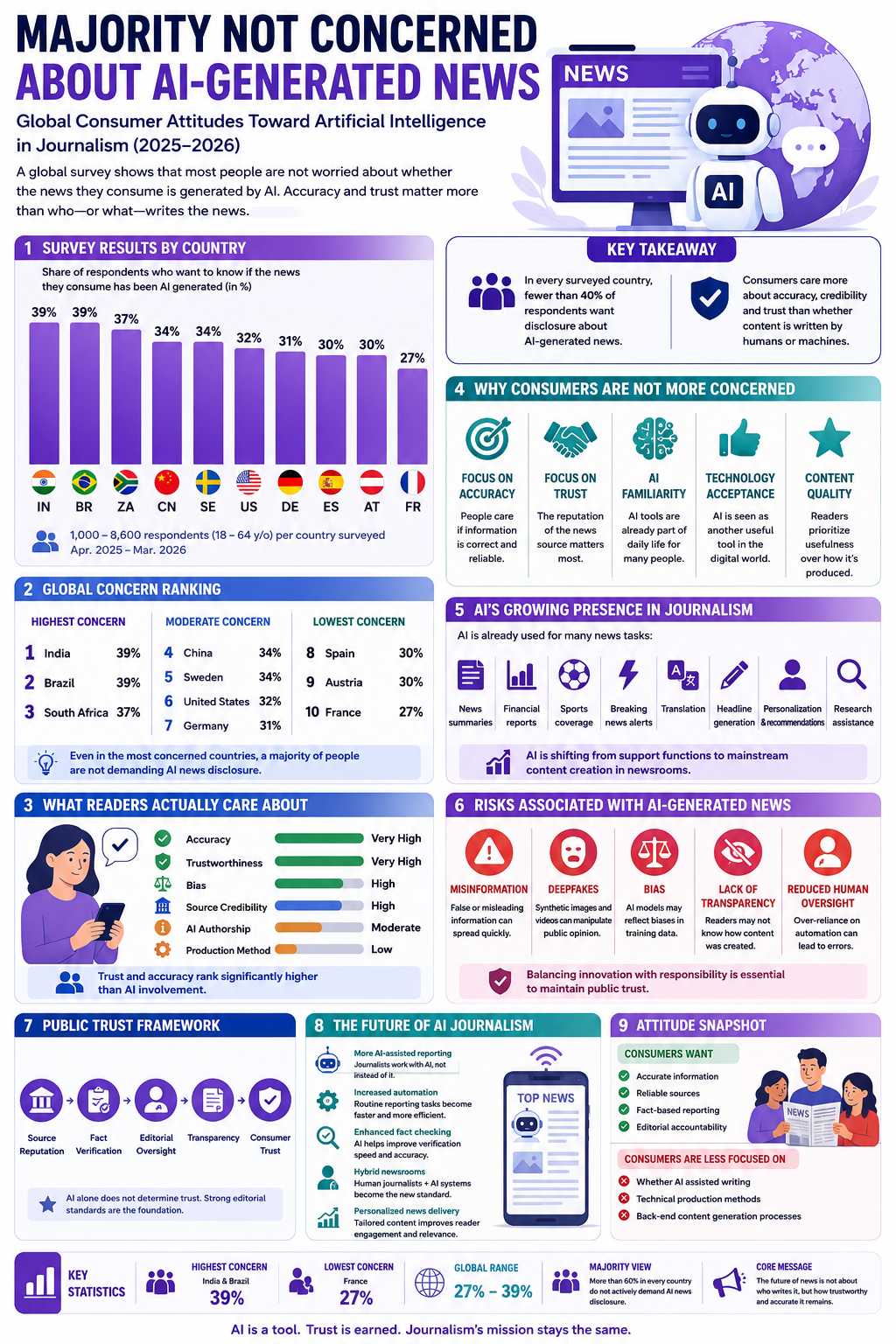
Artificial intelligence has emerged as one of the most transformative technologies affecting the global media industry. News organizations across the world are increasingly incorporating AI tools into editorial workflows to assist with content generation, research, translation, data analysis, audience engagement, and content personalization. The rapid rise of generative AI platforms has created widespread discussion regarding the future of journalism, media credibility, and information transparency. While experts, policymakers, and media executives often debate the ethical implications of AI-generated content, public attitudes appear significantly more measured.
Recent international survey findings suggest that a majority of news consumers are not highly concerned about whether the news they read, watch, or listen to has been generated by artificial intelligence. In most surveyed countries, fewer than 40 percent of respondents expressed a desire to know whether content was AI-generated. Even in the countries demonstrating the highest levels of concern, such as India and Brazil, only 39 percent of respondents indicated a preference for disclosure. In several European markets, concern levels were even lower, falling below one-third of respondents.
These findings reveal an important distinction between industry discussions and consumer priorities. While journalists and regulators often focus on transparency requirements, many consumers appear more interested in the quality, reliability, and usefulness of information than in the technological tools used to create it. For many readers, the credibility of a news source matters more than whether an article was written entirely by a human journalist, partially assisted by AI, or generated through automated systems.
The results also suggest that AI has become increasingly normalized in everyday life. Consumers already interact with AI through search engines, recommendation systems, navigation applications, virtual assistants, online shopping platforms, and customer service systems. As AI becomes more integrated into daily experiences, its use within news production may appear less disruptive than many experts initially anticipated.
The growing acceptance of AI-generated content does not necessarily imply blind trust. Instead, it indicates that consumers evaluate news primarily based on outcomes rather than production methods. Accuracy, fairness, objectivity, and timeliness continue to serve as the most important criteria when assessing information quality. As AI technologies become more sophisticated and widely adopted, the future success of media organizations will likely depend on maintaining editorial integrity rather than simply disclosing technological involvement.
Understanding AI-Generated News and Its Growing Role in Modern Journalism
The concept of AI-generated news refers to journalistic content that is created either fully or partially through artificial intelligence systems. While public attention surrounding AI-generated content has intensified in recent years, automation has been present in newsrooms for much longer than many people realize. For more than a decade, media organizations have utilized automated systems to generate financial reports, sports summaries, weather updates, and election result coverage. These early applications were generally limited to structured data and repetitive reporting tasks.
The emergence of advanced generative AI systems represents a significant evolution in these capabilities. Modern AI platforms can now produce full-length articles, summarize complex reports, generate headlines, translate content across languages, create multimedia assets, and even provide personalized news experiences tailored to individual readers. Such capabilities have the potential to dramatically increase newsroom productivity while reducing content production costs.
For publishers facing financial pressures, AI offers compelling advantages. News organizations are operating in an environment characterized by declining print revenues, increasing competition for digital audiences, and rising operational expenses. AI technologies can help organizations produce content faster, cover more topics, serve global audiences through multilingual publishing, and improve engagement through personalization. These efficiencies are particularly attractive for smaller publishers that may lack extensive editorial resources.
However, the growing role of AI in journalism has also raised important questions regarding transparency, accountability, and trust. Critics argue that consumers deserve to know when content has been generated by machines rather than humans. Others worry about the potential spread of misinformation, factual inaccuracies, algorithmic bias, and reduced editorial oversight. These concerns have prompted calls for labeling requirements and disclosure frameworks in several countries.
Despite these concerns, survey findings suggest that consumers may be less focused on AI involvement than expected. This may reflect a broader shift in how people view technology. Rather than seeing AI as a distinct or unusual innovation, many consumers increasingly view it as another tool within the broader digital ecosystem. Similar concerns accompanied the introduction of search engines, social media platforms, and automated recommendation systems, yet these technologies eventually became accepted components of everyday life.
As AI continues to evolve, its role in journalism is likely to expand further. The challenge for media organizations will not be deciding whether to adopt AI, but rather determining how to integrate it responsibly while maintaining audience trust and journalistic standards.
Global Survey Results Reveal Significant Differences in Public Attitudes
One of the most interesting aspects of the survey findings is the considerable variation in public attitudes across countries. Although concern levels remain relatively low overall, regional differences suggest that cultural, economic, technological, and media-related factors influence how consumers perceive AI-generated news.
India and Brazil recorded the highest percentages of respondents expressing interest in knowing whether news content was AI-generated, with both countries reaching 39 percent. South Africa followed closely at 37 percent. China and Sweden each recorded 34 percent, while the United States stood at 32 percent. Germany, Spain, Austria, and France reported somewhat lower levels of concern, ranging between 27 percent and 31 percent.
The relatively narrow range between countries indicates that skepticism toward AI-generated news is not overwhelmingly dominant in any surveyed market. Even among the most concerned populations, a majority of respondents did not specifically request AI disclosure. This suggests that public attitudes are generally characterized by cautious acceptance rather than strong opposition.
Several factors may explain these differences. Countries experiencing rapid digital transformation often demonstrate heightened awareness of emerging technologies and their societal impacts. In nations where misinformation has become a major public issue, consumers may place greater value on transparency regarding content creation processes. Conversely, in markets with strong trust in established media institutions, consumers may feel less concerned about whether AI contributes to news production.
Another important consideration is the varying level of AI exposure across regions. Populations that regularly interact with AI-powered services may become more comfortable with automation over time. Familiarity often reduces uncertainty and can lead to greater acceptance of technological innovations. In contrast, consumers with limited experience using AI tools may perceive AI-generated content as less trustworthy or more experimental.
The survey findings highlight the importance of avoiding broad assumptions regarding public attitudes. Consumer perceptions of AI-generated news are influenced by a complex combination of technological literacy, media trust, cultural norms, regulatory environments, and personal experiences. Understanding these nuances will be essential for publishers, policymakers, and technology providers as AI adoption continues to accelerate across the global media landscape.
Why Consumers Prioritize Accuracy Over Authorship
One of the most important insights emerging from the survey data is that consumers appear to prioritize information quality over content authorship. For many readers, the fundamental purpose of news is to provide accurate, relevant, and timely information. Whether that information is produced by a human journalist, an AI system, or a combination of both may be viewed as secondary.
Historically, audiences have evaluated media organizations based on reputation, credibility, and journalistic standards rather than production methods. Readers rarely ask what software was used to design a newspaper, what database supported a news investigation, or what technology assisted with fact-checking. Instead, they focus on whether the final product delivers trustworthy information.
The same principle increasingly applies to AI-generated news. If an article provides accurate facts, balanced reporting, and useful insights, many consumers may see little reason to object to AI involvement. Conversely, content that contains errors, bias, or misinformation is likely to be criticized regardless of whether it was created by humans or machines.
This perspective reflects a broader shift toward outcome-based evaluation. Consumers care about results rather than processes. In many industries, automation has become accepted because it improves efficiency and convenience without compromising quality. Online banking, airline booking systems, digital navigation tools, and automated customer service platforms all experienced initial skepticism before becoming mainstream.
News consumption may be following a similar trajectory. As AI systems improve and demonstrate their ability to support high-quality journalism, public concern may continue to decline. Rather than focusing exclusively on AI disclosure, media organizations may achieve greater success by emphasizing editorial oversight, fact-checking procedures, and accountability mechanisms.
The future of trust in journalism may therefore depend less on whether AI is used and more on how effectively organizations ensure that AI-generated content meets the same standards expected of traditional reporting. Consumers ultimately seek reliable information, and their willingness to accept AI-generated news suggests that trust remains rooted in content quality rather than content origin.
Explore Related News, Media, and Digital Information Market Research Reports
As artificial intelligence becomes increasingly integrated into content creation, news distribution, and information discovery, the media industry is undergoing significant transformation. While public concern about AI-generated news remains relatively limited compared with the rapid pace of AI adoption, publishers, technology providers, news organizations, and digital platforms continue to invest heavily in tools that enhance content production, aggregation, distribution, and audience engagement.
For readers interested in understanding the broader business and technology landscape surrounding digital news and information ecosystems, the following market research reports provide valuable insights into emerging trends, competitive dynamics, and future growth opportunities.
Featured Reports:
Global News Aggregator Tool Market Competitive Environment 2026-2033
Global Virtual Health News Platforms Market Growth Drivers and Challenges 2026-2033
Global News Inks Market Future Outlook 2026-2033
Global News Printing Ink Market Key Players and Market Share 2026-2033
Global Satellite News Gathering Vehicle(SNG Vehicles) Market Industry Best Practices 2026-2033
Global Clay Coated News Backboard (CCNB) Market Growth Drivers and Challenges 2026-2033
Global News Portal Software Market Competitive Landscape 2026-2033
Global News Scraper Tool Market Research and Development Focus 2026-2033
Global News Ink and Coldset Market Investment Landscape 2026-2033
Global News Apps Market Innovation Trends 2026-2033
These reports cover a wide range of technologies and services that support the modern news ecosystem, including content aggregation platforms, digital publishing software, mobile news applications, automated content collection tools, broadcasting infrastructure, and traditional print media supplies. They provide detailed market forecasts, competitive intelligence, technology trends, regional analysis, and strategic insights through 2033.
As AI continues to reshape how information is created, distributed, and consumed, these studies offer valuable perspectives for media companies, technology providers, publishers, broadcasters, investors, and digital platform operators seeking to navigate the future of the global news and information industry.
Blogs récents
Parabolic Trough Collector Market Outlook Through 2035
Railway Propulsion Systems Market
Global Mental Health Outlook 2026-2030
The Next Five Years of Digital Innovation, AI Governance, and Europe's Competitive Future (2026
EU Digital Protection Index 2025: Public Confidence, Privacy and AI Governance
Public Concern About AI-Generated News Remains Limited Despite Rapid AI Adoption
Asia Gains Ground in Global Travel Demand: How the Global Tourism Map Is Being Redrawn Through
Housing Cost Burden in the EU Continues to Ease Through 2027, Yet Urban Residents Still Face th