
-
Écrivez-nous
- Rapports phares
Global Seafood Production 1950–2027: How Aquaculture Overtook Wild Fisheries and Became the Future of Food Introduction
Publié le 18 June, 2026
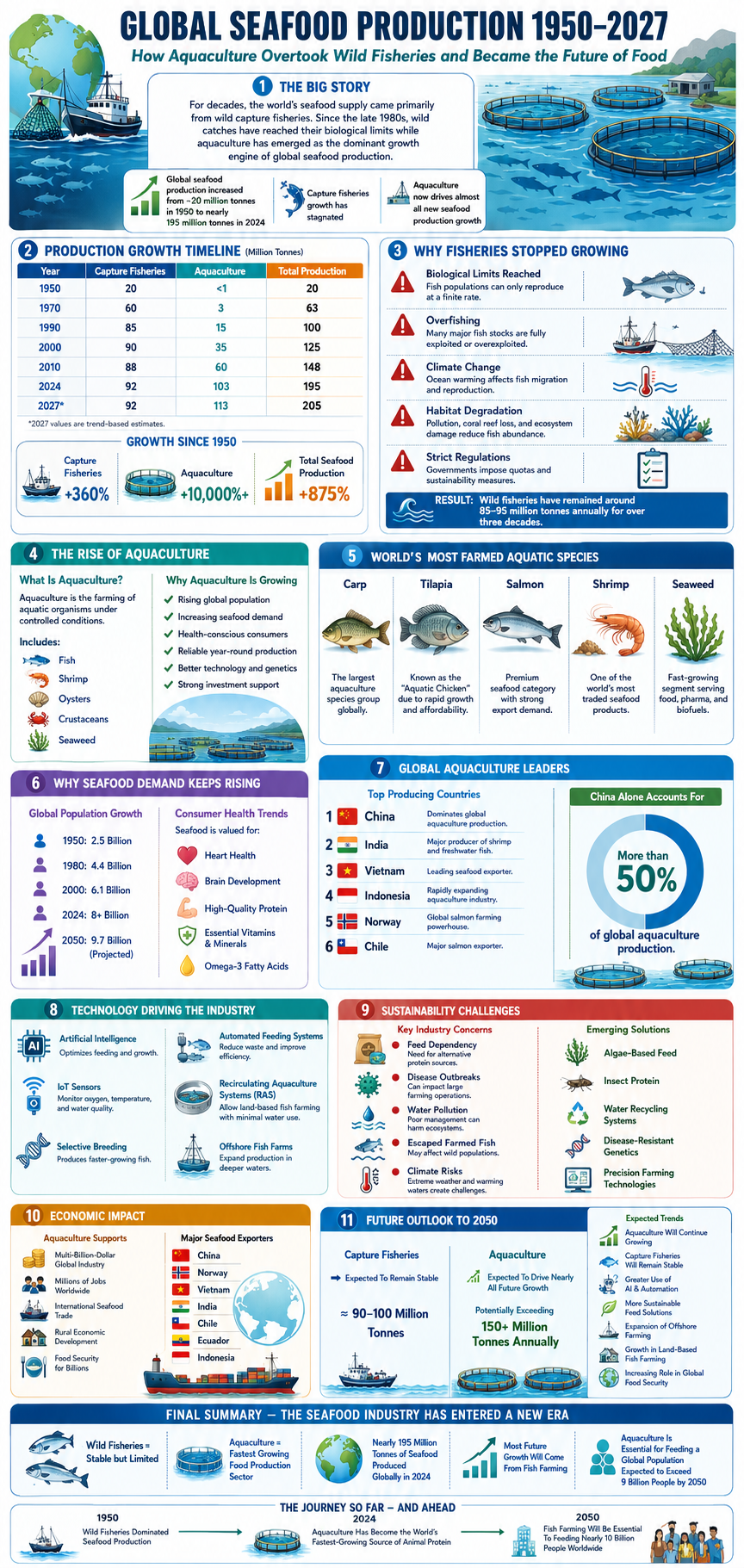
The global seafood industry has undergone a remarkable transformation over the past seven decades. Once dominated almost entirely by wild capture fisheries, the sector is increasingly being driven by aquaculture, the farming of fish, shellfish, crustaceans, and aquatic plants. This shift represents one of the most significant developments in global food production since the industrialization of agriculture.
From 1950 to 2027, seafood production has expanded from approximately 20 million tonnes to an estimated 205 million tonnes. However, the sources of this growth have changed dramatically. While capture fisheries fueled much of the industry's expansion during the twentieth century, their growth has largely stagnated since the late 1980s due to biological, environmental, and regulatory constraints. In contrast, aquaculture has emerged as the world's fastest-growing food production sector, providing most of the additional seafood required by a rapidly growing global population.
By 2027, aquaculture is estimated to account for approximately 56% of total global seafood production, firmly establishing itself as the primary driver of growth in the seafood industry. This transition has profound implications for food security, nutrition, sustainability, trade, technology, employment, and economic development.
The Evolution of Global Seafood Production
The growth of global seafood production since 1950 tells a story of human innovation, rising demand, and environmental limits. In the early post-war decades, expanding fishing fleets and technological advancements enabled countries to harvest increasing quantities of fish from oceans, rivers, and lakes. Production rose rapidly as refrigeration systems improved, transportation networks expanded, and seafood became more accessible to consumers worldwide.
Global Seafood Production Timeline
| Year | Capture Fisheries | Aquaculture | Total Production |
| 1950 | 20 Mt | <1 Mt | 20 Mt |
| 1970 | 60 Mt | 3 Mt | 63 Mt |
| 1990 | 85 Mt | 15 Mt | 100 Mt |
| 2000 | 90 Mt | 35 Mt | 125 Mt |
| 2010 | 88 Mt | 60 Mt | 148 Mt |
| 2024 | 92 Mt | 103 Mt | 195 Mt |
| 2027* | 92 Mt | 113 Mt | 205 Mt |
2027 values represent trend-based estimates derived from recent growth patterns.
The figures reveal a clear transition. While total production continued growing, nearly all expansion after 1990 came from aquaculture rather than capture fisheries.
The Golden Age of Capture Fisheries
Between 1950 and 1990, capture fisheries experienced unprecedented growth. Nations invested heavily in industrial fishing fleets equipped with advanced technologies such as sonar fish finders, onboard processing facilities, refrigeration systems, and satellite navigation. Fishing operations expanded into deeper waters and more distant regions, dramatically increasing harvest volumes.
During this period, seafood was increasingly viewed as an affordable and nutritious protein source. Growing populations, urbanization, and rising incomes boosted demand across developed and developing economies alike. Governments often encouraged fisheries expansion to strengthen food security and economic development.
As a result, capture fisheries production increased from approximately 20 million tonnes in 1950 to about 85 million tonnes by 1990. Many observers believed this upward trajectory would continue indefinitely. However, the biological realities of marine ecosystems eventually imposed limits on growth.
Why Capture Fisheries Stopped Growing
One of the most important developments in global seafood production has been the stagnation of capture fisheries. Despite improvements in technology and fishing efficiency, global wild fish catches have remained largely stable at approximately 85 to 95 million tonnes annually for more than three decades.
The primary reason is that fish populations can only reproduce at finite rates. Every species has a maximum sustainable yield, beyond which harvesting begins to deplete stocks faster than they can recover. As fishing pressure intensified during the twentieth century, many fisheries approached or exceeded these biological limits.
Overfishing became a widespread concern in numerous regions. Several commercially important species, including cod, tuna, haddock, hake, and anchoveta, experienced significant declines due to excessive harvesting. The collapse of Newfoundland's Atlantic cod fishery remains one of the most notable examples, demonstrating how quickly even large fish populations can deteriorate when exploitation becomes unsustainable.
Climate change has further complicated fisheries management. Rising ocean temperatures alter migration patterns, breeding behavior, and ecosystem dynamics. Species are increasingly shifting toward cooler waters, creating challenges for traditional fishing grounds. Ocean acidification, pollution, coral reef degradation, and habitat loss further reduce marine ecosystem productivity.
Governments and international organizations have responded with stricter management measures, including catch quotas, seasonal closures, protected areas, and licensing restrictions. While these policies are essential for long-term sustainability, they also limit the potential for future production growth.
The Rise of Aquaculture
As capture fisheries reached their natural limits, aquaculture emerged as the industry's growth engine. Aquaculture refers to the controlled cultivation of aquatic organisms, including fish, shrimp, oysters, mussels, seaweed, and numerous other species.
Unlike capture fisheries, aquaculture allows producers to manage breeding, feeding, growth, and harvesting under controlled conditions. This provides greater predictability and scalability than relying solely on wild fish populations.
Aquaculture has evolved from a small-scale agricultural activity into one of the largest food-producing industries in the world. Production increased from less than one million tonnes in 1950 to more than 103 million tonnes in 2024, and it is projected to exceed 113 million tonnes by 2027.
The industry's growth rate far exceeds that of most agricultural sectors. Since 1950, aquaculture production has expanded by more than one hundredfold, making it one of the most successful food production innovations of the modern era.
Why Aquaculture Is Expanding So Rapidly
Several powerful forces are driving aquaculture growth worldwide.
The first is population growth. The global population increased from approximately 2.5 billion people in 1950 to more than 8 billion in 2024. By 2050, the United Nations projects that the population could approach 9.7 billion. Feeding this growing population requires substantial increases in food production, particularly protein-rich foods.
Second, seafood consumption continues rising as incomes increase. Economic development across Asia, Africa, and Latin America has expanded the middle class, creating stronger demand for fish and seafood products.
Third, consumers increasingly recognize the nutritional benefits of seafood. Fish provides high-quality protein, omega-3 fatty acids, essential vitamins, and minerals while often containing lower levels of saturated fat than many terrestrial meat products. Growing awareness of these health benefits has increased seafood consumption globally.
Finally, aquaculture offers reliable year-round production. Unlike capture fisheries, which are influenced by weather conditions, migration patterns, and seasonal fluctuations, fish farms provide predictable harvest schedules and stable supply chains. This reliability is highly attractive to retailers, processors, restaurants, and consumers.
Major Aquaculture Species Driving Growth
Aquaculture encompasses a wide variety of species, each serving different markets and production systems.
Carp remains the largest aquaculture species group globally and plays a particularly important role in Asian food systems. Carp farming has centuries of history and remains highly efficient due to the species' adaptability and relatively low production costs.
Tilapia has become one of the most widely farmed fish species in the world. Often referred to as the "aquatic chicken," tilapia grows quickly, adapts to various environments, and provides an affordable source of protein for consumers.
Salmon farming represents one of the most valuable segments of global aquaculture. Countries such as Norway, Chile, Scotland, and Canada have developed highly sophisticated salmon industries that supply premium seafood markets worldwide.
Shrimp farming has also experienced extraordinary growth. Farmed shrimp is among the most traded seafood products globally and serves both developed and emerging markets. Major producers include India, Ecuador, Vietnam, Indonesia, and China.
Seaweed farming represents another rapidly expanding segment. Beyond food applications, seaweed is increasingly used in pharmaceuticals, cosmetics, biofuels, fertilizers, and animal feed. Many experts believe seaweed cultivation will play an increasingly important role in sustainable food and industrial systems.
China and the Global Aquaculture Revolution
No country has had a greater impact on aquaculture development than China. The nation accounts for more than half of global aquaculture production and has been the dominant force behind industry growth for decades.
China's success stems from a combination of favorable geography, extensive freshwater resources, strong government support, technological innovation, and large domestic demand. Fish farming has become deeply integrated into China's agricultural economy, supporting food security and rural livelihoods while generating substantial export revenues.
Beyond China, several countries have emerged as major aquaculture producers. India has become a global leader in shrimp and freshwater fish production. Vietnam and Indonesia continue expanding their aquaculture sectors rapidly, while Norway and Chile dominate global salmon production.
Together, these countries play a critical role in meeting growing international seafood demand.
Technology Is Transforming Aquaculture
Modern aquaculture is increasingly driven by advanced technology. Artificial intelligence, automation, biotechnology, and digital monitoring systems are helping producers improve productivity while reducing environmental impacts.
Artificial intelligence is being used to optimize feeding schedules, predict growth rates, detect disease outbreaks, and improve farm management decisions. By analyzing large volumes of data, AI systems can help farmers maximize efficiency while minimizing waste.
Internet of Things sensors continuously monitor water quality parameters such as oxygen concentration, temperature, salinity, and pH levels. Real-time monitoring allows rapid responses to changing conditions and reduces production risks.
Selective breeding programs have produced fish strains that grow faster, resist disease more effectively, and utilize feed more efficiently. These improvements contribute significantly to productivity gains.
Automated feeding systems are increasingly common in commercial operations. By delivering precise quantities of feed based on fish behavior and environmental conditions, these systems reduce costs and environmental impacts.
Recirculating Aquaculture Systems represent one of the most promising innovations. These land-based facilities continuously recycle water through advanced filtration technologies, enabling fish production near urban markets while minimizing water consumption.
Offshore aquaculture is another emerging frontier. Moving fish farms into deeper offshore waters can reduce environmental pressures in coastal areas while providing access to larger production zones.
Sustainability Challenges Facing Aquaculture
Despite its many advantages, aquaculture faces significant sustainability challenges that must be addressed to ensure long-term growth.
Feed dependency remains a major concern. Historically, many farmed fish species relied on fishmeal and fish oil derived from wild fish populations. Although feed efficiency has improved dramatically, reducing dependence on marine ingredients remains a priority.
Researchers are developing alternative feed sources including algae-based oils, insect protein, microbial proteins, and plant-based ingredients. These innovations could significantly improve sustainability while reducing pressure on wild fisheries.
Disease outbreaks pose another challenge. Intensive farming conditions can facilitate the spread of pathogens, leading to production losses and economic disruptions. Strong biosecurity protocols, vaccination programs, and genetic improvements are helping mitigate these risks.
Environmental impacts such as nutrient discharge, habitat alteration, and escaped fish also require careful management. Regulatory frameworks and improved farming practices are increasingly focused on minimizing these effects.
Climate change introduces additional uncertainty. Rising temperatures, changing precipitation patterns, extreme weather events, and ocean acidification may affect both marine and freshwater aquaculture systems. Building climate resilience will be essential for future industry success.
Economic Importance of the Seafood Industry
The seafood sector is a major contributor to global economic activity. Aquaculture alone supports millions of jobs across farming, processing, transportation, equipment manufacturing, feed production, and retail industries.
Global seafood trade is valued at hundreds of billions of dollars annually. Major exporters such as China, Norway, Vietnam, India, Chile, Ecuador, and Indonesia supply seafood products to markets throughout North America, Europe, Asia, and the Middle East.
For many developing countries, aquaculture serves as an important source of foreign exchange earnings, employment, and rural development. Fish farming often provides livelihood opportunities in regions where agricultural alternatives may be limited.
The industry's contribution to food security is equally significant. Seafood supplies essential nutrients to billions of people worldwide and represents a critical protein source for many coastal and island communities.
Outlook to 2027 and Beyond
By 2027, global seafood production is expected to exceed 205 million tonnes, with aquaculture accounting for most of the increase. Capture fisheries are likely to remain relatively stable around 90 to 95 million tonnes, reflecting continued biological constraints and sustainability considerations.
Aquaculture production is projected to surpass 113 million tonnes, increasing its share of total seafood production and reinforcing its position as the dominant growth driver.
Technological innovation will continue reshaping the industry. Artificial intelligence, automation, precision feeding, genetic improvements, offshore farming, and recirculating systems are expected to improve efficiency and sustainability.
Consumer demand for sustainable seafood products will likely strengthen, encouraging producers to adopt more environmentally responsible practices. Alternative feeds, renewable energy integration, and circular production systems may become increasingly important.
Looking further toward 2050, most analysts expect aquaculture to provide the majority of additional seafood required to feed a global population approaching 10 billion people.
The history of global seafood production from 1950 to 2027 reflects one of the most important transitions in modern food systems. Wild capture fisheries fueled rapid growth for much of the twentieth century, expanding from approximately 20 million tonnes to more than 90 million tonnes. However, biological limits, overfishing, climate change, and environmental pressures have largely halted further expansion.
Aquaculture has emerged as the solution to this challenge. From producing less than one million tonnes in 1950, fish farming has grown into a global industry exceeding 100 million tonnes annually and is projected to surpass 113 million tonnes by 2027. Today, aquaculture accounts for the majority of seafood production growth and has become one of the fastest-growing sources of animal protein worldwide.
The future of seafood will increasingly depend on the ability of aquaculture systems to balance productivity, sustainability, technological innovation, and environmental stewardship. As the global population grows and demand for nutritious protein continues rising, aquaculture will play an indispensable role in ensuring food security, supporting economic development, and supplying healthy seafood to billions of people around the world.
The era when expanding fishing fleets could indefinitely increase seafood production has ended. The future belongs to sustainable aquaculture, advanced technology, and responsible management of aquatic resources. In many ways, the next chapter of global food security will be written not in the open ocean, but in fish farms, recirculating systems, offshore cages, and innovative aquaculture facilities that are redefining how the world produces food.
Explore Related Seafood Industry Market Research Reports
The global seafood industry is undergoing a profound transformation as aquaculture expands, food safety regulations become more stringent, seafood-derived ingredients gain commercial importance, and alternative protein technologies reshape the future of food production. While this article examines the long-term evolution of seafood production from 1950 through 2027, readers seeking deeper market intelligence on specific seafood sectors may find the following research reports valuable.
Our latest seafood-related market studies provide comprehensive analysis of industry trends, technological developments, competitive dynamics, regulatory frameworks, investment opportunities, and long-term growth prospects across multiple segments of the seafood value chain.
Featured Reports:
Global Seafood Microbiological Detection Market Business Opportunities 2026-2033
Global Fresh and Seafood Absorbent Pads Market Technological Advancements 2026-2033
Global Seafood Extract Powder Market Revenue Forecasts 2026-2033
Global Food Safety Testing for Seafood Market Technological Advancements 2026-2033
Global Seafood Product Extract Seasoning Market Forecast and Trend Analysis 2026-2033
Global Seasoning Made from Seafood Market Segmentation Analysis 2026-2033
Global Seafood Base Market Industry Best Practices 2026-2033
Global Seafood Appetizer Market Scenario Forecasting 2026-2033
Global Cell-based Meat and Seafood Market Technological Advancements 2026-2033
Global Cell-Based Seafood Market Key Players and Market Share 2026-2033
Together, these reports cover critical areas ranging from seafood quality assurance and food safety testing to value-added seafood ingredients, seasonings, convenience foods, and next-generation cell-based seafood technologies. They provide detailed market forecasts, regional analysis, competitive benchmarking, emerging consumer trends, and strategic insights designed to support business planning, investment decisions, product development, and market expansion initiatives.
For readers interested in understanding where the global seafood industry is heading beyond production volumes, these reports offer valuable perspectives on the technologies, products, and business models shaping the future of seafood markets worldwide.
Blogs récents
Parabolic Trough Collector Market Outlook Through 2035
Railway Propulsion Systems Market
Global Mental Health Outlook 2026-2030
The Next Five Years of Digital Innovation, AI Governance, and Europe's Competitive Future (2026
EU Digital Protection Index 2025: Public Confidence, Privacy and AI Governance
Public Concern About AI-Generated News Remains Limited Despite Rapid AI Adoption
Asia Gains Ground in Global Travel Demand: How the Global Tourism Map Is Being Redrawn Through
Housing Cost Burden in the EU Continues to Ease Through 2027, Yet Urban Residents Still Face th