
-
이메일 문의
- 주요 보고서
Asia Gains Ground in Global Travel Demand: How the Global Tourism Map Is Being Redrawn Through 2050
게시일 22 June, 2026
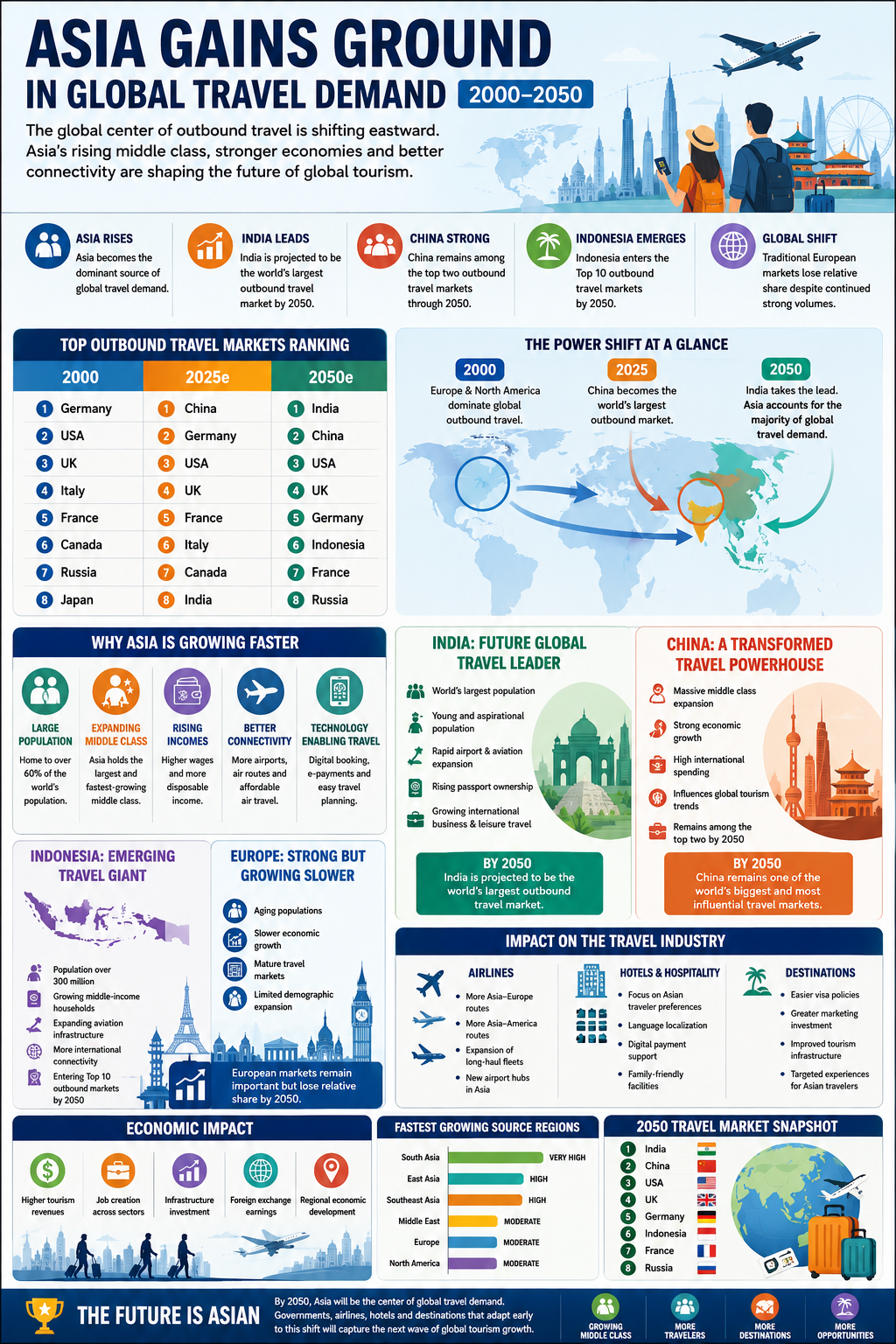
The global travel industry is entering one of the most significant transformations in its history. For decades, international tourism was largely driven by travelers from Europe and North America. Countries such as Germany, the United States, the United Kingdom, France, and Italy consistently ranked among the world's largest outbound tourism markets, generating hundreds of millions of international trips and shaping the strategies of airlines, hotels, travel agencies, cruise operators, and tourism boards worldwide.
However, the center of gravity in global travel demand is steadily shifting eastward. Economic expansion, rising disposable incomes, urbanization, expanding middle-class populations, improved transportation infrastructure, and increasing passport ownership are fueling a new era in international tourism. Asia, once considered primarily a destination region, is rapidly becoming the world's most influential source of outbound travelers.
The transition has already begun. China emerged as the world's leading outbound tourism market during the past two decades, surpassing many traditional travel powerhouses. Looking further ahead, India is expected to become an even larger source of international travelers, while countries such as Indonesia continue to gain importance. By the middle of the century, Asia could dominate global outbound tourism flows in a way that Europe and North America once did.
This transformation will affect every segment of the travel industry. Airlines will adjust route networks. Airports will expand capacity. Hotels will redesign services for new customer demographics. Tourist destinations will compete more aggressively for Asian visitors. Governments will revise visa policies to capture a larger share of future tourism spending.
The rise of Asia is not merely a regional story. It represents a fundamental restructuring of global travel demand that will reshape tourism economics, infrastructure investment, and international mobility for decades to come.
Understanding Outbound Travel Demand
Outbound travel refers to residents traveling outside their home country for leisure, business, education, healthcare, religious purposes, or other reasons. It is one of the most important indicators of tourism strength because it reflects purchasing power, consumer confidence, mobility infrastructure, and international connectivity.
Countries that generate large numbers of outbound travelers influence tourism economies around the world. Their travelers spend money on:
- Flights
- Accommodation
- Food and beverage services
- Retail purchases
- Entertainment
- Transportation
- Cultural attractions
- Medical tourism
- Educational travel
The largest outbound tourism markets often become strategic priorities for destinations seeking visitor growth.
Historically, outbound travel leadership has closely followed economic prosperity. Wealthier countries with higher per-capita incomes typically generated more international travelers. This explains why Germany, the United States, the United Kingdom, France, Italy, Canada, and Japan dominated international tourism demand throughout much of the late twentieth century.
The twenty-first century, however, is bringing a broader distribution of global wealth and mobility, creating opportunities for emerging economies to become major tourism source markets.
The Travel Landscape in 2000: Dominated by Europe and North America
At the beginning of the millennium, Europe represented the undisputed center of global outbound travel.
Germany occupied the leading position, reflecting the country's strong economy, high incomes, generous vacation policies, and long-standing culture of international travel. German tourists were among the world's most frequent travelers and highest spenders.
The United States ranked second, supported by its large population, high disposable income, and extensive global airline connectivity.
The United Kingdom maintained a strong presence due to affordable air travel within Europe and growing international tourism participation.
France and Italy also ranked among the world's most influential outbound travel markets.
The top outbound tourism markets around 2000 reflected a world economy still heavily concentrated in advanced Western nations.
Several factors contributed to this dominance:
Strong Purchasing Power
Western Europe and North America accounted for a substantial share of global GDP. High household incomes made international travel accessible to millions of people.
Mature Aviation Networks
Air travel infrastructure in Europe and North America had already reached advanced levels. Major airports provided extensive international connectivity.
Passport Penetration
Large portions of the population already possessed passports and travel experience.
Liberal Travel Policies
Visa-free travel agreements within Europe and relatively open travel environments encouraged frequent international movement.
At this stage, Asia remained relatively underrepresented among leading outbound travel markets despite housing the majority of the world's population.
China's Rise Changes the Global Travel Industry
No country has altered the global tourism landscape more dramatically than China.
In the early 2000s, China's outbound travel activity remained modest compared with established Western markets. International travel was still emerging among Chinese consumers, and passport ownership rates remained relatively low.
Everything changed as China's economy expanded rapidly.
Over two decades, China experienced:
- Massive industrial growth
- Rising wages
- Expanding urban populations
- Growth of the middle class
- Improved transportation networks
- Greater international connectivity
Hundreds of millions of people moved into income brackets capable of supporting international travel.
The effects were extraordinary.
Chinese tourists became major contributors to tourism revenues across Asia, Europe, North America, Australia, and the Middle East. Destinations increasingly developed Chinese-language services, digital payment compatibility, cultural accommodations, and targeted marketing campaigns.
Luxury shopping districts, hotels, airlines, and tourism operators adapted products specifically for Chinese visitors.
By the mid-2020s, China had become the world's largest outbound travel source market, marking a historic turning point in global tourism.
The significance of China's rise extends beyond volume. Chinese travelers have influenced destination development strategies worldwide.
Cities that previously focused on European and American visitors began prioritizing Chinese tourism growth. Airlines launched new direct routes. Airports expanded capacity. Retail sectors adjusted inventory and staffing to accommodate changing customer demographics.
China's emergence demonstrated how rapidly global tourism leadership can change when economic development intersects with population scale.
Why India Could Become the World's Largest Outbound Travel Market
While China's rise has already transformed tourism, the next major shift may be even larger.
India is projected to become the world's leading outbound tourism market by 2050.
Several structural factors support this outlook.
Population Advantage
India possesses the largest population globally. Even modest increases in travel participation rates can generate enormous growth in outbound tourism volumes.
A small increase in international travel frequency among India's population translates into tens of millions of additional travelers.
Expanding Middle Class
India's middle class continues to grow rapidly.
Rising incomes are enabling more households to allocate spending toward leisure experiences, vacations, and international travel.
As economic development continues, discretionary spending on tourism is expected to increase significantly.
Growing Air Connectivity
India's aviation sector is expanding rapidly.
New airports, airline fleet expansion, and increased international routes are making overseas travel more accessible.
Lower airfares and greater route availability are reducing barriers to international mobility.
Digital Travel Ecosystem
Online booking platforms, digital payments, mobile travel applications, and travel-focused financial products are simplifying international travel planning.
Technology is reducing friction throughout the customer journey.
Young Population
India's demographic profile supports long-term tourism growth.
Younger consumers generally travel more frequently than older generations and demonstrate greater interest in international experiences.
As millions of young professionals enter higher-income brackets, outbound travel demand is likely to accelerate.
The combination of these factors positions India as perhaps the most significant future growth engine in global tourism.
Indonesia Emerges as a New Tourism Powerhouse
One of the most notable developments in future travel projections is the appearance of Indonesia among the leading outbound travel markets.
Indonesia's emergence reflects broader economic changes occurring across Southeast Asia.
The country benefits from:
- A large population
- Rising urbanization
- Growing consumer spending
- Expanding aviation infrastructure
- Increasing international business activity
Historically, Indonesia generated relatively modest outbound tourism compared with major Western economies.
However, economic modernization is creating a larger traveling middle class.
As household incomes improve and international connectivity expands, more Indonesians are expected to participate in overseas travel.
Destinations throughout Asia-Pacific are already witnessing increased visitor arrivals from Indonesia.
By 2050, Indonesia could become one of the most influential tourism source markets globally.
The Relative Decline of Traditional European Leaders
The projected rise of Asia does not necessarily imply shrinking travel demand from Europe.
Instead, it reflects differences in growth rates.
Germany, France, Italy, and the United Kingdom are expected to continue generating substantial numbers of international travelers. However, their share of global outbound tourism is likely to decline as Asian markets grow faster.
Several factors explain this trend.
Slower Population Growth
Many European countries face stagnant or declining population growth.
Smaller demographic expansion limits long-term growth potential in traveler volumes.
Mature Travel Markets
International travel participation rates are already high in Europe.
Future growth opportunities are therefore more limited compared with emerging economies where large portions of the population are only beginning to travel internationally.
Aging Populations
Demographic aging may moderate future travel growth.
While older travelers remain active consumers of tourism services, overall mobility patterns can differ from younger populations.
Economic Maturity
European economies remain highly developed, but growth rates are generally slower than those observed in emerging Asian markets.
As a result, Europe is expected to remain important while gradually losing relative dominance.
How Airlines Will Respond to Asia's Growing Demand
Airlines are among the first industries affected by changes in outbound tourism patterns.
As Asian travel demand expands, airlines will increasingly focus on routes connecting:
- Asia to Europe
- Asia to North America
- Asia to the Middle East
- Asia to Africa
- Asia to Latin America
Future aviation investments are likely to prioritize:
- Fleet expansion
- Long-haul aircraft acquisition
- Airport capacity upgrades
- Secondary city connectivity
Major aviation hubs in Asia may handle significantly larger passenger volumes by 2050.
This growth could drive new airline partnerships, route development strategies, and infrastructure projects across the region.
Implications for Hotels and Hospitality Providers
Hotels worldwide must prepare for changing guest demographics.
Asian travelers often display unique preferences regarding:
- Payment methods
- Language support
- Food options
- Group travel arrangements
- Family travel patterns
- Digital services
Hospitality companies increasingly recognize the importance of adapting offerings to attract travelers from emerging Asian markets.
Future hotel developments may place greater emphasis on:
- Multilingual staff
- Technology integration
- Cultural customization
- Family-friendly facilities
- Flexible booking options
Properties that successfully adapt to evolving traveler demographics are likely to gain competitive advantages.
Destinations Competing for Asian Visitors
Tourism destinations are already competing aggressively for Asian travelers.
Governments understand that future tourism growth will increasingly depend on attracting visitors from rapidly expanding Asian economies.
As a result, many countries are:
- Simplifying visa processes
- Expanding air service agreements
- Investing in tourism infrastructure
- Increasing marketing budgets
- Launching destination awareness campaigns
Countries that establish strong relationships with emerging outbound markets today may benefit significantly over the coming decades.
Technology's Role in Future Travel Growth
Technology will play a central role in facilitating Asia's tourism expansion.
Digital transformation is making travel more accessible than ever before.
Key developments include:
- Mobile booking platforms
- AI-powered travel planning
- Digital payment systems
- Automated visa processing
- Smart airport technologies
- Personalized travel recommendations
As technology reduces friction across the travel journey, international tourism participation is likely to increase further.
The impact will be particularly significant in developing economies where digital adoption continues to accelerate.
Economic Impact of Asia's Tourism Expansion
The economic implications are enormous.
Higher outbound travel volumes generate spending across multiple sectors, including aviation, hospitality, retail, entertainment, transportation, and tourism services.
Countries that successfully attract growing numbers of Asian travelers could experience:
- Increased tourism revenues
- Job creation
- Infrastructure investment
- Foreign exchange earnings
- Regional economic development
The redistribution of tourism spending will become one of the defining economic trends within the global travel industry.
Challenges That Could Influence Future Growth
Despite strong projections, several challenges could affect the pace of tourism expansion.
These include:
Geopolitical Tensions
International conflicts and diplomatic disputes can disrupt travel flows.
Economic Volatility
Recessions or financial instability may reduce discretionary spending.
Climate Change
Extreme weather events could alter destination attractiveness and travel patterns.
Infrastructure Constraints
Airports, transportation systems, and tourism facilities must keep pace with demand growth.
Sustainability Concerns
Governments and businesses will need to balance tourism growth with environmental protection.
Addressing these challenges will be essential for sustaining long-term tourism expansion.
Outlook Toward 2050
By 2050, the global tourism landscape is expected to look fundamentally different from that of 2000.
Asia will likely occupy a dominant position in outbound travel demand, with India and China leading the rankings and Indonesia joining the world's most influential tourism source markets.
Europe and North America will remain important contributors to global tourism, but their relative dominance will diminish as emerging economies generate larger shares of international travelers.
The shift reflects broader economic and demographic transformations reshaping the global economy.
Travel demand increasingly follows population growth, rising incomes, urbanization, and expanding middle classes. These forces are particularly powerful across Asia, creating unprecedented opportunities for tourism-related industries.
The rise of Asia as the primary driver of global outbound tourism represents one of the most important structural changes in the travel industry. What began with China's rapid economic ascent is evolving into a broader regional transformation powered by India, Indonesia, and other emerging Asian economies.
The transition is not merely about rankings. It reflects changing patterns of wealth creation, consumer behavior, demographic expansion, and global mobility. By mid-century, hundreds of millions of additional travelers from Asia are expected to enter international tourism markets, reshaping airline networks, hotel strategies, destination marketing efforts, and tourism investment priorities.
For governments, tourism boards, airlines, hospitality companies, and investors, understanding this shift will be essential. The destinations and businesses that successfully position themselves to serve the next generation of Asian travelers are likely to capture a significant share of future tourism growth.
As the world moves toward 2050, the geography of travel demand will continue to evolve. The evidence increasingly points toward a future where Asia is not only the world's most populous region, but also the world's most influential source of international travelers, redefining the global tourism industry for decades to come.
Explore Related Travel and Tourism Market Research Reports
The global tourism landscape is undergoing a profound transformation as Asia strengthens its position as a major driver of international travel demand through 2050. Rising incomes, expanding middle-class populations, digital travel platforms, improved connectivity, and evolving traveler preferences are reshaping how people explore the world. As tourism flows shift and new destinations emerge, a wide range of travel-related industries are experiencing significant growth and innovation.
For readers interested in gaining deeper insights into the business, technology, and consumer trends shaping the future of travel, the following market research reports provide valuable analysis across key segments of the global tourism ecosystem.
Featured Reports:
Global Pet Dog Travel Crates Market Key Success Factors 2026-2033
Global Travel Destination Marketing Market Historical Impact Review 2026-2033
Global Traveling Wave Fault Ranging Device Market Growth Drivers and Challenges 2026-2033
Global Long-travel Automotives Electronic Accelerator Pedal Market Scenario Forecasting 2026-2033
Global Virtual Reality in Travel Market Technological Advancements 2026-2033
Global Travel Booking Market Overview and Outlook 2026-2033
Global Travel Blogging Market Revenue Forecasts 2026-2033
Global Travel Apps Market Key Success Factors 2026-2033
Global Accessible Travel Market Innovation Trends 2026-2033
Global B2B Travel Platform Market Key Players and Market Share 2026-2033
These reports explore critical areas of the travel industry, including digital booking technologies, destination marketing strategies, travel content creation, mobile travel applications, accessibility solutions, business travel platforms, virtual tourism experiences, and emerging consumer travel behaviors. They provide comprehensive market forecasts, competitive intelligence, regional analysis, technological developments, and strategic insights through 2033.
As global travel demand continues to expand and diversify, these studies offer valuable perspectives for tourism organizations, travel technology providers, investors, destination marketers, hospitality companies, transportation providers, and other stakeholders seeking to understand the opportunities shaping the future of the global travel economy.
최신 블로그
Parabolic Trough Collector Market Outlook Through 2035
Railway Propulsion Systems Market
Global Mental Health Outlook 2026-2030
The Next Five Years of Digital Innovation, AI Governance, and Europe's Competitive Future (2026
EU Digital Protection Index 2025: Public Confidence, Privacy and AI Governance
Public Concern About AI-Generated News Remains Limited Despite Rapid AI Adoption
Asia Gains Ground in Global Travel Demand: How the Global Tourism Map Is Being Redrawn Through
Housing Cost Burden in the EU Continues to Ease Through 2027, Yet Urban Residents Still Face th