
-
メールでお問い合わせ
- 注目レポート
The Next Five Years of Digital Innovation, AI Governance, and Europe's Competitive Future (2026-2030)
投稿日 22 June, 2026
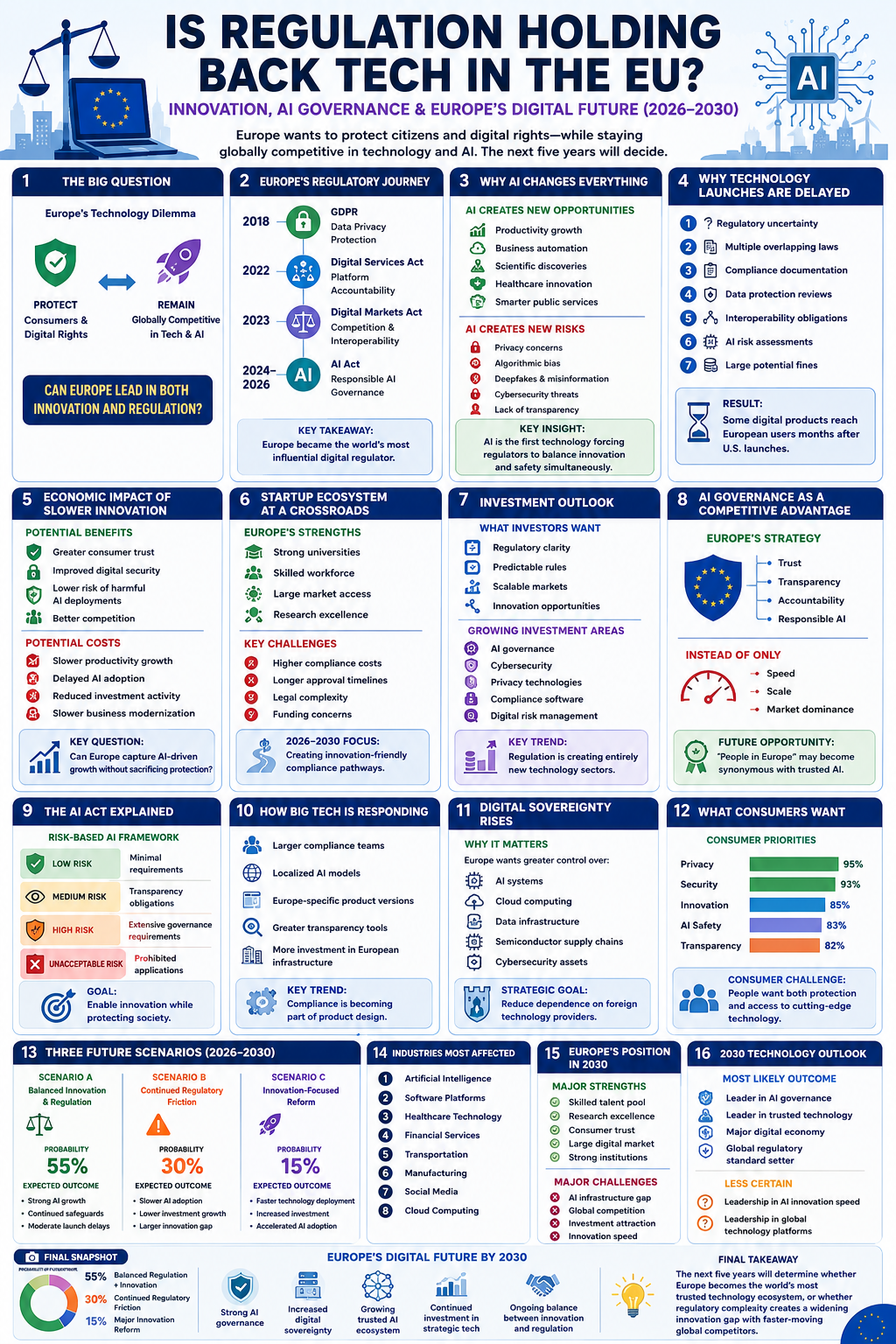
The relationship between technological innovation and government regulation has always been complex. Throughout history, societies have struggled to find the right balance between encouraging innovation and protecting citizens from potential risks. In the digital era, this challenge has become significantly more complicated as technologies increasingly influence every aspect of modern life, from communication and healthcare to finance, education, transportation, and national security. Few regions have embraced this balancing act as aggressively as the European Union, which has emerged as the world's leading regulator of digital technologies.
Over the past decade, Europe has introduced some of the most comprehensive technology regulations ever implemented. Privacy laws, competition rules, artificial intelligence governance frameworks, cybersecurity requirements, and digital platform regulations have collectively transformed how technology companies operate within the European market. These efforts were designed to address legitimate concerns regarding personal data misuse, market monopolization, algorithmic bias, misinformation, cybersecurity threats, and the growing influence of large technology platforms over society and the economy.
Supporters argue that Europe's regulatory framework has strengthened consumer protection, increased corporate accountability, and established important safeguards for the digital age. They believe regulation is not an obstacle to innovation but rather a necessary foundation for sustainable technological development. According to this view, trustworthy technologies will ultimately create stronger and more resilient digital economies.
Critics, however, increasingly point to a growing pattern of delayed technology launches, slower AI adoption, reduced venture capital activity, and rising compliance costs. Several major digital products have reached American consumers months or even years before becoming available in Europe. The concern among many industry observers is that Europe may be sacrificing innovation speed in pursuit of regulatory perfection.
Artificial intelligence has intensified this debate dramatically. AI is not simply another software category. It represents a foundational technology that could reshape productivity, employment, economic competitiveness, healthcare, scientific research, and government services over the coming decades. Countries that successfully adopt and deploy AI at scale may enjoy substantial economic advantages. Consequently, any factors that slow AI deployment have become matters of strategic importance.
The years between 2026 and 2030 will likely determine whether Europe can maintain its reputation as the global leader in digital governance while remaining competitive in the emerging AI-driven economy. The decisions made during this period will affect businesses, consumers, investors, governments, and technology developers throughout the continent. Success could position Europe as the world's model for responsible innovation. Failure could widen the technology gap between Europe and faster-moving regions such as the United States and parts of Asia.
The future of European technology policy will therefore be shaped by a single critical question: can regulation and innovation reinforce one another, or are they increasingly moving in opposite directions?
How Europe Became the World's Regulatory Powerhouse
Europe's rise as the world's most influential technology regulator did not happen overnight. It was the result of a gradual shift in policy thinking that accelerated during the growth of the internet economy and intensified as technology companies became increasingly central to everyday life.
Unlike the United States, where innovation was often prioritized over regulation, European policymakers became concerned about the long-term societal consequences of allowing digital platforms to expand without significant oversight. Concerns emerged regarding privacy violations, market dominance, consumer exploitation, tax practices, online misinformation, and the concentration of power among a small number of global technology firms.
These concerns led European institutions to adopt a fundamentally different approach. Rather than reacting after problems emerged, policymakers increasingly sought to establish rules before technologies became deeply embedded within society. This proactive philosophy would eventually become one of Europe's defining characteristics in the global digital economy.
The General Data Protection Regulation represented a major turning point. Introduced in 2018, GDPR established some of the strictest privacy protections in the world. Organizations were required to obtain meaningful consent, disclose data collection practices, provide users with access to their personal information, and report breaches promptly. The regulation imposed significant penalties for non-compliance, demonstrating Europe's willingness to challenge even the largest corporations.
GDPR's influence extended far beyond Europe. Companies operating globally often adopted GDPR standards worldwide because maintaining separate compliance frameworks was inefficient. As a result, European regulatory philosophy began shaping global digital governance.
The success of GDPR encouraged policymakers to pursue additional reforms. The Digital Markets Act targeted anti-competitive behavior among large digital platforms. The Digital Services Act addressed online content moderation and platform accountability. Cybersecurity regulations strengthened digital infrastructure protections. Most recently, the AI Act introduced comprehensive governance requirements for artificial intelligence systems.
These regulations reflect a broader European vision that technological progress must be accompanied by strong ethical safeguards. Policymakers believe that innovation should support social values rather than undermine them.
However, the expansion of regulatory frameworks has also increased complexity. Technology companies must now navigate multiple overlapping rules covering privacy, competition, cybersecurity, content moderation, and AI governance. Compliance has become a significant operational challenge, particularly for smaller companies.
As Europe enters the next phase of digital transformation, its regulatory leadership presents both opportunities and risks. The same framework that protects consumers may also create barriers that slow innovation. Whether Europe can successfully manage this tension will largely determine its position in the global technology landscape through 2030 and beyond.
The Rise of AI Intensifies Regulatory Challenges
Artificial intelligence has fundamentally altered the relationship between innovation and regulation. Previous generations of digital technologies primarily processed information according to predefined instructions. AI systems, by contrast, can learn, adapt, generate content, make predictions, and influence decisions in ways that are often difficult to explain.
This unprecedented capability has created enormous economic opportunities. AI promises to improve productivity, automate repetitive tasks, accelerate scientific discoveries, optimize supply chains, enhance customer service, and transform entire industries. Organizations around the world are investing billions of dollars in AI development and deployment.
At the same time, AI introduces risks that traditional regulatory frameworks were never designed to address.
One major concern involves transparency. Many advanced AI systems function as "black boxes," making decisions through processes that even developers may struggle to fully explain. This creates challenges for accountability, particularly when AI systems influence employment decisions, financial approvals, healthcare diagnoses, or legal outcomes.
Another concern involves bias and discrimination. AI models learn from historical data, which may contain existing societal inequalities. Without appropriate safeguards, AI systems can unintentionally reinforce or amplify these biases.
Privacy concerns are equally significant. Modern AI systems often require enormous amounts of data for training and operation. Regulators worry that personal information may be collected, processed, or shared in ways that violate individual rights.
Cybersecurity risks add another layer of complexity. AI technologies can be used both defensively and offensively. While they enhance threat detection capabilities, they can also enable sophisticated cyberattacks, misinformation campaigns, and automated fraud.
Europe's response has been proactive. Policymakers recognized that waiting until AI-related problems become widespread could create significant societal harm. The AI Act therefore seeks to establish governance mechanisms before AI reaches full maturity.
Critics argue that this approach may slow innovation. Technology companies often face uncertainty regarding compliance requirements, risk classifications, documentation obligations, and approval processes. Such uncertainty can delay product launches and increase development costs.
Supporters counter that responsible governance will ultimately strengthen public trust and encourage broader AI adoption. Without adequate safeguards, they argue, public backlash could create even greater barriers to innovation.
The next five years will determine which perspective proves more accurate. If Europe successfully balances innovation and oversight, it could establish a globally influential model for AI governance. If regulatory burdens become excessive, however, AI development and adoption may increasingly shift toward regions with more flexible frameworks.
Why Technology Launch Delays Are Increasing
One of the most visible consequences of Europe's regulatory environment has been the growing number of technology products that launch later in Europe than in other major markets. This trend has become particularly noticeable in artificial intelligence, digital assistants, social media services, and advanced software features.
Several factors contribute to these delays.
The first is regulatory uncertainty. Emerging technologies often do not fit neatly into existing legal frameworks. Companies must determine how new products interact with privacy regulations, competition laws, consumer protection rules, cybersecurity requirements, and AI governance standards. When uncertainty exists, businesses frequently choose to postpone launches until compliance questions are resolved.
The second factor is the increasing complexity of the regulatory landscape. Companies operating in Europe must often comply with multiple regulations simultaneously. A single AI-powered product may require assessment under GDPR, the Digital Markets Act, the AI Act, cybersecurity rules, and sector-specific regulations.
This complexity extends development timelines. Legal teams, compliance officers, engineers, and regulators must work together to ensure products satisfy all applicable requirements.
Interoperability requirements have become another source of friction. European policymakers increasingly encourage open digital ecosystems that reduce dependency on dominant platforms. While these objectives promote competition, they can create technical challenges for companies whose products rely on tightly integrated ecosystems.
Data governance requirements also contribute to delays. AI systems frequently depend on access to large datasets, user information, and platform interactions. Ensuring that data practices comply with European standards often requires extensive modifications to product architecture.
Furthermore, regulatory penalties in Europe can be substantial. The financial consequences of non-compliance encourage companies to adopt cautious approaches. Delaying a product launch may be viewed as less risky than introducing a service that later faces regulatory sanctions.
Over the next five years, launch delays are likely to remain a recurring feature of Europe's technology landscape. However, improved regulatory clarity and greater cooperation between industry and policymakers could gradually reduce these delays.
The critical challenge will be ensuring that consumer protection goals do not unintentionally prevent European users and businesses from accessing transformative technologies in a timely manner.
Economic Consequences of Slower Innovation
Technology adoption has historically been one of the most important drivers of economic growth. From the industrial revolution to the internet age, societies that embraced transformative technologies early often achieved significant productivity gains and competitive advantages.
Artificial intelligence may become the most economically significant technology of the twenty-first century. Estimates suggest that AI could contribute trillions of dollars to global economic output over the coming decades. Organizations that successfully integrate AI into operations may benefit from improved efficiency, reduced costs, enhanced decision-making, and accelerated innovation.
If Europe adopts AI more slowly than competing regions, the economic implications could be substantial.
Productivity growth is perhaps the most important concern. European economies have struggled with relatively modest productivity gains in recent years. AI has the potential to reverse this trend by automating routine tasks, optimizing workflows, and augmenting human capabilities.
Delayed access to advanced technologies could slow these benefits. Businesses may take longer to modernize operations, reducing their competitiveness relative to firms in faster-moving markets.
Labor markets could also be affected. While AI may automate certain tasks, it is also expected to create new categories of employment. Regions that lead AI adoption are likely to attract skilled workers, entrepreneurs, researchers, and investors.
Investment flows represent another important factor. Venture capital firms generally seek environments where innovation can scale rapidly. Persistent regulatory uncertainty may discourage some investments or redirect capital toward alternative markets.
However, the relationship between regulation and economic growth is not entirely negative. Strong governance frameworks can increase trust, reduce systemic risks, and create stable operating environments. Industries such as cybersecurity, compliance technology, AI governance software, and privacy management solutions may benefit directly from Europe's regulatory approach.
The next five years will reveal whether the economic advantages of trust and stability outweigh the costs associated with slower innovation cycles. Europe's ability to capture AI-driven productivity gains while maintaining robust safeguards may become one of the defining economic challenges of the decade.
The Startup Ecosystem at a Crossroads
Europe's startup ecosystem has undergone a remarkable transformation over the past decade. Cities such as Berlin, Paris, Stockholm, Amsterdam, Barcelona, Dublin, Copenhagen, and Lisbon have emerged as vibrant innovation hubs attracting entrepreneurs, investors, engineers, and researchers from around the world. European startups have demonstrated their ability to build globally competitive businesses across sectors ranging from fintech and cybersecurity to software-as-a-service, health technology, clean energy, and artificial intelligence. However, as regulatory frameworks become increasingly sophisticated, many founders are beginning to question whether Europe can maintain its attractiveness as a location for launching and scaling technology companies.
For startups, speed is often the most valuable asset. Early-stage companies typically operate with limited resources and short financial runways. Their survival frequently depends on launching products quickly, gathering customer feedback, attracting investors, and adapting rapidly to changing market conditions. Regulatory complexity can directly affect this process by increasing legal costs, delaying product releases, and requiring additional compliance infrastructure that many young companies struggle to afford.
Unlike large multinational corporations that maintain extensive legal and compliance teams, startups often have only a handful of employees. Every additional regulatory requirement can divert resources away from product development and customer acquisition. A startup building an AI-powered solution may need to invest significant time in risk assessments, documentation, governance frameworks, and legal reviews before reaching the market. While these safeguards may be reasonable in principle, they can represent substantial burdens for small organizations.
The challenge becomes particularly pronounced in artificial intelligence. AI startups represent one of the fastest-growing segments of the European technology ecosystem. Europe possesses world-class universities, highly skilled researchers, and strong scientific capabilities. However, entrepreneurs increasingly face concerns regarding how evolving AI regulations may affect innovation timelines and funding opportunities. Some founders worry that compliance costs could create barriers that discourage experimentation and limit competitiveness against firms operating in more flexible environments.
Over the next five years, policymakers will likely face growing pressure to create startup-friendly pathways within existing regulatory frameworks. Regulatory sandboxes, simplified compliance procedures, phased implementation schedules, and support programs for early-stage companies may become increasingly important. These mechanisms could allow startups to innovate while still maintaining necessary safeguards.
If Europe successfully addresses these concerns, its startup ecosystem could continue attracting global talent and investment. If not, there is a risk that some entrepreneurs may choose to establish businesses in jurisdictions perceived as more innovation-friendly. The outcome will play a significant role in determining Europe's long-term position within the global technology economy.
The Investment Perspective
Investment capital serves as the fuel that powers technological innovation. Whether funding early-stage startups, scaling growth companies, or financing breakthrough research, investors play a critical role in determining which technologies succeed and which fail. Consequently, investor sentiment toward Europe's regulatory environment will significantly influence the continent's technological trajectory through 2030.
Investors generally seek two characteristics when evaluating markets: opportunity and predictability. Europe continues to offer substantial opportunities. The region represents one of the world's largest consumer markets, possesses highly educated workforces, maintains advanced infrastructure, and benefits from strong academic institutions. These strengths make Europe an attractive destination for technology investment.
However, predictability can be more challenging. Investors often express concerns regarding regulatory uncertainty, particularly in emerging technology sectors. When legal obligations remain unclear or subject to interpretation, investment decisions become more difficult. Venture capital firms and private equity investors typically prefer environments where companies can forecast regulatory requirements with reasonable confidence.
Artificial intelligence has intensified these concerns. AI companies often operate in rapidly evolving markets where first-mover advantages can be significant. Delays caused by compliance reviews or regulatory ambiguity may reduce growth potential and affect company valuations. Investors naturally consider these risks when allocating capital.
At the same time, regulation also creates opportunities. Entire industries have emerged around compliance, cybersecurity, privacy management, governance software, and risk assessment. Organizations seeking to comply with European regulations require tools and services that simplify compliance processes. This demand has generated new markets and attracted substantial investment.
Another important consideration is institutional investment. Pension funds, sovereign wealth funds, and large asset managers increasingly incorporate environmental, social, and governance considerations into investment strategies. Europe's emphasis on responsible technology development may appeal to investors seeking long-term sustainability rather than short-term growth.
Over the next five years, investment trends will likely depend on whether Europe can provide greater clarity regarding AI governance and digital regulations. If policymakers successfully reduce uncertainty while preserving safeguards, investment activity could accelerate significantly. If regulatory complexity continues expanding without corresponding guidance, some investors may redirect capital toward regions perceived as more predictable.
Ultimately, the investment community is unlikely to oppose regulation itself. Most investors recognize the importance of consumer protection and market stability. Their primary concern is ensuring that rules remain clear, consistent, and practical. Achieving this balance may become one of Europe's most important economic priorities during the remainder of the decade.
AI Governance Could Become Europe's Competitive Advantage
Much of the debate surrounding regulation assumes that stricter rules inevitably weaken competitiveness. However, an alternative perspective is gaining traction among policymakers, business leaders, and technology experts. According to this view, Europe's emphasis on AI governance may eventually become one of its greatest competitive advantages.
Trust is rapidly becoming a critical factor in technology adoption. Businesses, governments, and consumers increasingly want assurance that AI systems are reliable, transparent, secure, and accountable. High-profile controversies involving biased algorithms, misinformation, privacy violations, and AI-generated content have heightened awareness of potential risks. As AI becomes integrated into essential services, trust will likely become even more important.
Europe is uniquely positioned to capitalize on this trend. By establishing governance frameworks early, European institutions aim to create an environment where organizations can deploy AI with greater confidence. Rather than viewing regulation as an obstacle, supporters argue that it provides a foundation for sustainable growth.
This approach may prove particularly valuable in highly regulated industries such as healthcare, finance, insurance, pharmaceuticals, transportation, and public administration. Organizations operating in these sectors often require extensive assurances regarding compliance, accountability, and risk management. AI solutions that meet European standards could become highly attractive within global markets.
Furthermore, governance itself is emerging as a significant business opportunity. Demand for AI auditing tools, model monitoring platforms, compliance software, transparency solutions, and risk management services is expected to increase dramatically over the coming years. European companies specializing in these areas may develop strong competitive positions.
The concept of "trusted AI" could become increasingly important as international regulations evolve. Just as GDPR influenced privacy discussions worldwide, European AI governance standards may shape global expectations regarding responsible AI deployment. Companies already operating within these frameworks may gain advantages as similar requirements emerge elsewhere.
However, realizing this vision requires careful execution. Excessive bureaucracy could undermine the benefits of trust by slowing innovation and discouraging investment. Successful governance must therefore remain practical, adaptive, and supportive of technological progress.
Between 2026 and 2030, Europe has an opportunity to demonstrate that innovation and accountability are not mutually exclusive. If successful, the continent may establish a distinctive competitive position based not on being the fastest innovator, but on being the most trusted innovator. Such a position could prove increasingly valuable as AI becomes a foundational component of the global economy.
The Evolution of the AI Act
The AI Act represents one of the most ambitious attempts ever undertaken to regulate artificial intelligence. As implementation accelerates between 2026 and 2030, its evolution will significantly influence Europe's technology landscape and potentially shape global AI governance practices.
The fundamental principle underlying the AI Act is risk-based regulation. Rather than treating all AI systems equally, the framework classifies technologies according to their potential impact on individuals and society. Applications considered high-risk face more stringent requirements, while lower-risk systems encounter fewer obligations. This approach reflects an effort to balance innovation with protection.
The coming years will test whether this framework can function effectively in practice. AI technologies are evolving at extraordinary speed. Models capable of generating text, images, software code, audio, and video continue improving rapidly. New applications emerge almost monthly. Regulators face the difficult task of creating rules that remain relevant despite constant technological change.
One likely development is increased guidance and clarification. Companies frequently seek detailed explanations regarding compliance obligations, risk classifications, and documentation requirements. Regulatory authorities will probably issue supplementary guidance aimed at reducing uncertainty and improving consistency across member states.
Another important trend will involve international coordination. AI is inherently global. Developers, users, investors, and researchers operate across borders. European regulators will increasingly engage with policymakers in the United States, Asia, and other regions to address common challenges. Greater international cooperation could reduce fragmentation and simplify compliance for multinational organizations.
Technological advancements may also influence regulatory adjustments. As AI systems become more capable, policymakers may identify new risks requiring attention. Conversely, practical experience could reveal areas where certain requirements are unnecessarily burdensome. Regulatory frameworks are therefore likely to evolve rather than remain static.
Businesses will play an important role in shaping this evolution. Industry feedback, pilot programs, regulatory sandboxes, and public consultations may help policymakers refine implementation approaches. Constructive collaboration between regulators and technology developers could improve outcomes for both innovation and consumer protection.
The ultimate success of the AI Act will depend not only on its legal provisions but also on its practical implementation. If the framework encourages responsible innovation while maintaining competitiveness, it may become a global model. If implementation proves excessively complex, critics will likely cite it as evidence that regulation is slowing technological progress.
The period through 2030 will therefore serve as a critical testing ground for one of the world's most important experiments in AI governance.
How Large Technology Companies Will Respond
Global technology companies have invested billions of dollars in artificial intelligence, cloud infrastructure, digital platforms, and advanced software ecosystems. Europe represents one of their most important markets, making regulatory developments impossible to ignore. Rather than withdrawing from the region, most large technology firms are expected to adapt their strategies in response to evolving European requirements.
One likely response involves increasing investment in compliance capabilities. Technology companies are already expanding legal teams, policy departments, risk management functions, and regulatory affairs operations throughout Europe. These investments reflect the growing importance of compliance as a strategic priority rather than merely a legal necessity.
Product development processes may also change significantly. Companies increasingly evaluate regulatory considerations during early development stages rather than after products are completed. This "compliance by design" approach allows organizations to identify potential issues before launch, reducing the likelihood of costly delays.
Regional customization is expected to become more common. Some technology providers may introduce Europe-specific product features designed to satisfy local requirements. AI systems could incorporate additional transparency mechanisms, privacy controls, consent management tools, or governance safeguards tailored to European regulations.
Partnerships may become increasingly important as well. Large technology firms could collaborate more closely with European governments, research institutions, universities, and industry organizations. Such partnerships may help build trust while supporting innovation and regulatory compliance simultaneously.
Another significant development may involve infrastructure localization. Data centers, cloud services, and AI processing facilities could increasingly be located within Europe to address concerns regarding data sovereignty, security, and regulatory oversight. This trend may generate substantial investment in European digital infrastructure over the coming years.
However, companies may also continue delaying certain product launches when compliance challenges remain unresolved. If regulatory requirements create significant uncertainty, organizations may prioritize markets where products can be deployed more quickly. This dynamic will remain a source of tension between policymakers and industry leaders.
Despite these challenges, Europe remains too important for global technology companies to ignore. The region's large consumer base, economic strength, and regulatory influence ensure that multinational firms will continue investing heavily in European operations.
The key question for the next five years is whether these investments will primarily support compliance activities or drive genuine innovation. The answer will depend largely on how effectively Europe balances governance objectives with the need to remain competitive in an increasingly AI-driven global economy.
Digital Sovereignty Will Gain Importance
One of the most significant themes shaping Europe's technology strategy through 2030 will be digital sovereignty. While discussions about regulation often focus on privacy, competition, and artificial intelligence, a deeper concern increasingly influences policymaking across the continent: Europe's dependence on foreign technology providers.
Over the past two decades, most of the world's largest technology companies have emerged from the United States and, increasingly, China. Cloud infrastructure, artificial intelligence platforms, operating systems, semiconductor manufacturing, social media platforms, online marketplaces, and digital advertising networks are largely controlled by organizations headquartered outside Europe. While these companies have contributed enormously to innovation and economic growth, their dominance has also created strategic vulnerabilities that European leaders are becoming increasingly reluctant to ignore.
Digital sovereignty refers to Europe's ability to maintain control over critical digital infrastructure, data assets, technological capabilities, and strategic industries. Policymakers increasingly view technology not only as an economic issue but also as a matter of national security, geopolitical stability, and long-term competitiveness. The COVID-19 pandemic, supply chain disruptions, semiconductor shortages, and rising geopolitical tensions highlighted the risks associated with excessive dependence on external providers.
Artificial intelligence has accelerated these concerns. AI systems require enormous computing resources, advanced semiconductor technologies, cloud infrastructure, and large datasets. Much of this ecosystem is currently concentrated among a small number of global technology giants. European governments worry that without substantial investment, the continent could become permanently dependent on foreign AI providers.
In response, significant public and private investments are expected across several strategic areas. Semiconductor manufacturing initiatives aim to strengthen Europe's position in advanced chip production. Cloud infrastructure projects seek to provide alternatives to dominant foreign providers. AI research programs are receiving increased funding from both national governments and European institutions. Public-private partnerships are also emerging to support the development of sovereign digital capabilities.
The pursuit of digital sovereignty does not necessarily imply technological isolation. Europe remains deeply committed to global trade, international cooperation, and open markets. Rather, the objective is to ensure that Europe retains sufficient technological capacity to make independent strategic decisions while participating in the global digital economy.
Over the next five years, digital sovereignty initiatives will likely influence investment priorities, industrial policy, AI development, cybersecurity strategies, and regulatory frameworks. Success could strengthen Europe's resilience and competitiveness. Failure could deepen existing dependencies and limit Europe's influence over future technological developments. As artificial intelligence becomes increasingly central to economic growth and national competitiveness, digital sovereignty may emerge as one of the defining policy priorities of the decade.
The Consumer Perspective
Although much of the debate surrounding technology regulation focuses on governments and corporations, consumers remain at the center of every policy decision. Ultimately, regulations exist to protect citizens, and technology companies succeed only when consumers trust and adopt their products. Understanding the consumer perspective is therefore essential when evaluating whether regulation is helping or hindering Europe's technological future.
European consumers have historically demonstrated strong support for privacy protections and digital rights. Surveys consistently show that many citizens are concerned about how companies collect, use, and share personal data. High-profile incidents involving data breaches, misinformation, cybercrime, and unauthorized data collection have reinforced these concerns. As a result, many Europeans view regulation as a necessary safeguard rather than an unnecessary burden.
This support explains why measures such as GDPR received broad public acceptance despite concerns from parts of the business community. Consumers generally appreciate having greater control over personal information and value transparency regarding how digital services operate. Trust remains one of Europe's strongest competitive advantages in the digital economy.
However, consumer attitudes are becoming increasingly complex as artificial intelligence enters mainstream adoption. On one hand, users want strong protections against AI-related risks, including bias, misinformation, surveillance, and privacy violations. On the other hand, they also want access to the latest technological innovations. When popular AI tools, digital assistants, productivity applications, or social media features become available elsewhere before reaching Europe, frustration can emerge.
This tension creates a delicate balancing act for policymakers. Excessive regulation may protect consumers but delay innovation. Insufficient regulation may accelerate innovation but increase risks. Most citizens do not view these objectives as mutually exclusive. Instead, they expect governments to deliver both protection and access.
The next five years will likely see increasing public debate regarding this balance. As AI becomes integrated into healthcare, education, transportation, banking, and government services, consumers will demand both convenience and accountability. Trustworthy AI systems may gain a competitive advantage, but only if they remain accessible and useful.
Generational differences may also shape future attitudes. Younger consumers tend to adopt new technologies more quickly and may be less tolerant of launch delays. Older populations may prioritize security, transparency, and reliability. Policymakers will need to address these differing expectations while maintaining public confidence in regulatory institutions.
Ultimately, consumer trust will remain one of Europe's most valuable assets. The challenge will be ensuring that trust supports innovation rather than unintentionally slowing it. If Europe can successfully align consumer expectations with technological progress, it may establish a sustainable model for digital transformation that other regions seek to emulate.
Scenario Analysis: Europe's Most Likely Future Through 2030
The future of Europe's technology sector will depend on how effectively policymakers, businesses, investors, and consumers navigate the relationship between innovation and regulation. While the exact outcome cannot be predicted with certainty, several plausible scenarios provide insight into how the next five years may unfold.
Scenario 1: Balanced Innovation and Regulation
Probability: 55%
This represents the most likely outcome and is generally viewed as the most desirable scenario for Europe.
Under this pathway, policymakers continue refining existing regulations while increasing cooperation with industry stakeholders. Regulatory agencies provide clearer guidance regarding compliance requirements, reducing uncertainty for businesses. Companies adapt to governance frameworks and integrate compliance into product development processes more efficiently.
Artificial intelligence adoption accelerates as organizations gain confidence in regulatory expectations. Startups benefit from regulatory sandboxes, simplified compliance procedures, and targeted support programs. Venture capital activity remains strong, particularly in sectors such as AI governance, cybersecurity, cloud infrastructure, and enterprise software.
Technology launch delays continue to occur occasionally but become less severe as compliance processes mature. Europe establishes itself as a global leader in trusted AI and responsible digital innovation. International organizations increasingly look to European frameworks as models for governance.
Economic growth benefits from AI-driven productivity improvements while maintaining strong consumer protections. Europe does not necessarily become the fastest innovator globally, but it develops a reputation for trustworthy and sustainable technological development.
Under this scenario, Europe successfully balances innovation and accountability, strengthening both competitiveness and public trust.
Scenario 2: Continued Regulatory Friction
Probability: 30%
In this scenario, tensions between regulators and technology companies persist throughout the remainder of the decade.
Compliance requirements become increasingly complex, and regulatory guidance remains inconsistent across sectors and member states. Businesses continue facing uncertainty regarding AI governance obligations, delaying product launches and reducing investment activity.
Some startups relocate to jurisdictions perceived as more innovation-friendly. Venture capital investment grows more slowly than in competing regions. European organizations adopt AI technologies later than their global counterparts, creating productivity gaps in certain industries.
Consumers continue benefiting from strong protections but increasingly notice delays in access to new technologies. Public debate intensifies regarding whether regulation is limiting Europe's competitiveness. Policymakers face growing pressure from businesses, investors, and innovation advocates to reform existing frameworks.
Economic growth remains positive but underperforms relative to regions that achieve faster AI adoption. Europe retains its reputation as a regulatory leader but struggles to establish itself as a technological leader.
While this scenario does not imply economic decline, it results in a widening innovation gap between Europe and faster-moving global competitors.
Scenario 3: Innovation-Focused Reform
Probability: 15%
This scenario assumes that policymakers undertake significant reforms aimed at accelerating technological innovation while preserving core protections.
Regulatory frameworks become substantially more streamlined. Approval processes are simplified, compliance obligations become clearer, and innovation-focused policies receive greater emphasis. Governments introduce aggressive incentives to attract AI investment, startup formation, and technology talent.
Large-scale investments in digital infrastructure, cloud computing, semiconductors, and AI research accelerate technological development. Europe becomes a highly attractive destination for entrepreneurs and investors seeking both market access and regulatory certainty.
Technology launches occur more rapidly, reducing delays relative to the United States and Asia. AI adoption accelerates across industries, driving productivity growth and economic competitiveness.
However, this approach carries risks. Faster innovation may increase exposure to unintended consequences if safeguards fail to keep pace with technological developments. Policymakers must carefully manage these risks to maintain public trust.
If executed successfully, this scenario could position Europe as both a regulatory and technological leader. However, achieving such a transformation would require substantial political coordination and sustained investment across multiple sectors.
Which Scenario Is Most Likely?
Current trends suggest that the first scenario remains the most probable outcome. European policymakers have shown little indication of abandoning regulation, but they increasingly recognize the importance of maintaining competitiveness. Industry stakeholders, meanwhile, generally accept the need for governance while seeking greater clarity and predictability.
As a result, the most realistic expectation is gradual adaptation rather than radical change. Regulations will likely evolve, implementation processes will improve, and cooperation between regulators and technology companies will increase. Europe's future will therefore depend less on choosing between innovation and regulation and more on finding ways to ensure that both objectives reinforce one another.
The decisions made between 2026 and 2030 will shape not only Europe's digital economy but also the global debate regarding how advanced societies govern transformative technologies in the age of artificial intelligence.
Industry Sectors Most Affected by Regulation
While the debate surrounding technology regulation often focuses on large technology companies and artificial intelligence developers, the reality is that regulatory policies influence nearly every sector of the modern economy. As digital transformation accelerates, industries that once operated largely independent of technology are becoming increasingly dependent on software, cloud infrastructure, data analytics, and AI-powered systems. Consequently, the impact of European regulation extends far beyond Silicon Valley-style technology firms.
Over the next five years, several sectors will experience particularly significant effects from evolving regulatory frameworks.
Artificial Intelligence and Software Development
Artificial intelligence will undoubtedly remain the most affected industry. AI companies face extensive requirements regarding transparency, risk assessment, governance, accountability, and documentation. Developers must increasingly demonstrate that their systems operate safely and fairly while minimizing risks related to discrimination, privacy violations, misinformation, and security vulnerabilities.
For software companies, compliance will become an integrated component of product development rather than an afterthought. Organizations that successfully incorporate governance mechanisms into their development processes may gain competitive advantages, while those that struggle with compliance could face delays and increased costs.
At the same time, AI governance itself is becoming a rapidly expanding market. Demand for monitoring tools, audit platforms, explainability software, and risk management systems is expected to grow substantially throughout the decade.
Healthcare and Life Sciences
Healthcare represents one of the most promising applications of artificial intelligence, but it is also one of the most heavily regulated sectors. AI technologies are increasingly being used for medical imaging, diagnostics, drug discovery, treatment planning, patient monitoring, and administrative automation.
European regulators must ensure that these technologies improve healthcare outcomes without compromising patient safety or privacy. As a result, healthcare AI systems often face extensive validation and approval requirements.
While these safeguards may slow deployment, they also help build trust among healthcare professionals and patients. Given Europe's aging population and growing healthcare demands, AI adoption in healthcare will likely continue expanding despite regulatory complexity.
Financial Services and Fintech
Financial institutions have long operated under strict regulatory oversight, making them relatively accustomed to compliance requirements. However, AI introduces new challenges involving algorithmic decision-making, fraud detection, credit scoring, investment recommendations, and risk assessment.
Banks, insurance companies, and fintech providers must demonstrate that AI-driven decisions remain transparent, explainable, and non-discriminatory. Regulatory scrutiny is likely to intensify as AI becomes more deeply integrated into financial services.
At the same time, compliance technologies represent a major growth opportunity. Financial institutions increasingly require sophisticated tools to monitor AI systems and satisfy regulatory obligations.
Transportation and Mobility
The transportation sector is undergoing rapid transformation through autonomous systems, connected vehicles, predictive maintenance, smart logistics, and AI-powered mobility platforms.
European regulations will play a major role in determining how quickly these technologies reach widespread adoption. Safety considerations are particularly important in transportation, where system failures can have severe consequences.
Autonomous vehicles represent one of the clearest examples of the tension between innovation and regulation. While self-driving technologies offer substantial economic and societal benefits, regulators must ensure they meet rigorous safety standards before deployment.
The pace of regulatory adaptation will significantly influence the competitiveness of Europe's transportation technology sector.
Manufacturing and Industry 4.0
Europe remains one of the world's leading manufacturing regions. Artificial intelligence, robotics, predictive analytics, and industrial automation are transforming production processes across sectors including automotive, aerospace, chemicals, pharmaceuticals, and consumer goods.
Industrial AI applications generally face fewer regulatory challenges than consumer-facing technologies because they often operate in controlled environments. Nevertheless, data governance, cybersecurity, and AI accountability requirements will continue influencing adoption strategies.
Manufacturers that successfully leverage AI may achieve substantial productivity gains, helping Europe maintain its industrial competitiveness in an increasingly digital global economy.
Media, Communications, and Digital Platforms
Digital platforms face some of the most visible regulatory pressures. Content moderation, misinformation, online safety, privacy protection, and competition concerns have become major policy priorities throughout Europe.
Generative AI introduces additional challenges by enabling large-scale content creation. Regulators are increasingly focused on transparency requirements, content labeling, and measures designed to combat misinformation.
As AI-generated content becomes more sophisticated, media organizations and digital platforms will likely face increasing scrutiny regarding how information is produced, distributed, and consumed.
Overall, the sectors most affected by regulation are also among those with the greatest growth potential. The challenge for policymakers will be ensuring that safeguards support innovation rather than unintentionally restricting it.
Europe's Competitive Position in 2030
Looking ahead to 2030, Europe's competitive position will depend largely on how successfully it balances innovation, regulation, investment, and technological sovereignty. The continent enters this period with significant strengths but also faces substantial challenges in an increasingly competitive global environment.
One of Europe's greatest advantages remains its human capital. The region possesses world-class universities, highly skilled researchers, strong engineering talent, and sophisticated industrial capabilities. European scientists continue to make important contributions to artificial intelligence, advanced computing, cybersecurity, biotechnology, and clean energy technologies.
Europe also benefits from a large and affluent consumer market. With hundreds of millions of consumers and businesses operating under a relatively unified regulatory framework, the European Union remains one of the world's most attractive markets for technology companies.
However, Europe faces growing competition from both the United States and Asia. American technology firms continue to dominate many areas of software, cloud computing, and AI infrastructure. Meanwhile, countries such as China, South Korea, Singapore, and Japan are investing heavily in advanced technologies and digital infrastructure.
The next five years will therefore be critical in determining whether Europe can maintain technological relevance while preserving its regulatory leadership.
One likely outcome is that Europe increasingly differentiates itself through trust, governance, and quality rather than attempting to compete solely on speed. This strategy could prove effective as businesses and governments place greater emphasis on responsible AI deployment and cybersecurity resilience.
Digital sovereignty initiatives may also strengthen Europe's position. Investments in semiconductor manufacturing, cloud infrastructure, cybersecurity capabilities, and AI research could reduce dependence on foreign providers and improve long-term resilience.
Another important factor will be talent retention. Competition for AI researchers, software engineers, and technology entrepreneurs is intensifying globally. Europe must remain attractive not only for businesses but also for highly skilled professionals.
Infrastructure investment will play an equally important role. AI systems require enormous computational resources, advanced data centers, reliable connectivity, and access to high-quality datasets. Continued investment in digital infrastructure will be essential if Europe hopes to compete effectively in the AI economy.
By 2030, Europe is unlikely to dominate global technology markets in the same way that certain American firms currently do. However, it may emerge as the world's leading ecosystem for trusted, accountable, and sustainable digital innovation. Such a position could provide significant economic and geopolitical advantages as societies increasingly demand technologies that are both powerful and responsible.
The ultimate measure of success will not simply be how many technologies Europe develops, but whether those technologies improve productivity, strengthen competitiveness, protect citizens, and support long-term economic growth.
The question of whether regulation is holding back technology in Europe does not have a simple answer. The evidence suggests that both supporters and critics of regulation are correct in important ways.
Europe's regulatory framework has delivered meaningful benefits. Privacy protections are stronger than in many other regions. Consumers enjoy greater control over personal data. Competition authorities possess tools to challenge anti-competitive practices. Policymakers have taken significant steps to address the risks associated with artificial intelligence before those risks become widespread.
These achievements should not be underestimated. In an era where technology increasingly shapes economies, societies, and political systems, strong governance frameworks provide important safeguards against abuse and unintended consequences.
At the same time, growing evidence suggests that regulation can create friction. Product launches are sometimes delayed. Compliance costs continue rising. Startups face additional burdens. Investors occasionally express concerns regarding uncertainty. Some organizations may postpone innovation while waiting for regulatory clarification.
The challenge facing Europe is therefore not whether to regulate, but how to regulate effectively.
The next five years will be particularly important because artificial intelligence is advancing at an unprecedented pace. AI has the potential to transform productivity, healthcare, education, transportation, manufacturing, financial services, scientific research, and public administration. Regions that successfully harness these technologies may gain substantial economic advantages.
Europe's goal should not be to replicate the American model of innovation at all costs, nor should it seek to maximize regulation without considering economic consequences. Instead, Europe must continue refining a distinctive approach that combines technological progress with accountability, transparency, and public trust.
The most likely future is one of gradual adaptation. Regulatory frameworks will evolve. Policymakers and technology companies will cooperate more closely. Compliance processes will become more efficient. AI governance standards will mature. Consumers will continue demanding both innovation and protection.
By 2030, Europe may not be the fastest-moving technology market in the world. However, it has the potential to become the most trusted. In an age where artificial intelligence will increasingly influence decisions, economies, and societies, trust may prove to be one of the most valuable competitive advantages of all.
The real question is not whether regulation is holding back technology today. The more important question is whether Europe can demonstrate that innovation and regulation can work together to create a digital economy that is competitive, resilient, ethical, and sustainable.
The answer to that question will define Europe's technological future for decades to come.
Explore More Digital Innovation Research
As organizations across healthcare, financial services, insurance, manufacturing, and public sectors accelerate their digital transformation initiatives, demand for innovation platforms, AI-powered solutions, collaborative ecosystems, and governance frameworks continues to rise. These reports provide in-depth analysis of market dynamics, emerging technologies, competitive developments, investment opportunities, regulatory trends, and long-term growth prospects across the global digital innovation landscape through 2033.
Related Market Intelligence Reports
Global Healthcare Digital Innovation Market Business Opportunities 2026-2033
Global Digital Innovation Crowdsourcing Platforms Market Competitive Environment 2026-2033
Global Digital Innovation Collaboration Platforms Market Investment Landscape 2026-2033
Global Digital Innovation Review Platforms Market Scenario Forecasting 2026-2033
Global Digital Innovation in Insurance Market Technological Advancements 2026-2033
These reports offer comprehensive insights into digital transformation strategies, AI adoption trends, innovation management platforms, collaborative technology ecosystems, investment opportunities, regulatory developments, and future market outlooks shaping the next generation of global digital innovation.
最近のブログ
Parabolic Trough Collector Market Outlook Through 2035
Railway Propulsion Systems Market
Global Mental Health Outlook 2026-2030
The Next Five Years of Digital Innovation, AI Governance, and Europe's Competitive Future (2026
EU Digital Protection Index 2025: Public Confidence, Privacy and AI Governance
Public Concern About AI-Generated News Remains Limited Despite Rapid AI Adoption
Asia Gains Ground in Global Travel Demand: How the Global Tourism Map Is Being Redrawn Through
Housing Cost Burden in the EU Continues to Ease Through 2027, Yet Urban Residents Still Face th