
-
Email Us
- Top Reports
EU Digital Protection Index 2025: Public Confidence, Privacy and AI Governance
Posted On 22 June, 2026
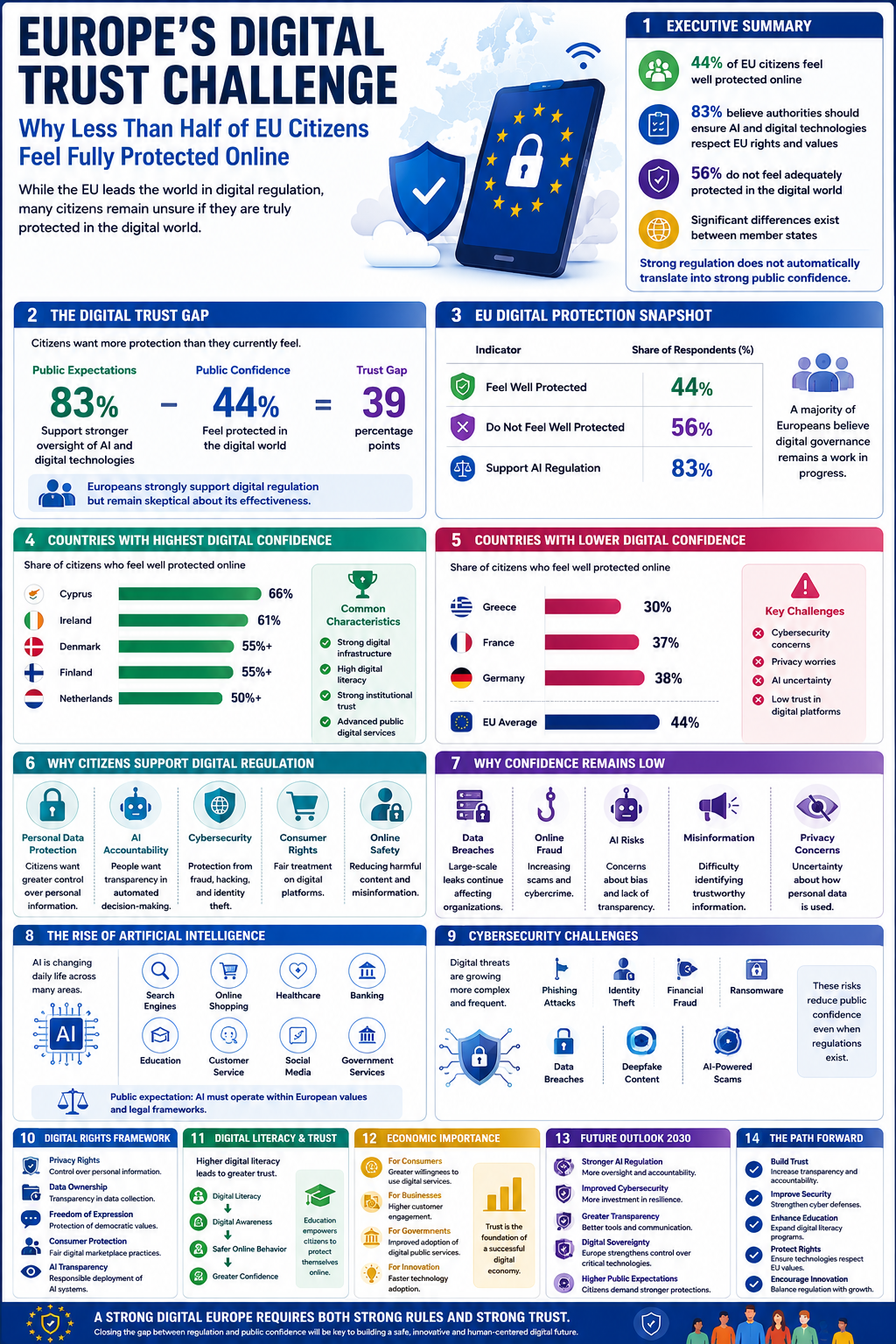
The digital economy has become one of the most important pillars of modern society. From online banking and digital healthcare services to e-commerce, cloud computing, social media, artificial intelligence, and connected devices, digital technologies increasingly influence how citizens work, communicate, consume information, and interact with governments. As digital transformation accelerates, the question of how effectively citizens are protected online has become a central policy challenge for governments around the world.
Among major global economies, the European Union has positioned itself as a leader in digital governance. Over the past decade, European policymakers have introduced some of the world's most comprehensive regulations addressing privacy, cybersecurity, competition, artificial intelligence, consumer rights, and digital platform accountability. These initiatives have established Europe as a global standard-setter in digital regulation and have influenced policy discussions far beyond the region's borders.
Despite these efforts, recent survey findings suggest that many Europeans remain unconvinced about the level of protection they receive in the digital world. While 83 percent of EU citizens believe it is important that authorities ensure artificial intelligence and digital technologies respect European rights and values, only 44 percent say they feel well protected online. This gap highlights an important challenge for policymakers. Strong regulations alone do not automatically translate into public confidence. Citizens judge digital protection not only by laws and policies but also by their everyday experiences with technology, cybersecurity threats, privacy breaches, misinformation, online fraud, and data misuse.
The findings reveal a growing disconnect between regulatory ambition and public perception. Europe may have built one of the world's most advanced digital governance frameworks, yet a majority of citizens still harbor concerns about their online safety and rights. Understanding this trust gap is critical as artificial intelligence, digital platforms, and emerging technologies continue reshaping society. The future success of Europe's digital strategy will depend not only on creating new rules but also on convincing citizens that those rules effectively protect them in practice.
Europe's Leadership in Digital Regulation
Over the last decade, the European Union has become synonymous with digital regulation. While many governments initially adopted a hands-off approach toward technology companies, European institutions increasingly embraced proactive oversight. Policymakers recognized that digital technologies were becoming deeply integrated into daily life and that unchecked technological growth could create significant risks for privacy, competition, democracy, and consumer protection.
The introduction of comprehensive data protection legislation marked a turning point in global digital governance. European rules established new standards regarding personal data collection, storage, processing, and sharing. Individuals gained stronger rights over their information, while organizations faced greater accountability regarding how data was used. These measures fundamentally altered how businesses operate online and forced companies around the world to rethink their data management practices.
Beyond privacy protection, Europe expanded its focus to include digital competition, cybersecurity resilience, online platform responsibility, and artificial intelligence governance. Large technology firms became subject to stricter oversight, while new frameworks sought to improve transparency and accountability across digital ecosystems.
These efforts reflect a broader European philosophy that technological innovation should align with fundamental rights and democratic values. Unlike some regions that prioritize rapid innovation with limited intervention, Europe has generally pursued a balanced approach emphasizing both innovation and citizen protection.
As a result, Europe has become one of the most influential voices shaping the future of digital governance. Many countries outside the region now look to European regulations as models for their own digital policies. However, regulatory leadership does not automatically guarantee public confidence, as evidenced by the survey findings.
Understanding the Digital Protection Gap
The most striking aspect of the survey is the contrast between public expectations and public confidence. While 83 percent of respondents support government efforts to ensure that artificial intelligence and digital technologies respect European values, only 44 percent feel that they are currently well protected online.
This difference reveals what can be described as a digital protection gap. Citizens clearly support stronger regulation and recognize the importance of digital safeguards. Yet many remain uncertain about whether existing measures adequately address the risks they encounter.
Several factors may contribute to this perception. First, digital threats have become increasingly visible. Data breaches, ransomware attacks, online scams, identity theft, and misinformation campaigns frequently receive media attention. Even when regulations exist, these incidents remind citizens that risks remain prevalent.
Second, technological change often moves faster than regulation. New AI systems, social media platforms, digital services, and cybersecurity threats emerge continuously. Citizens may perceive regulators as struggling to keep pace with innovation, creating concerns that protections are always one step behind evolving technologies.
Third, many aspects of digital governance are complex and difficult for the average person to understand. Citizens may be unaware of specific protections available to them or may find regulatory frameworks difficult to navigate. As a result, even effective regulations may fail to generate confidence if people do not understand how they benefit from them.
The protection gap therefore reflects not only the existence of risks but also challenges related to communication, implementation, and public awareness. Closing this gap will require more than additional legislation. It will require demonstrating tangible improvements in citizens' digital experiences.
Why Digital Trust Matters More Than Ever
Trust has become one of the most valuable assets in the digital economy. Every online interaction requires a degree of confidence that systems will function securely and fairly. Consumers trust banks with financial information, healthcare providers with medical records, governments with personal data, and technology companies with countless aspects of their daily lives.
Without trust, digital adoption slows. Citizens become reluctant to share information, use online services, adopt new technologies, or engage with digital platforms. This reluctance can undermine economic growth, innovation, and public service modernization.
Artificial intelligence makes trust even more important. AI systems increasingly influence decisions involving employment, education, healthcare, financial services, and public administration. As algorithms play a greater role in determining outcomes that affect people's lives, concerns about transparency, fairness, accountability, and bias become more significant.
The survey findings indicate that European citizens recognize the importance of trust in digital systems. The fact that 83 percent support ensuring AI respects European values demonstrates strong public awareness of technology's societal impact. Citizens are not rejecting technological progress. Rather, they are demanding assurances that innovation occurs within ethical and legal boundaries.
Trust therefore represents more than a public relations issue. It is a prerequisite for successful digital transformation. Governments, businesses, and technology providers must recognize that public confidence directly influences technology adoption and long-term economic development.
Artificial Intelligence Intensifies Public Concerns
Artificial intelligence has emerged as one of the most influential technologies shaping public perceptions of digital safety. While AI offers substantial opportunities to improve productivity, efficiency, healthcare outcomes, scientific research, and public services, it also introduces new uncertainties.
Many citizens worry about how AI systems collect and use personal data. Concerns about surveillance, profiling, automated decision-making, and loss of privacy continue to influence public opinion. Questions regarding algorithmic bias, accountability, and transparency further complicate the discussion.
The rapid advancement of generative AI has added another layer of complexity. AI systems can now generate text, images, audio, and video content that closely resembles human-created material. While these capabilities create valuable opportunities, they also increase concerns about misinformation, deepfakes, and content authenticity.
European policymakers have responded by developing regulatory frameworks specifically targeting AI governance. These efforts aim to ensure that AI development aligns with human rights, ethical principles, and democratic values. However, regulations alone may not immediately alleviate public concerns.
Many citizens remain uncertain about how AI affects them personally. They may support oversight measures while simultaneously questioning whether regulators can effectively enforce them. The survey results suggest that public confidence in digital protection has not yet caught up with the pace of regulatory development.
As AI adoption expands across industries, strengthening public understanding of how these technologies operate will become increasingly important.
Regional Differences Reveal Uneven Confidence
Survey results also reveal significant differences among European countries regarding perceptions of digital protection. Some nations demonstrate considerably higher levels of confidence than others.
Ireland stands out with one of the highest levels of perceived digital protection, with approximately 61 percent of respondents expressing confidence. Cyprus reports an even higher figure at 66 percent. In contrast, countries such as Greece report significantly lower levels, closer to 30 percent.
These differences highlight the complexity of digital trust. Confidence levels are influenced by numerous factors, including economic conditions, digital literacy, institutional trust, cybersecurity awareness, government effectiveness, and public experiences with digital services.
Countries that have invested heavily in digital government services may benefit from stronger public confidence because citizens regularly experience efficient and secure digital interactions. Conversely, countries facing greater cybersecurity challenges or lower trust in public institutions may struggle to convince citizens that existing protections are sufficient.
The variation demonstrates that digital trust cannot be achieved solely through centralized regulation. National implementation, public communication, education initiatives, and institutional effectiveness all play important roles in shaping perceptions.
Understanding why certain countries perform better than others may provide valuable insights for improving digital confidence across the European Union.
Cybersecurity Threats Continue to Shape Public Perception
One of the primary reasons many citizens remain cautious about digital protection is the growing visibility of cybersecurity threats. Cybercrime has evolved into a global challenge affecting governments, businesses, and individuals alike.
Modern cyber threats include:
- Ransomware attacks
- Identity theft
- Financial fraud
- Data breaches
- Phishing scams
- State-sponsored cyber operations
- Infrastructure attacks
These incidents frequently receive significant media coverage, reinforcing public awareness of digital vulnerabilities. Even when organizations comply with regulations, successful cyberattacks can undermine confidence in digital systems.
For many citizens, perceptions of digital safety are influenced less by legislation and more by real-world outcomes. High-profile cybersecurity incidents create the impression that no system is fully secure, regardless of regulatory safeguards.
The increasing sophistication of cybercriminals adds further complexity. Attackers continuously develop new techniques to exploit vulnerabilities, often adapting faster than defensive measures can respond. This dynamic creates a persistent sense of uncertainty among consumers.
Improving cybersecurity resilience will therefore remain essential for strengthening public trust. Citizens must see evidence that governments and organizations can effectively protect critical systems and personal information against evolving threats.
The Role of Digital Literacy in Building Confidence
Digital protection depends not only on regulations and technology but also on citizens' ability to navigate digital environments safely. Digital literacy plays a crucial role in shaping perceptions of security and empowerment.
Individuals who understand online risks are generally better equipped to protect themselves. They are more likely to recognize scams, manage privacy settings, evaluate information sources, and use security tools effectively. As a result, they often feel more confident interacting with digital technologies.
Conversely, limited digital literacy can contribute to feelings of vulnerability. People who struggle to understand how digital systems work may perceive greater risk and uncertainty, even when protections are available.
The rapid growth of artificial intelligence makes digital literacy even more important. Citizens increasingly need to understand concepts such as algorithmic decision-making, data privacy, AI-generated content, and cybersecurity best practices.
Education initiatives aimed at improving digital literacy can therefore complement regulatory efforts. By helping citizens better understand technology, governments can strengthen both actual protection and perceived protection.
In the long term, digital literacy may prove just as important as regulation in building a trustworthy digital society.
The Future of Digital Rights in Europe
Looking ahead, Europe's digital governance framework will continue evolving. Emerging technologies such as artificial intelligence, quantum computing, extended reality, autonomous systems, and advanced data analytics will create new opportunities and challenges.
Policymakers will likely focus on several priorities:
- Strengthening AI oversight
- Enhancing cybersecurity resilience
- Protecting personal privacy
- Improving platform accountability
- Expanding digital literacy
- Promoting ethical technology development
The challenge will be maintaining a balance between innovation and protection. Excessive regulation could slow technological progress, while insufficient oversight could undermine public trust.
Europe's experience demonstrates that digital governance is not a one-time achievement but an ongoing process requiring constant adaptation. New technologies will continue to raise new questions, requiring flexible and responsive policy approaches.
Success will ultimately be measured not only by the number of regulations enacted but by whether citizens genuinely feel protected and empowered in the digital world.
The finding that only 44 percent of EU citizens feel well protected online reveals an important challenge for Europe's digital future. Despite being a global leader in digital regulation and governance, the European Union faces a significant gap between regulatory ambition and public confidence.
At the same time, the fact that 83 percent of citizens support ensuring that AI and digital technologies respect European rights and values demonstrates strong public backing for continued oversight. Europeans are not rejecting technology. Rather, they want innovation to occur within a framework that prioritizes safety, fairness, transparency, and accountability.
Closing the digital trust gap will require more than new legislation. Governments must demonstrate that regulations produce meaningful real-world outcomes. Organizations must strengthen cybersecurity, improve transparency, and communicate protections more effectively. Citizens must be empowered through greater digital literacy and awareness.
As artificial intelligence and digital technologies become increasingly embedded in everyday life, trust will become one of the most important determinants of success. The future of Europe's digital economy depends not only on technological innovation but also on citizens' confidence that their rights, privacy, and security remain protected in an increasingly connected world.
Explore Related AI Governance and Digital Trust Market Research Reports
As artificial intelligence becomes increasingly embedded in everyday digital experiences, public confidence in online privacy, data protection, and responsible AI deployment has become a critical policy and business priority. The findings highlighted in the EU Digital Protection Index 2025 demonstrate that while digital adoption continues to accelerate, citizens remain focused on issues such as transparency, accountability, cybersecurity, and the ethical use of AI technologies.
For readers seeking deeper insights into the technologies, platforms, and services supporting responsible AI deployment and digital governance, the following market research reports provide valuable analysis of one of the fastest-growing segments of the digital economy.
Featured Reports:
Global AI Governance Tools Software Market Key Success Factors 2026-2033
Global AI Governance Service Market Future Outlook 2026-2033
Global AI Governance Platform Market Risk Analysis 2026-2033
Global AI Governance Market Key Players and Market Share 2026-2033
These reports examine the evolving landscape of AI governance solutions, including risk management frameworks, compliance monitoring tools, algorithm transparency platforms, ethical AI implementation strategies, regulatory compliance services, and enterprise governance technologies. They provide comprehensive market forecasts, competitive intelligence, technology trends, regional opportunities, and strategic insights through 2033.
As governments and organizations work to balance innovation with accountability, AI governance is becoming an essential component of digital transformation strategies. These studies offer valuable perspectives for technology providers, regulators, enterprises, investors, cybersecurity professionals, and policy leaders seeking to understand the future of responsible artificial intelligence and digital trust worldwide.
Recent Blogs
Parabolic Trough Collector Market Outlook Through 2035
Railway Propulsion Systems Market
Global Mental Health Outlook 2026-2030
The Next Five Years of Digital Innovation, AI Governance, and Europe's Competitive Future (2026
EU Digital Protection Index 2025: Public Confidence, Privacy and AI Governance
Public Concern About AI-Generated News Remains Limited Despite Rapid AI Adoption
Asia Gains Ground in Global Travel Demand: How the Global Tourism Map Is Being Redrawn Through
Housing Cost Burden in the EU Continues to Ease Through 2027, Yet Urban Residents Still Face th