
-
E-Mail an uns
- Top-Berichte
FIFA World Cup 2026: Economic Impact on the Short-Term Rental Industry
Veröffentlicht am 18 June, 2026
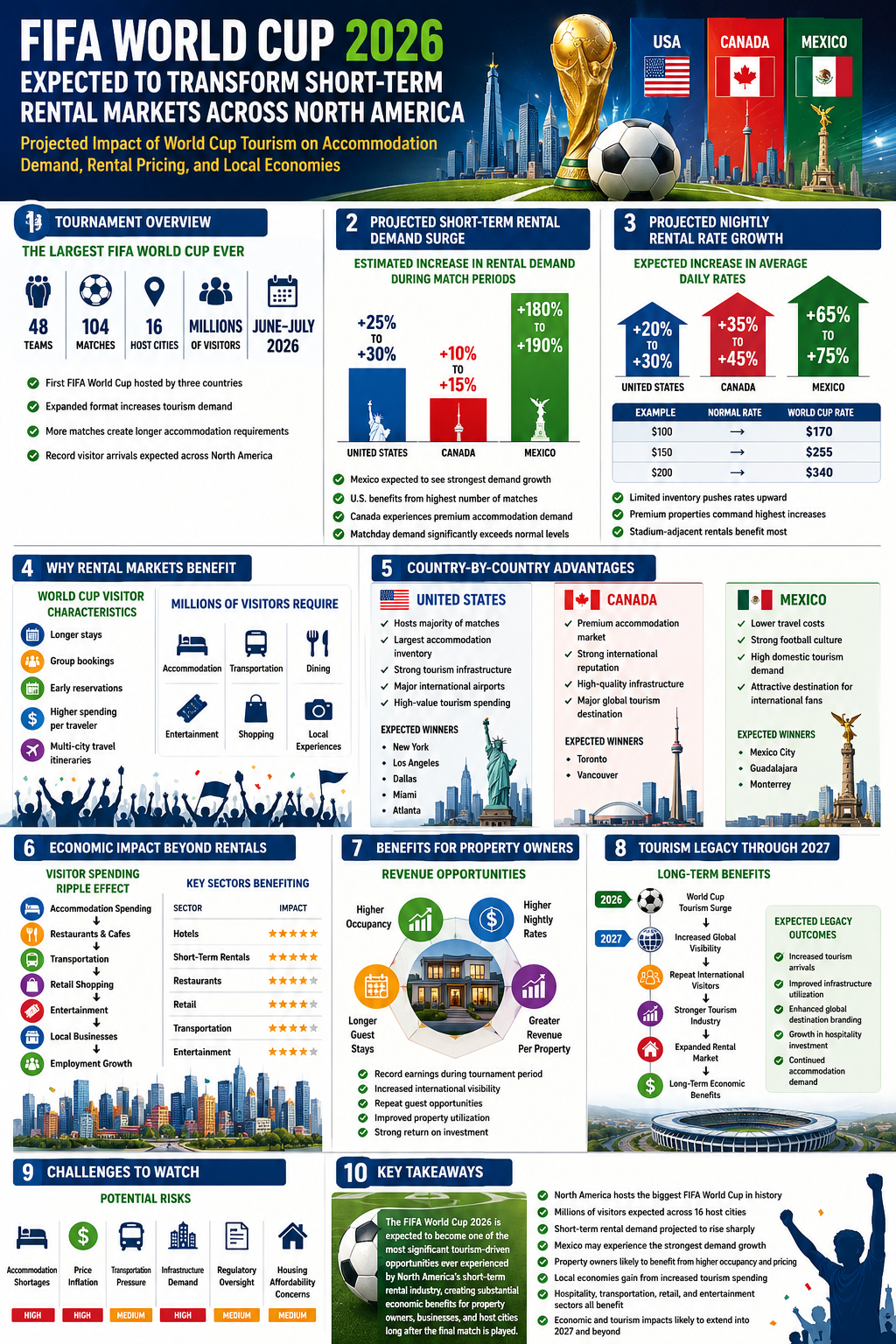
The FIFA World Cup is far more than a football tournament. It is one of the largest global events in terms of tourism, economic activity, media attention, infrastructure investment, and international travel. Every four years, millions of supporters travel across borders to watch their national teams compete on football's biggest stage. These visitors require transportation, accommodation, food services, entertainment, and various tourism-related services, creating significant economic opportunities for host countries and cities.
The 2026 FIFA World Cup represents a historic milestone in the evolution of the tournament. For the first time, the competition is being jointly hosted by three countries: the United States, Canada, and Mexico. The tournament is also expanding from 32 teams to 48 teams, resulting in more matches, more visitors, and a broader geographical footprint than any previous FIFA World Cup. With over one hundred matches scheduled across numerous host cities, the event is expected to generate unprecedented tourism activity throughout North America.
Among the sectors poised to benefit most from this influx of visitors is the short-term rental market. Over the past decade, short-term rentals have become an essential component of global tourism infrastructure. Travelers increasingly prefer apartments, houses, condominiums, villas, and other alternative accommodations that offer greater flexibility, privacy, and affordability than traditional hotels. During mega-events such as the FIFA World Cup, these properties play a critical role in accommodating visitors when hotel inventory becomes constrained.
Preliminary accommodation market estimates suggest that host cities could experience substantial increases in booking demand, occupancy rates, and nightly rental prices during tournament periods. In some locations, demand may rise dramatically as international supporters, domestic travelers, media personnel, sponsors, and event staff compete for limited accommodation inventory. As a result, property owners, investors, hospitality operators, and tourism authorities are closely monitoring how the tournament may reshape rental market dynamics across North America.
The World Cup therefore serves not only as a sporting spectacle but also as a powerful economic catalyst capable of transforming local accommodation markets, generating new revenue streams for property owners, and creating long-term tourism benefits that may extend well beyond the final match.
The Growing Importance of Short-Term Rentals in Global Tourism
The global tourism industry has undergone significant changes during the last fifteen years. One of the most notable developments has been the rapid expansion of short-term rental accommodations. Traditionally, travelers relied heavily on hotels, resorts, guesthouses, and serviced apartments. Today, however, millions of tourists choose alternative accommodations that provide more space, greater flexibility, and often lower costs.
This shift has fundamentally altered how destinations accommodate visitors during periods of peak demand. Short-term rentals have evolved from a niche segment into a major component of the global hospitality ecosystem. In many cities, the number of available rental units now rivals or exceeds traditional hotel room inventories.
Several factors have contributed to this growth. Modern travelers increasingly seek authentic local experiences rather than standardized hotel stays. Families prefer larger accommodations with multiple bedrooms and kitchen facilities. Groups of friends often find rental properties more economical than booking several hotel rooms. Business travelers and digital nomads appreciate the flexibility and residential amenities offered by short-term rentals.
The FIFA World Cup creates ideal conditions for this segment to thrive. Football supporters frequently travel in groups, stay for extended periods, and prioritize convenience near stadiums, fan zones, and transportation hubs. These characteristics align perfectly with the advantages offered by short-term rental properties.
As a result, major sporting events increasingly depend on alternative accommodation providers to absorb excess demand and support local tourism capacity.
Why the FIFA World Cup Creates Extraordinary Accommodation Demand
Few global events generate accommodation demand on the scale of the FIFA World Cup. Unlike traditional tourism seasons, which unfold gradually throughout the year, the World Cup concentrates enormous numbers of visitors into specific cities during a relatively short timeframe.
This concentration creates a unique market environment. Millions of football supporters make travel plans months or even years in advance. Their primary objective is attending matches, which often makes them less sensitive to accommodation prices than ordinary tourists. Many visitors are willing to pay premium rates to secure accommodations close to stadiums or major transportation corridors.
In addition to fans, the tournament attracts journalists, broadcasters, sponsors, government officials, athletes' families, security personnel, volunteers, and corporate hospitality guests. Each of these groups contributes additional demand to local accommodation markets.
Another important factor is visitor length of stay. Many World Cup attendees remain in host cities for several days or even weeks. Some travel between multiple host destinations to follow their teams throughout the tournament. Longer stays reduce accommodation turnover while increasing occupancy rates, creating highly favorable conditions for property owners.
The result is a temporary but powerful imbalance between supply and demand. Accommodation inventory becomes increasingly scarce as match dates approach, allowing property owners to raise prices while maintaining high occupancy levels.
This economic dynamic has been observed repeatedly during previous World Cups, Olympic Games, European Championships, and other major sporting events.
Estimated Rental Market Growth During the 2026 Tournament
Current accommodation market projections suggest that host cities across North America could experience significant growth in short-term rental demand throughout the tournament period. While actual outcomes will vary by location, match schedules, and local market conditions, several broad trends are expected to emerge.
Demand growth is likely to be strongest in cities hosting multiple matches, particularly those featuring knockout-stage fixtures and high-profile national teams. These destinations are expected to attract larger numbers of international visitors, increasing pressure on available accommodation inventory.
Occupancy rates may reach levels significantly above seasonal averages in many host cities. Properties located near stadiums, downtown entertainment districts, transportation hubs, and tourist attractions are likely to experience particularly strong demand.
At the same time, property owners are expected to respond by increasing nightly rates. Historical patterns from major sporting events suggest that accommodation prices often rise substantially when demand exceeds available supply. Premium locations may command even larger price increases, especially during weekends and match days.
The combination of higher occupancy and increased nightly rates creates a powerful revenue opportunity for short-term rental operators. Many hosts may generate earnings during the tournament period that exceed several months of normal operating income.
For investors, the World Cup highlights the growing strategic value of accommodation assets located in major urban tourism markets.
Mexico's Potential Advantage During the Tournament
Among the three host nations, Mexico may experience some of the strongest accommodation market impacts during the tournament. Several structural factors contribute to this outlook.
One major advantage is affordability. Compared with many North American destinations, accommodation, dining, transportation, and entertainment costs in Mexico generally remain more accessible for international travelers. This affordability can make Mexican host cities particularly attractive to visitors seeking to maximize the value of their travel budgets.
Football also occupies a uniquely important place within Mexican culture. The sport enjoys immense popularity across the country, creating strong domestic demand alongside international visitation. Millions of local supporters are expected to travel between host cities to attend matches, participate in fan festivals, and experience the tournament atmosphere.
Mexico's host cities already possess well-established tourism industries. Their existing hospitality infrastructure, cultural attractions, culinary experiences, and entertainment offerings make them attractive destinations even outside the context of the World Cup. The tournament therefore amplifies an already robust tourism ecosystem rather than creating demand from scratch.
These factors collectively suggest that accommodation providers in Mexico may benefit from some of the strongest demand growth observed during the tournament. Property owners could experience exceptional occupancy rates, while visitors may encounter increasingly limited availability as match dates approach.
For local economies, this surge in tourism activity has the potential to generate significant spending across multiple sectors, including restaurants, retail businesses, transportation services, and entertainment venues.
The United States: Scale Creates Massive Opportunity
The United States will host the majority of tournament matches, making it the centerpiece of the 2026 FIFA World Cup. The country's extensive transportation infrastructure, large urban populations, and established tourism markets position it to welcome millions of visitors throughout the competition.
Unlike smaller host nations, the United States benefits from enormous accommodation capacity. Major metropolitan areas already possess extensive hotel inventories and large short-term rental markets. Consequently, while percentage increases in demand may appear more moderate than in smaller markets, the absolute number of additional visitors is expected to be extremely large.
Cities hosting multiple matches could experience substantial increases in accommodation bookings. Downtown districts, entertainment zones, airport corridors, and neighborhoods near stadiums are likely to attract the greatest demand.
The World Cup may also introduce many international visitors to destinations they have never previously considered. As a result, host cities gain an opportunity to showcase their cultural attractions, tourism assets, and economic strengths to a global audience.
For property owners, the tournament provides an opportunity to capitalize on elevated demand while gaining exposure to international travelers who may return for future visits.
Canada's Opportunity in a Global Spotlight
Canada's participation as a co-host offers significant opportunities despite hosting fewer matches than the United States. Major Canadian cities are expected to receive substantial international attention, creating a valuable platform for tourism promotion and economic development.
Canadian host cities combine modern infrastructure, high-quality public services, multicultural communities, and strong reputations for safety and livability. These characteristics make them attractive destinations for international visitors attending the tournament.
Accommodation providers may benefit from elevated occupancy rates and stronger pricing power as demand increases. Limited accommodation supply in certain areas could contribute to higher nightly rates, particularly near stadiums and major transit corridors.
The tournament also provides an opportunity for Canada to strengthen its position within the global tourism market. Positive visitor experiences may encourage future leisure and business travel, extending economic benefits beyond the tournament itself.
For local property owners, the World Cup represents a rare opportunity to participate in one of the world's largest tourism events while showcasing Canadian hospitality to a global audience.
Economic Benefits Beyond Accommodation
The impact of the FIFA World Cup extends far beyond short-term rental operators. Every accommodation booking triggers additional spending throughout the local economy.
Visitors spend money on restaurants, cafés, bars, transportation services, retail stores, entertainment venues, tourist attractions, and cultural experiences. This spending supports employment across numerous sectors while generating tax revenues for local governments.
Small businesses often benefit significantly from increased visitor traffic. Local restaurants experience higher customer volumes, transportation providers see increased demand, and retailers benefit from greater consumer spending.
The economic effects multiply as tourism revenue circulates throughout host communities. Employees earn wages, suppliers receive new orders, and businesses invest in expansion to meet growing demand.
For many cities, the World Cup therefore represents a temporary economic stimulus capable of generating benefits across a wide range of industries.
Long-Term Legacy and the Outlook Through 2027
While the tournament itself will conclude in 2026, its influence may continue well into 2027 and beyond. Host cities are likely to benefit from increased international visibility, enhanced tourism infrastructure, and stronger global brand recognition.
Millions of viewers worldwide will be exposed to North American destinations through tournament broadcasts, digital content, and social media coverage. This exposure serves as a powerful marketing campaign that would otherwise require substantial promotional investment.
Many visitors who attend the World Cup may choose to return in future years for leisure travel, business meetings, or educational opportunities. Such repeat visitation can generate long-term economic benefits for host regions.
Accommodation markets may also experience lasting effects. Property owners who enter the short-term rental sector during the tournament may continue operating afterward, increasing overall market capacity. Enhanced service standards and technological investments made in preparation for the event may further strengthen the hospitality ecosystem.
By 2027, many host cities could still be benefiting from the tourism momentum generated by the tournament, particularly if local authorities successfully leverage the global exposure to attract future visitors and events.
The FIFA World Cup 2026 is expected to become one of the most economically significant sporting events ever hosted. Its unprecedented scale, expanded format, and multinational hosting structure create extraordinary opportunities for tourism and accommodation markets across North America.
Short-term rentals are positioned to play a central role in accommodating the millions of visitors expected to travel throughout the tournament. Increased demand, higher occupancy rates, and stronger pricing power may generate substantial revenue opportunities for property owners and investors. At the same time, local economies stand to benefit from increased spending across hospitality, transportation, retail, and entertainment sectors.
While the most visible impact will occur during match periods, the tournament's legacy may extend far beyond the final whistle. Enhanced international exposure, infrastructure improvements, and stronger tourism ecosystems could continue supporting economic growth throughout 2027 and beyond.
Ultimately, the FIFA World Cup demonstrates how global sporting events can reshape local accommodation markets, stimulate tourism investment, and create lasting economic opportunities for host communities. The tournament is not simply a celebration of football. It is a powerful catalyst for travel, business activity, and urban development across an entire continent.
Related Football Market Research Reports
For readers seeking deeper insights into the commercial, technological, and economic dimensions of the football industry, we have published several comprehensive market research reports covering various segments of the global football ecosystem. These studies provide detailed analysis of market trends, growth opportunities, competitive developments, consumer behavior, technological innovations, and future forecasts through 2033.
Explore our latest football-related market reports:
Global Football Market Growth Opportunities 2026-2033
Global Glowing Football Market Segmentation Analysis 2026-2033
Global Children's Luminous Football Market Industry Best Practices 2026-2033
Global Football League Market Competitive Landscape 2026-2033
Global Shin Pads for Football Market Economic and Social Impact 2026-2033
Global Football Field Artificial Turf Market Strategic Planning Insights 2026-2033
Global Man Football League Market Research and Development Focus 2026-2033
These reports offer extensive market sizing, growth forecasts, competitive benchmarking, emerging trends, regional analysis, investment opportunities, and strategic recommendations for manufacturers, investors, sports organizations, distributors, retailers, and industry stakeholders worldwide.
For more detailed information, complete report coverage, and customized research solutions, please explore the individual reports listed above.
Aktuelle Blogs
Parabolic Trough Collector Market Outlook Through 2035
Railway Propulsion Systems Market
Global Mental Health Outlook 2026-2030
The Next Five Years of Digital Innovation, AI Governance, and Europe's Competitive Future (2026
EU Digital Protection Index 2025: Public Confidence, Privacy and AI Governance
Public Concern About AI-Generated News Remains Limited Despite Rapid AI Adoption
Asia Gains Ground in Global Travel Demand: How the Global Tourism Map Is Being Redrawn Through
Housing Cost Burden in the EU Continues to Ease Through 2027, Yet Urban Residents Still Face th